Ag Safety and Health Publication Resources

Print, video, and webinar resources are valuable to agricultural producers, agricultural educators, agricultural safety and health professionals, and Cooperative Extension personnel. In addition to the resources available on eXtension and through the Ag Safety and Health Community of Practice site, there are additional agricultural safety and health resources available through universities and organizations. The following information provides links to available online publications (2000 and newer) from universities and agricultural safety and health organizations. Topics are listed below. Click on the topic to be linked to topic article where the individual publication links are located.

Animal Safety

Behavioral Health

Chemical and Biological Material Safety

Confined Space Safety

  • Grain Bins
  • Manure Storages
  • Silos

Crops and Feed Safety

Emergency Response and Preparedness

  • Agricultural Emergencies
  • Fire and Fire Prevention
  • First Aid
  • Weather-Related Issues

General Farm and Ranch Safety

  • Agritourism
  • General Farm and Ranch Safety

Machinery and Equipment

  • Agricultural Tractors and Equipment
  • Agricultural Vehicles, Visibility, and Public Roadways
  • ATV
  • Chainsaws and Tree Felling
  • Hand Signals
  • Lawncare

Occupational Health and Safety

  • Agriculture and Weather
  • Falls and Fall Prevention
  • Health Conditions
  • Personal Protective Equipment

Special Populations

  • Agricultural Producers with a Disability
  • Anabaptist (e.g., Amish) Populations
  • Children and Youth
  • Hispanic Resources
  • Secondary Injury Prevention

Structures and Landscapes

For video resources, click here to access an online directory of agricultural safety and health video resources.

Summarized by:
Linda M. Fetzer, Pennsylvania State University – lmf8@psu.edu
Reviewed by:
Dennis J. Murphy, Pennsylvania State University – djm13@psu.edu
Aaron M. Yoder, Pennsylvania State University – ayoder@psu.edu

National Institute for Occupational Safety and Health: Agricultural Safety and Health Centers

The National Institute for Occupational Safety and Health (NIOSH), which is part of the Centers for Disease Control and Prevention (CDC), provides national leadership in the prevention of workplace illnesses and injuries. This organization focuses on industries and occupations, hazards, exposures, diseases, injuries, chemicals, safety, prevention, and emergency preparedness and response.

The Agricultural Safety and Health Centers (Ag Centers) are the primary means by which NIOSH promotes agricultural safety and health for owners, managers, and workers. Established in 1990, the Ag Centers are responsible for conducting research activities, educational programs, and prevention projects that address priority areas in agricultural safety and health. Click here to learn more about the objectives for the Ag Centers.

The 10 Ag Centers are located in various regions across the United States. They have similar objectives based on NIOSH protocols, but each Ag Center also focuses on specialty projects relative to their emphasis and/or geographical area. Contact the Ag Centers in your area to learn about their pilot grant programs and additional ways that you can partner with their organization. Listed below are the 10 Ag Centers with a brief description of their territory and primary areas of interest. Click on the Ag Center to be directed to its website.

Central States Center for Agricultural Safety and Health (CS-CASH)

Location: University of Nebraska Medical Center – Provides services in a seven-state region.

Primary focus: Reduction of injuries and illnesses in the agricultural community with specialized focus on agricultural injury surveillance, allergic and nonallergic asthma, hearing loss, sleep deprivation, education needs of diverse agricultural populations, promotion of AgriSafe and Certified Safe Farm programs for farmers and ranchers, and information dissemination through the National Ag Safety Database, electronic communication, and participation in agricultural meetings and events.

Great Plains Center for Agricultural Health (GPCAH)

Location: University of Iowa – Provides services and programs throughout the Midwest.

Primary focus: Roadway crashes involving farm equipment, musculoskeletal disorders among agricultural workers, gas and dust exposure, epidemiological studies, and education and training to prevent occupational injury and illness among agricultural workers and their families. Special emphasis is placed on risk factor research, intervention, outreach, education, and translation activities.

High Plains Intermountain Center for Agricultural Health and Safety (HICAHS)

Location: Colorado State University – Provides services and programs throughout Montana, North Dakota, Utah, and Wyoming.

Primary focus: Organic dust aerosols, respiratory disease, pesticides, engineering of tractor rollover protective structures (ROPS), and health needs of dairy farm workers.

National Children’s Center for Rural and Agricultural Health and Safety (NCCRAHS)

Location: National Farm Medicine Center, Wisconsin – National resource in the area of children and youth safety.

Primary focus: Safety and prevention programming for children living, working, and visiting in agricultural or rural areas. Special projects include safe agricultural work guidelines for hired and family youth, creating safe play areas on farms, model rural child care programs, safety guidelines for agritourism operators, media guidelines, and the Childhood Agricultural Safety Network.

The Northeast Center of Agricultural Safety and Health (NEC)

Location: Bassett Healthcare, New York – Provides services and programs throughout the New England and Mid-Atlantic regions.

Primary focus: Promotes agricultural safety and health research, education, and prevention activities with special projects focusing on social marketing of rollover protection, tractor retrofitting initiatives, confined space manure storage entry, musculoskeletal disorders, farm worker health, and injury surveillance.

Pacific Northwest Agricultural Safety and Health Center (PNASH)

Location: University of Washington – Provides services and programs throughout Alaska, Idaho, Oregon, and Washington.

Primary focus: Injury and illness prevention especially for hired laborers, migrant/seasonal workers, and children with a specialized focus on projects that emphasize pesticide exposure, cholinesterase, heat-related illnesses, injuries associated with new and emerging technologies, and ergonomics in the tree fruit industry.

Southeast Center for Agricultural Health and Injury Prevention (SCAHIP)

Location: University of Kentucky – Provides services and programs throughout Alabama, Florida, Georgia, Mississippi, North Carolina, Tennessee, South Carolina, Virginia, and West Virginia.

Primary focus: Special populations, cost analysis of tractor and other types of farm-related injuries, and educational opportunities for public health professionals related to agricultural safety and health. Special projects focus on aquaculture safety, injury prevention programs, surveillance of poisonings, and agricultural education programs for nurses.

Southeastern Coastal Center for Agricultural Health and Safety

Location: University of Florida

Primary focus: Unique occupational safety and health challenges for persons working in agriculture, fishing, and forestry in the southern and coastal states of Florida, Georgia, Alabama, Mississippi, and North and South Carolina.

Southwest Center for Agricultural Health, Injury Prevention, and Education (SWAG)

Location: University of Texas Health Science Center – Provides services throughout Arkansas, Louisiana, New Mexico, and Oklahoma.

Primary focus: Improving the safety and health of agricultural, forestry, and fishing workers through projects that build and leverage strategic partners. Special projects currently focus on poultry dust exposure, respirator use among poultry workers, neuromotor function and work injuries among Hispanic adolescents, social marketing with the Vietnamese shrimper community, and safety and assistive technology education for farmers and ranchers.

Western Center for Agricultural Health and Safety Center (WCAHS)

Location: University of California, Davis

Primary focus: Western agricultural health and safety issues including health among migrant and seasonal farm workers with an emphasis on ergonomics of labor-intensive crop work. Special projects focus on respiratory hazards, heat-related illnesses, ergonomics, pesticides, health for women and children, and dairy safety training.

Upper Midwest Agricultural Safety and Health Center (UMASH)

Location: University of Minnesota.

Primary focus: Occupational hazards in pork production, zoonotic diseases in agricultural workers, and surveillance of disease and injury in the dairy industry.


Reviewed and Summarized by:
Linda M. Fetzer, Pennsylvania State University – lmf8@psu.edu
Ellen M. Heywood, Great Plains Center for Agricultural Health – ellen-heywood@uiowa.edu
Barbara Lee, Marshfield Clinic – lee.barbara@mcrf.mflddin.edu
John May, Northeast Center – john.may@bassett.org
Dennis J. Murphy, Pennsylvania State University – djm13@psu.edu
Stephen J. Reynolds, High Plains Intermountain Center for Agricultural Safety & Health – Stephen.Reynolds@Colostate.edu
Risto Rautianen, Central States Center for Agricultural Safety and Health rrautianinen@unmc.edu
Amanda Wickman, SW Ag Center – Amanda.Wickman@uthct.edu
Aaron M. Yoder, University of Nebraska Medical Center – aaron.yoder@unmc.edu
 

American Society of Agricultural and Biological Engineers

ASABE Logo

The American Society of Agricultural Engineers (ASAE) is a technical and educational organization for engineers and others dedicated to advancement of engineering applicable to agricultural, food, and biological systems. Originally founded in 1907 as the American Society of Agricultural Engineers, the organization changed its name in 2005 to the American Society of Agricultural and Biological Engineers (ASABE) to include advances in biology to the engineering profession.

ASABE Standards Program

ASAE adopted its first standard practice in 1912. The ASABE Standards Program, which is accredited by the American National Standards Institute (ANSI), is the recognized standard for engineering in agricultural, food, and biological systems. According to ASABE, standards are defined as engineering requirements or specifications prepared to define materials, products, processes, tests, testing procedures, and performance criteria to achieve a specific purpose. These standards are developed because there is a need to address a common problem. ASAE/ASABE has adopted approximately 75 standards that are totally or largely safety oriented.

Click here for more information about the ASABE Standards Program.

Ergonomics, Safety. and Health Division

The Ergonomic, Safety. and Health (ESH) Division was formed in 2002 to lead and coordinate the activities of ASABE so that the talent of its members are effectively applied to agricultural safety, ergonomic, and health needs of constituents served by ASABE. The ESH Division encompasses all aspects of agricultural safety, ergonomics, and health for users of equipment, systems, and facilities. The major areas of responsibility are addressed by five committees and special task forces. The five committees are ESH-01 Executive/Oversight Committee, ESH-02 Policy and Forward Planning Committee, ESH-03 Standards Committee, ESH-04 Technology Exchange Committee, and ESH-05 Nominations Committee.

ASABE Activities

In addition to the standards programs, ASABE offers annual professional conferences, publications, a technical library, and professional journals, including the Journal of Agricultural Safety and Health (JASH).

Click here to visit the organization’s home page and learn more about its activities.

 
Reviewed and Summarized by:
Linda M. Fetzer, Pennsylvania State University – lmf8@psu.edu

Dennis J. Murphy, Pennsylvania State University – djm13@psu.edu
Charles V. Schwab, Pennsylvania State University – cvschwab@iastate.edu
Aaron Yoder, University of Nebraska Medical Center – aaron.yoder@unmc.edu


Machinery and Equipment Safety Publications


Agricultural Tractors and Equipment

Topic Titles Organization Pub Date
Big Tractor Safety University of Maine Extension 2002
Chipper-Shredders University of Missouri Extension 2010
Combine Fires University of Illinois 2015
Combines and Corn Picker Safety University of Maine Extension 2002
Dangers of Agricultural Machinery University of Maine Extension 2002
Driving Farm Machinery Safely University of Maine Extension 2002
Electrocution Hazards on the Farm Iowa State University Extension and Outreach 2004
Extra Riders on Farm Equipment Pennsylvania State University 2006
Extra Riders Mean Extra Dangers Iowa State University Extension and Outreach 2008
Farm Dump Truck and Trailer Safety Pennsylvania State University 2005
Farm Machinery and Equipment Safety Part 1: Recognizing and Understanding the Hazards Rutgers Cooperative Extension 2007
Farm Machinery and Equipment Safety Part 2: Preventing Machinery Accidents During Operation Rutgers Cooperative Extension 2007
Front-End Loader Safety University of Maine Extension 2002
Hazards of the PTO on Farm Tractors Alabama Cooperative Extension 2005
Machinery Safety on the Farm Virginia Cooperative Extension 2009
Machinery Safety on the Farm Kansas State University 2010
Operating Mowers Safely Rutgers Cooperative Extension 2005
Potato Harvester Safety University of Maine 2002
Power Take-Off Safety Pennsylvania State University 2014
Preventing Farm Vehicle Backover Incidents

Protecting Farmworkers from Tractor and Harvester Hazards

OSHA

OSHA

2015

2014

Recognize Limitations to Avoid Injury Iowa State University Extension and Outreach 2011
Rollover Protection for Farm Tractor Operators Pennsylvania State University 2014
Safe Implement Hitching: A Guide for Safe Connection of Agricultural Tractors to Implements Association of Equipment Manufacturers and Canadian Agricultural Safety Association 2011
Safe Operation of Compact Tractors Virginia Cooperative Extension 2009
Safe Tractor Operation University of Missouri 2002
Selection and Inspection of Hoses: An Integral Component of Everyday Equipment Purdue Extension 2010
Skid Steer Safety for Farm and Landscape Pennsylvania State University 2006
Skidder Safety and Efficiency: A Discussion Leader’s Guide Virginia Cooperative Extension 2009
Three-Point Rotary Lawn and Brush Mower Safety The Ohio State University 2015
Tractor Hitch Pin: A Critical Component in Keeping Control of Implements Purdue Extension 2012
Tractors in the Woods Pennsylvania State University 2011
Tractor Stability and Instability Pennsylvania State University 2014
Tractor Safety University of Maine 2002
Use Tractors with ROPS to Save Lives Iowa State University Extension and Outreach 2002
Wagon Safety University of Maine Extension 2002

Agricultural Vehicles, Visibility, and Public Roadways

Topic Titles Organization Pub Date
A New Look for Farm Safety: Reflective and Fluorescent Tape Iowa State University and Outreach 2000
Farm Dump Truck and Trailer Safety Pennsylvania State University 2013
Hold it Down! (Poster)

Hold it Down! (Pocket Guide)

Purdue University 2008
Lighting Self-Propelled Farm Equipment Alabama Cooperative Extension 2005
Make Sure Your Load Is Secure The Ohio State University 2011
Rx for SMV Highway Safety: Be Conspicuous Pennsylvania State University 2013
Securing the Load Purdue Extension 2009
Transporting Farm Equipment Purdue University 2011
Use SMV Emblems for Your Safety Iowa State University Extension and Outreach 2004

ATV

Topic Titles Organization Pub Date
All-Terrain Vehicle Safety National Children’s Center for Rural and Agricultural Health and Safety 2003
All-Terrain Vehicle Safety: ATV Safety for Farm Work, Recreation Iowa State University Extension and Outreach 2008
All-Terrain Vehicles University of Missouri Extension 2000
ATVs and Youth: Matching Children and Vehicles Pennsylvania State University 2013
Safe Use of ATVs in Agriculture Pennsylvania State University 2013

Chain Saws and Tree Felling

Topic Titles Organization Pub Date
Chain Saw Safety University of Maine Extension 2002
Chain Saws: Safety, Operation, Tree Felling Techniques Kansas State University 2011
Chainsaw Safety Tips University of Georgia Cooperative Extension 2010
Felling, Limbing, and Bucking Trees University of Missouri 2011
Operating a Chain Saw Safely University of Missouri 2011

Hand Signals

Topic Titles Organization Pub Date
Agricultural Hand Signals Pennsylvania State University 2008

Lawn Care

Topic Titles Organization Pub Date
Hand Tools Safety: Lawncare Virginia Cooperative Extension 2012
Hand Tools Safety: Lawncare Training Guide Virginia Cooperative Extension 2012
Lawnmower Safety: Practice Lawnmower Safety on Farms Iowa State University Extension 2008
Power Tool Safety University of Maine Extension 2002
Powered Hand Tool Safety: Lawncare Virginia Cooperative Extension 2012
Powered Hand Tool Safety: Lawncare Training Guide Virginia Cooperative Extension 2012
Rotary Mowers Safety: Lawncare Virginia Cooperative Extension 2012
Rotary Mowers Safety: Lawncare Training Guide Virginia Cooperative Extension 2012
Utility Type Vehicle (UTV) Safety: Lawncare Virginia Cooperative Extension 2012
Utility Type Vehicle (UTVs): Lawncare Training Guide Virginia Cooperative Extension 20012

Safety for Diverse Populations Publications


Agricultural Producers with a Disability

Topic Title Organization Pub Date
Adapting Motor Vehicles University of Missouri Extension, Missouri AgrAbility Project 2010
Assistive Technology for the Farm The Ohio State University 2011
Assistive Technologies in Agriculture

Assistive Technologies for Lower Extremity Mobility on the Farm

Assistive Technologies for Upper Extremity Mobility on the Farm

Assistive Technologies to Improve Safety and Accessibility on Small Scale Diversified Vegetable Farms and Home Gardens

Assistive Technologies to Support Farmers with Low Vision or Blindness

Virginia Cooperative Extension 2010


2021


2021


2021

Extending Universal Design Principles onto the Farmstead The Ohio State University 2010
Farming after a Stroke The Ohio State University 2011
Farming with Alzheimer’s Disease The Ohio State University 2013
Farming with a Visual Impairment The Ohio State University 2013
Farming with Chronic Back Pain The Ohio State University 2013
Farming with Diabetes The Ohio State University 2011
Farming with Lower Extremity Amputation The Ohio State University 2011
Farming with Parkinson’s Disease The Ohio State University 2011
Farming with Upper Extremity Limitation or Amputation The Ohio State University 2011
Gardening with a Physical Limitation The Ohio State University 2013
Recovery from Hip or Knee Replacement for Farmers The Ohio State University 2013
Tractor-Mounted Inclined Lifts Virginia Cooperative Extension 2013
The Toolbox: Agricultural Tools, Equipment, Machinery & Buildings for Farmers and Ranchers with Physical Disabilities National AgrAbility Project 1986-2014

Anabaptist (e.g., Amish) Populations

Topic Title Organization Pub Date
Driving Safely in Plain Communities Virginia Cooperative Extension 2011
Lighting and Marking for Horse Drawn Buggies, Carriages, Carts, and Wagons Pennsylvania State University 2013
Lighting and Marking Recommendations for Buggies and Wagons The Ohio State University 2009
Plain Facts about Arthritis: A Guide to Understanding and Living with Arthritis in Plain Communities National AgrAbility Project – Purdue University 2005
Snowplows in Amish Country: A Guide for Buggy Drivers, Pedestrians, and Snowplow Operators The Ohio State University 2011

Children and Youth

Topic Title Organization Pub Date
Harvesting Health: Children and Dairy Chemicals National Farm Medicine Center 2009
Children and Safety on the Farm Pennsylvania State University 2006
Child Safety Around Animals University of Maine Extension 2002
Creating Safe Play Areas on Farms National Children’s Center for Rural and Agricultural Health and Safety 2001
Equestrian Safety National Farm Medicine Center 2003
Farm Safety for Young Children Iowa State University Extension and Outreach 2004
Farm Youth Safety: Know Laws about Youth Farm Workers Iowa State University Extension and Outreach 2008
Guidelines for Protecting Youth Workers Virginia Cooperative Extension 2012
Kids on the Farm: Hazards Inside the Home University of Maine Extension 2002
Kids on the Farm: Hazards Outside the Home University of Maine Extension 2002
Interactive Demonstrations of Safe Play Areas at Rural and Agricultural Events National Children’s Center for Rural and Agricultural Health and Safety 2006
Review Family Farm Safety Rules Iowa State University Extension and Outreach 2004
Safety Guidelines for Hired Adolescent Farm Workers National Farm Medicine Center 2008
Youth Safety: Match Age, Abilities to Farm Chores Iowa State University Extension and Outreach 2001

Hispanic Resources

Topic Title Organization Pub Date
10 Sugerencias de Seguridad con los ATV Pennsylvania State University 2014
10 Sugerencias de Seguridad con las Cortadoras de Cesped Pennsylvania State University 2014
10 Surgerencias de Seguridad con los Mini Cargadores Pennsylvania State University 2014
10 Surgerencias de Seguridad con los Tractores Pennsylvania State University 2014
Could Arthritis Be What Is Causing My Pain?  – ¿Podrá ser la Artritis lo que me causa Dolor? National AgrAbility Project – Purdue University
Creating Safe Play Areas on Farms – Creacion de areas de juego seguras en granjas miniedicion National Children’s Center for Rural and Agricultural Health and Safety 2010
Pesticides Nearby…But Staying Healthy – Aunque cerca…sanco. Una guia para prevencion de los riesgos de los pesticidas

Posters: Seguridad con Agujas (Needle Safety), Mantengase Sano Trabajando con Animales (Stay Healthy Working with Animals), Seguridad con la Minicargadora (Skid Steer Safety), Seguridad con Quimicos (Dairy Chemical Safety), Seguridad con el Tractor (Tractor Safety), Manejo de Animales (Animal Handling Safety)

National Children’s Center for Rural and Agricultural Health and Safety


The Northeast Center for Occupational Health and Safety

2003


2019

Secondary Injury Prevention

Topic Title Organization Pub Date
Evaluating Agricultural Workplace Assistive Technology for Secondary Injury Hazards National AgrAbility Project – Purdue University 2008
Overexertion Causing Secondary Injury The Ohio State University 2010
Preventing Secondary Injuries in Agricultural Workplaces Virginia Cooperative Extension 2009
Secondary Injury Prevention: Caught in, Caught between, or Struck by Objects The Ohio State University 2010
Secondary Injury Prevention: Ergonomics The Ohio State University 2010
Secondary Injury Caused by Lifting The Ohio State University 2010
Secondary Injury Prevention: Farming with a Pacemaker The Ohio State University 2010
Secondary Injury Prevention: Heat Stress The Ohio State University 2010
Secondary Injury Prevention: Repetitive Motion The Ohio State University 2011
Secondary Injury Prevention for Senior Farmers The Ohio State University 2010
Secondary Injury Prevention: Understanding Concussions The Ohio State University 2011
Secondary Injury Prevention: Walking and Working Surfaces The Ohio State University 2010

Animal Safety Publications


Topic Titles Organization Pub Date
A Health and Safety Guide for Handling Farm Animals and Poultry Farm and Ranch Safety and Health Association 2006
Animal Handling Tips Pennsylvania State University 2007
Child Safety Around Animals University of Maine Extension 2002
Horse Trailer Maintenance and Trailer Safety Rutgers Cooperative Extension 2007
Livestock Safety: Know Your Livestock and Be Safe Iowa State University Extension and Outreach 2008
Low Stress Cattle Handling Institute of Agricultural Rural and Environmental Health 2002
Lyme Disease University of Maine Extension 2002
Rabies: Need to Know Information for Agricultural Producers Institute of Agricultural Rural and Environmental Health 2004
Safe Operating Procedure: Sharps Use and Handling Livestock University of Nebraska 2013


Confined Space Safety Publications


Grain Bins

Topic Titles Organization Pub Date
Beware of Flowing Grain Dangers Purdue Extension 2010
Grain Bin Hazards and Safety Considerations Alabama Cooperative Extension 2008
Grain Storage Safety University of Maine Extension 2002
Hazards of Flowing Grain Pennsylvania State University 2014
Managing Moldy Grain Purdue Extension 2010
Safe Operating Procedure – Grain Bin Safety University of Nebraska 2009
Safe Operating Procedure – Harvest Safety University of Nebraska 2009


Manure Storage

Topic Titles Organization Pub Date
Confined Space Manure Gas Monitoring Pennsylvania State University 2011
Confined Space Manure Storage Emergencies Pennsylvania State University 2011
Confined Space Manure Storage Hazards Pennsylvania State University 2011
Confined Space Manure Storage Ventilation Systems Pennsylvania State University 2011
Harvesting Health Series: Manure Gases National Farm Medicine Center 2009
Open Air Manure Storage Safety Tips Pennsylvania State University 2012


Silos

Topic Titles Organization Pub Date
Harvesting Health Series: Silo Gas National Farm Medicine Center 2009
Safety and Health: What You Need to Know about Silo Gas – A Deadly Killer Iowa State University Extension and Outreach 2008
Silo Gas Safety Government of Alberta – Agriculture and Rural Development 2004
Upright Silo Safety University of Maine Extension 2002


Structure and Landscape Safety Publications


Topic Titles Organization Pub Date
Accident-Proofing Farms and Stables Rutgers Cooperative Extension 2007
Barn and Farm Inspection Checklist Virginia Cooperative Extension 2009
Barn and Manure Storage Safety University of Maine Extension 2002
Combating the Dangers of Electrical Shock on the Farm Alabama Cooperative Extension 2005
Electrical Safety in the Home University of Maine Extension 2002
Electrical Safety on the Farm University of Maine Extension 2002
Farm Pond Safety Penn State University 2014
Rural Water Safety National Children’s Center for Rural and Agricultural Health and Safety & National Farm Medicine Center 2003
Safety Recommendations for the Stable, Barn Yard, and Horse/Livestock Structures Rutgers Cooperative Extension 2007
Storage Building Safety University of Maine Extension 2002
Working Safely Around Electricity WorkSafeBC 2009


Crop and Feed Safety Publications


Topic Titles Organization Pub Date
Control and Prevention of Hay Fires Kansas State University 2008
Corn Production Safety and Health for Farmers University of Georgia Cooperative Extension 2012
Farm Security – “Treat It Seriously” – Security for Plant Agriculture: On-Farm Assessment and Security Practices Virginia Cooperative Extension 2011
Farm Security – “Treat It Seriously” – Security for Plant Agriculture: Producer Response for Plant Diseases, Chemical Contamination, and Unauthorized Activity Virginia Cooperative Extension 2011
Guarding Against Corn Harvesting Accidents Pennsylvania State University 2014
Harvest Safety University of Maine Extension 2002
Harvesting Crops by Hand Safely University of Maine Extension 2002
Harvesting Hay Safely University of Maine Extension 2002
Hay Fire Prevention and Control Virginia Cooperative Extension 2009
Horizontal Silo Safety Pennsylvania State University 2007
Large Round Bale Safety Virginia Cooperative Extension 2009
Large Round Bale Safety Kansas State University 2008
Managing Moldy Grain Purdue Extension 2010
Safe Forage Harvesting Pennsylvania State University 2014
Safely Making and Handling Large Package Hay Bales Pennsylvania State University 2013


Bites, Stings, and Venomous Things

Practically all of us have a story about an unpleasant encounter with a spider, bee, wasp, or snake. In 2011, the American Association of Poison Control Centers reported that the 57 poison control centers in the United States received over 66,000 calls for bites or venom poisoning (envenomations). The Bureau of Labor Statistics reported that bites and stings from insects, spiders, or bees caused 25 deaths in the same year. Agricultural, forestry, and fishing workers are at high risk for bites and stings because they typically spend more time outdoors or working near the habitats of venomous critters.

The best way to prevent a bite or sting is to be aware of the critters’ homes and follow some simple avoidance strategies. Because each venomous critter lives in a different environment, the recommendations vary.

Bees

  • Stay clear of wild or commercial hives. Commercial hives usually look like white boxes and are clustered in fields near a pollen source.
  • Be careful around hollow trees, rock crevices, or other sheltered locations.
  • Avoid old or abandoned buildings, sheds, and vehicles.
  • Old upholstery is an ideal bumblebee habitat. Be careful when moving pieces that have been outside. 
  • Do not use heavily scented soaps, perfumes, or colognes.

Scorpions

  • Wear gloves when working outside or in barns and storage buildings.
  • Pay attention when hand harvesting or gardening.
  • Be cautious when moving rocks, firewood, lumber, and old boxes. Scorpions
    frequently nest under bark or in other concealed locations.
  • Do not leave clothing or bedding on the floor, and always shake these items before use. Scorpions are common in houses and near new construction sites.

Snakes

  • Wear long pants and boots when moving through high grass or rocky areas.
  • Watch where you sit or place your hands and feet.
  • Do not reach into spaces where you cannot see.
  • Be very cautious walking through high grass or rocky areas.
  • Pay attention as you move firewood, lumber, or other building materials.
  • Step on fallen logs, not over them.
  • Examine the ground around bodies of water.
  • Be particularly aware at night when snakes are more active.
  • If you see or hear a snake, back away. Snakes can strike about one-third of their body length.

Spiders

  • Wear gloves when working outside or in barns and storage buildings.
  • Never reach into areas where you cannot see.
  • Exercise caution when moving rocks or wood.
  • Be careful in attics, crawl spaces, basements, and closets.
  • Look carefully into corners and crevices of buildings, porches, or boxes.
  • Use a stick to sweep under the seat of outdoor toilets to dislodge venomous guests.
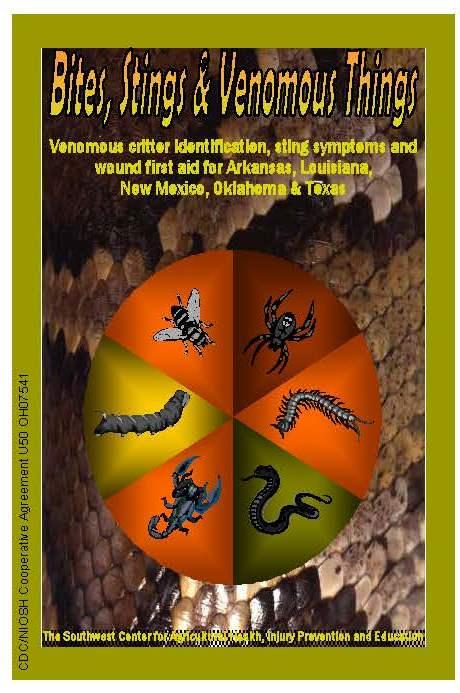
Bites, Stings & Venomous Things Image

Bites, Stings, & Venomous Things Image

Even when you are armed with habitat and avoidance information, a bite or sting can occur. Your next best option is to identify what bit or stung you and perform wound first aid.

Free resources are available from the Southwest Center for Agricultural Health, Injury Prevention and Education to help. The Bites, Stings and Venomous Things tip booklet covers venomous critter identification, sting symptoms, and wound first aid for caterpillars, insects, millipedes, scorpions, snakes, and spiders. Colorful pictures, sting symptoms, and facts about typical behavior help you figure out what the culprit was and what to do next. Click HERE to access the resource in Spanish.

Resources

American Association of Poison Control Centers


Written by:
Amanda Wickman, Southwest Center for Agricultural Health, Injury Prevention and Education – Amanda.Wickman@uthct.edu
 
Reviewed by:
Linda M. Fetzer, Pennsylvania State University – lmf8@psu.edu
Dennis J. Murphy, Pennsylvania State University – djm13@psu.edu
Aaron M. Yoder, University of Nebraska Medical Center – aaron.yoder@unmc.edu
 

Sources

2011 Annual Report of the American Association of Poison Control Centers’ National Poison Data System (NPDS): 29th Annual Report; https://aapcc.s3.amazonaws.com/pdfs/annual_reports/2011_NPDS_Annual_Report.pdf

Bureau of Labor Statistics: http://www.bls.gov/iif/oshwc/cfoi/cftb0267.pdf.

Bites, Stings and Venomous Things Tip Booklet (pdf): http://www.swagcenter.org/files/pdf/swagcenter_bsvt_english_rev_2015-jun….