User Directions for the SAY Curriculum Alignment Submission Tool

The Safety in Agriculture for Youth project (SAY) is compiling a national clearinghouse of materials for agricultural safety and health education. The SAY Curriculum Alignment Submission Tool (CAST) is an online instrument that participants use to submit an agricultural safety and health Formal Curriculum or Other Supporting Resource to SAY for possible inclusion in the national clearinghouse. Note: Explanations of the terms Formal Curriculum and Other Supporting Resource are included in the “Providing Submitter and Submission Information” section below. For convenience, these official terms are replaced by the term curriculum/other resource in most places in CAST and in these directions.

Materials submitted should align in some part with the Agriculture, Food and Natural Resources (AFNR) Career Cluster Content Standards promoted by the National Council for Agricultural Education and the National FFA Foundation. A currently existing curriculum/other resource may not align closely to these standards because the standards are relatively new to the agricultural safety and health community. However, even a curriculum/other resource with a low level of alignment can be a valuable educational resource for the SAY National Clearinghouse. Those not familiar with the AFNR Career Cluster Content Standards are strongly advised to study them thoroughly before submitting a curriculum/other resource. If your curriculum/other resource aligns with AFNR Career Cluster Content Standard(s), it will be added to the SAY National Clearinghouse and assigned high, medium, or low alignment. The alignment is based on the information that you provide in your submission so please be clear and concise. The following definitions outline the three alignment categories:

High Alignment—The curriculum/other resource aligns very well with this component of the Performance Indicator.

Medium Alignment—The curriculum/other resource has a moderate degree of alignment with this component of the Performance Indicator.

Low Alignment—The curriculum/other resource does not align well with this component of the Performance Indicator, but enough common language is involved to conclude that some alignment exists.

Before you begin the submission process, click HERE to open the latest version of the safety related AFNR Career Cluster Content Standards, Performance Indicators and Measurements. Print a copy so you can refer to it when completing your submission. This document will help you compare the objectives, goals or outcomes of your curriculum/other resource with those of AFNR. You will notice three shades of green (or gray). The darker shade is the Common Career Technical Core Standards. These are the broadest level of standards, and ultimately what your curriculum/other resource will align to. You will notice that these are very broad statements so more specific statements are listed below these. The middle shade is the ‘Indicators’. When you actually submit your information in the submission template, you will be submitting under the appropriate Indicators. Because these too are very broad, you will notice various statements below each indicator. These are the lightest shade. These measurements are examples of standards under the specific indicators. To us, it makes sense to compare your curriculum/other resource objectives and activities with these statements, because they are more specific.

As you compare your objectives and activities with the AFNR measurements, we suggest making a note of the lesson/page number(s)/activity that relate to the AFNR measurement. You may find that there are multiple activities that together will meet some measurements. For example, participants may need to complete a group or skills activity and/or correctly answer evaluation questions. You will be asked to enter this information on the CAST.

Once you feel that your program’s objectives come close to these examples, you are ready to start filling in the submission template (CAST). After printing these directions, click HERE to access CAST to submit your curriculum/other resource.

Providing Submitter and Submission Information

In the first part of CAST, you will provide information about the submitting organization and the materials to be submitted. The explanations that follow will help you complete this task.

Name of Submitter: Name of the person submitting the curriculum/other resource. This person should be an author or someone working with the author(s).

Name of Organization: Name of the organization that created and/or published the curriculum/other resource.

Email Address: Email address of the person making the submission.

Phone: Phone number for the person making the submission.

Title of Educational Resource: Name of the curriculum/other resource being submitted.

Type of Submission: Choose Formal Curriculum or Other Supporting Resource by clicking the appropriate button. Choose only one option. The term Formal Curriculum refers to material that: 1) has learning goals or objectives that are clearly stated; 2) includes subject matter content supportive of the learning goals or objectives; and 3) has an evaluation component (for example, some type of student assessment, such as a quiz). The term Other Supporting Resource refers to more individualized, originally authored resources, such as technical fact sheet series, video clips, PowerPoint presentations, or other materials that lack one or more of the three elements of a Formal Curriculum. Both types of materials may be supportive of AFNR Career Cluster Content Standards and can be valuable educational materials for youth agricultural safety and health.

Date Published/Latest Revision: Materials should have been authored or revised within the past 10 years.

Check the format of the curriculum/other resource you are submitting: Choose the best description of the format of the curriculum/other resource. If the curriculum/other resource is available only in hard-copy form, choose hard copy. If an electronic version is available, choose online/electronic. If the curriculum/other resource is available electronically, provide a link in the Describe how others can access this curriculum/other resource item in this part of the submission tool (described below). If the curriculum/other resource is available in hard-copy form only, mail a copy to Davis Hill, 204B Agricultural Engineering Building, University Park, PA 16802.

Describe in a sentence or two the curriculum/other resource being submitted: Provide a couple of sentences that describe the curriculum/other resource. Include information such as training type (for example, online training, in-person training, field day, and so on); intended length of the program; and unique aspects of the curriculum/other resource.

Check the age group(s) of the target audience: Choose all age groups that apply for the target audience of the curriculum/other resource.

List the learning goals, objectives, or outcomes of the curriculum/other resource: Provide the learning goals/objectives/expected outcomes for the curriculum/other resource.

Describe the testing/evaluation component(s) of the curriculum/other resource: Provide a brief description of the testing/evaluation component of the curriculum/other resource. If there is no testing or evaluation component because the material is an Other Supporting Resource submission, type “Not Applicable.”

Describe how others can access the curriculum/other resource: Provide a brief explanation of how people can access the curriculum/other resource. For example, state that the curriculum/other resource is available online through a university, and provide the applicable website.   

After you have entered the required information about the submitter and the submission, click the forward arrow to continue to the part of CAST in which you will provide information about how your materials align with the AFNR Common Career Technical Core Standards. CAUTION: Use only the forward and back arrows at the bottom right of the screen to navigate within CAST (Figure 1). Do not use the browser arrows (if you do so, your information may be lost).

Forward Back Button on Qualtrics

Fig. 1. Forward and back arrows on the CAST screen.

Completing the Self-Assessment of Alignment to AFNR Standards

The Curriculum Alignment Committee and SAY team members have identified the AFNR Career Cluster Content Standards that include agricultural safety and health Indicators and Measurements. For each relevant standard, CAST presents a block of questions you will use to supply information about the alignment of your materials to the standard. The block of questions is the same for each standard. The steps that follow provide information for completing the self-assessment of alignment to the standards.

  1. The first question asks whether your curriculum/other resource aligns with a specific Common Career Technical Core Standard. (Figure 2). Answer by choosing Yes or No. If you answer “Yes,” the next question in the block for the specified Common Career Technical Core Standard displays. If you answer “No,” the first question for the next Common Career Technical Core Standard displays.
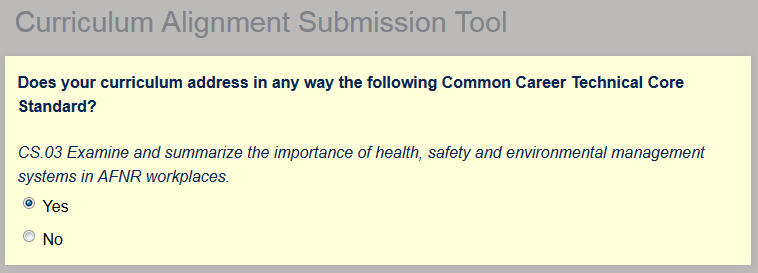
 

CAST Question 1

Fig. 2. Example of the first question in each block.

  1. After indicating that your curriculum/other resource aligns to the specified Common Career Technical Core Standard, identify the particular Performance Indicator(s) with which your curriculum/other resource aligns. Each Performance Indicator for the specified Common Career Technical Core Standard is listed with a corresponding check box (Figure 3). Your curriculum/other resource might align with multiple Performance Indicators, so choose all that apply. 
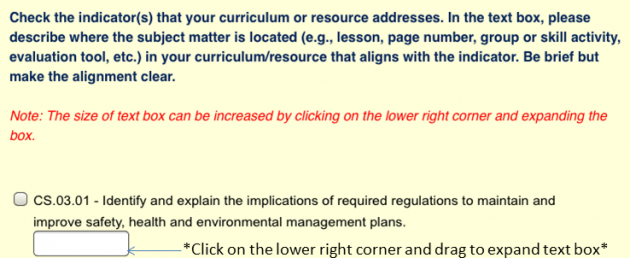
CAST Question 2 with text box

Fig. 3. Example of Indicators.

For each indicator that you check, you will need to indicate where the subject matter is located in your curriculum/resource that aligns with the indicator. Type this information in the text box below each of the indicator(s) and note that the size of the text box can be increased by clicking on the corner and expanding the box.  We suggest referring to the sample measurements in the downloaded document to help decide which specific indicator to list your material. It would be most helpful to us if you listed the sample measurement number with your submission. For example, in Figure 4, we have listed Lesson 7, pgs. 47-50 under CS.03.02 to say that the curriculum being submitted relates somewhat to measurements under this indicator and this can be found in Lesson 7 (on pages 47-50) of the submitted curriculum. That would make it easy for us to find and confirm.
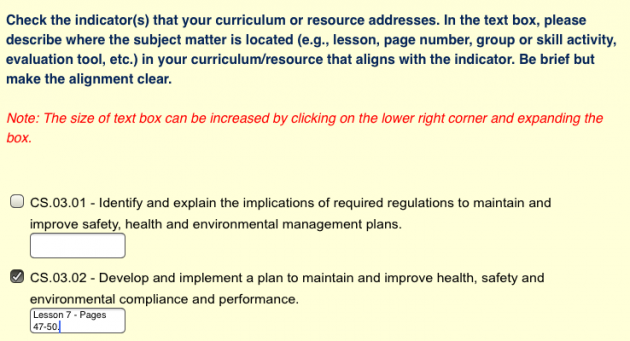
CAST Question 2 with page numbers

Figure 4. Stating location indicator is addressed in your curriculum/resource.

Thank you for submitting your curriculum/other resource for possible inclusion in the SAY National Clearinghouse. If you have questions about the curriculum/other resource submission process, contact Dave Hill at deh27@psu.edu or (814) 865-2808.
Summarized and reviewed by:
Linda M. Fetzer, Penn State University – lmf8@psu.edu
Kirby Barrick, University of Florida
Davis E. Hill, Penn State University (has since retired)
Dee Jepsen, Ohio State University – jepsen.4@osu.edu
Dewey Mann, Ohio State University – mann.309@osu.edu
Dennis J. Murphy, Penn State University (has since retired)
Ben Swan, California Polytechnic State University (San Luis Obispo)
Brian Warnick, Utah State University

SAY Project Background


Safety in Agriculture for Youth logo

SAY Project Logo

Special Note:  The material below represents the original plans for the SAY project as stated in the 2013-15 project proposal.  While much progress has been made toward the original goals and objectives, these and organizational structures shift over time.  To stay abreast of SAY project changes, be sure to look at the annual SAY project reports at the bottom of the SAY Project homepage

Project Vision

The mission of the Safety in Agriculture for Youth project (SAY) is to develop a sustainable and accessible national clearinghouse for agricultural safety and health curriculum for youth. This “national curriculum” is not a curriculum per se but is an umbrella compilation that includes many different curricula, programs, projects, and activities that together have a common purpose of increasing safety and health knowledge and reducing hazard and risk exposure to youth on farms and ranches. Additionally, this national curriculum must be sensitive to all types and scales of production agriculture and all ages and experience levels of target audiences; it must include parents and other educators; it must be culturally appropriate; and it must be usable in both formal and informal educational settings.

Project Goals

The goals of SAY are to coordinate a national curriculum and become a sustainable national clearinghouse by 

  1. connecting and enhancing existing educational resources in this area;
  2. developing a centralized location for relevant training and farm and ranch safety materials for both formal (school) and informal (home and agricultural industry) settings; and
  3. developing a national strategy that would enhance awareness of, access to, and utilization of farm safety materials by youth and adults who instruct and/or work with youth.

Project Objectives

SAY has the following implementation objectives:

  • Formulate the project team and identify and invite organizations to serve on the national steering committee and stakeholder groups.
  • Identify formally all safety and health curricula for agricultural youth that possibly align to current nationally recognized core competencies and learning objectives or outcomes.
  • Establish a protocol for development of a pool of exam items (test questions).
  • Develop and deliver an Occupational Safety and Health Administration (OSHA)-approved, 10-hour, web-based youth agricultural safety and health training course.
  • Develop and deliver an OSHA-approved, 10-hour, traditional (classroom-based and instructor-led) youth agricultural safety and health training course.
  • Establish a risk-assessment protocol for developing supervision strategies and guidelines for formal secondary students’ experiential learning activities (that is, supervised agricultural experiences).
  • Provide, through workshops, access to supervision and safety best practices and risk-assessment protocols.
  • Develop an immersive, 3-D, virtual learning environment, in proof-of-concept form, teaching farm safety hazards to youth ages 13 to 15.
  • Develop a sustainable process that ensures user-friendly access to educational resources and expertise.
  • Develop and implement a national strategy to promote awareness and utilization of youth safety materials by diverse stakeholder audiences.
  • Develop and implement a national strategy to increase use of youth safety materials through eXtension.org/agsafety.

Project Organization Chart

This two-year project began in September 2013 and will use the project team, a national steering committee, and four stakeholder groups (shown below) to complete the stated objectives.

SAY Natl Steering Comm

 
Summarized by:
Linda M. Fetzer, Pennsylvania State University – lmf8@psu.edu
 
Reviewed by:
Dave Hill, Pennsylvania State University – deh27@psu.edu
Dennis J. Murphy, Pennsylvania State University – djm13@psu.edu

Play It Farm Safe: An Online Educational Game

Play it Farm Safety Logo

(Source: University of Vermont Extension)

University of Vermont Extension 4-H has developed an online educational game called “Play It Farm Safe.” The Play It Farm Safe game is a self-paced learning tutorial for youth ages 12 through 15 that addresses the following topics:

  • tractor and machinery safety
  • animal and livestock safety
  • ATV safety
  • woodlot safety
  • general farmstead safety

Modules include educational diagrams, videos, and questions used to reinforce agricultural safety and health topics. Once a participant has completed all the modules, he or she can print and send a form to the University of Vermont for a completion certificate that will be mailed to the user.

Click HERE to visit the Youth Farm Safety Project and access the online training or HERE to view the program flyer. 

In addition to accessing the game, educators will soon be able to download free companion materials from the site. These materials will include game content for pencil and paper and other farm safety activities that align with Common Core Standards and National Agriculture, Food, and Natural Resources Career Cluster Standards.

 
Reviewed and Summarized by:
Linda M. Fetzer, Pennsylvania State University – lmf8@psu.edu
Kristen Mullins, University of Vermont – kristen.mullins@uvm.edu
Dennis J. Murphy, Pennsylvania State University – djm13@psu.edu
Aaron M. Yoder, University of Nebraska Medical Center – aaron.yoder@unmc.edu

Cultivate Safety

Cultivate Safety Logo

(Photo Source: National Children’s Center for Rural and Agricultural Health and Safety)

Family farms and farm workers from multiple generations are common in production agriculture. Involving children in work activities teaches them valuable skills and makes them feel included in the family business. However, work activities can also expose children to hazards and risks if they are completing tasks that are not appropriate for their age. In the United States, about 38 children are injured in farm-related incidents each day, and every three days a child dies as a result of a farm accident.

The National Children’s Center for Rural and Agricultural Health and Safety (NCCRAHS) developed a website to help parents remember that they are a “Parent First, Farmer Second.” The website provides user-friendly information about child development and age-appropriate work guidelines for farm tasks.

Click here to be directed to the Cultivate Safety website. In addition to information about child development and work guidelines, the website provides information on preventing injuries and real-life injury incidents. Interactive features provide users with opportunities to upload stories, videos, and photos about child injuries to encourage families to learn from one another.

 
Reviewed and Summarized by:
Linda M. Fetzer, Penn State University – lmf8@psu.edu
Dennis J. Murphy, Penn State University – djm13@psu.edu
Marsha A. Salzwedel, National Children’s Center for Rural and Agricultural Health and Safety – salzwedel.marsha@mcrf.mfldclin.edu
Aaron M. Yoder, University of Nebraska Medical Center – aaron.yoder@unmc.edu


Safety for Diverse Populations Publications


Agricultural Producers with a Disability

Topic Title Organization Pub Date
Adapting Motor Vehicles University of Missouri Extension, Missouri AgrAbility Project 2010
Assistive Technology for the Farm The Ohio State University 2011
Assistive Technologies in Agriculture

Assistive Technologies for Lower Extremity Mobility on the Farm

Assistive Technologies for Upper Extremity Mobility on the Farm

Assistive Technologies to Improve Safety and Accessibility on Small Scale Diversified Vegetable Farms and Home Gardens

Assistive Technologies to Support Farmers with Low Vision or Blindness

Virginia Cooperative Extension 2010


2021


2021


2021

Extending Universal Design Principles onto the Farmstead The Ohio State University 2010
Farming after a Stroke The Ohio State University 2011
Farming with Alzheimer’s Disease The Ohio State University 2013
Farming with a Visual Impairment The Ohio State University 2013
Farming with Chronic Back Pain The Ohio State University 2013
Farming with Diabetes The Ohio State University 2011
Farming with Lower Extremity Amputation The Ohio State University 2011
Farming with Parkinson’s Disease The Ohio State University 2011
Farming with Upper Extremity Limitation or Amputation The Ohio State University 2011
Gardening with a Physical Limitation The Ohio State University 2013
Recovery from Hip or Knee Replacement for Farmers The Ohio State University 2013
Tractor-Mounted Inclined Lifts Virginia Cooperative Extension 2013
The Toolbox: Agricultural Tools, Equipment, Machinery & Buildings for Farmers and Ranchers with Physical Disabilities National AgrAbility Project 1986-2014

Anabaptist (e.g., Amish) Populations

Topic Title Organization Pub Date
Driving Safely in Plain Communities Virginia Cooperative Extension 2011
Lighting and Marking for Horse Drawn Buggies, Carriages, Carts, and Wagons Pennsylvania State University 2013
Lighting and Marking Recommendations for Buggies and Wagons The Ohio State University 2009
Plain Facts about Arthritis: A Guide to Understanding and Living with Arthritis in Plain Communities National AgrAbility Project – Purdue University 2005
Snowplows in Amish Country: A Guide for Buggy Drivers, Pedestrians, and Snowplow Operators The Ohio State University 2011

Children and Youth

Topic Title Organization Pub Date
Harvesting Health: Children and Dairy Chemicals National Farm Medicine Center 2009
Children and Safety on the Farm Pennsylvania State University 2006
Child Safety Around Animals University of Maine Extension 2002
Creating Safe Play Areas on Farms National Children’s Center for Rural and Agricultural Health and Safety 2001
Equestrian Safety National Farm Medicine Center 2003
Farm Safety for Young Children Iowa State University Extension and Outreach 2004
Farm Youth Safety: Know Laws about Youth Farm Workers Iowa State University Extension and Outreach 2008
Guidelines for Protecting Youth Workers Virginia Cooperative Extension 2012
Kids on the Farm: Hazards Inside the Home University of Maine Extension 2002
Kids on the Farm: Hazards Outside the Home University of Maine Extension 2002
Interactive Demonstrations of Safe Play Areas at Rural and Agricultural Events National Children’s Center for Rural and Agricultural Health and Safety 2006
Review Family Farm Safety Rules Iowa State University Extension and Outreach 2004
Safety Guidelines for Hired Adolescent Farm Workers National Farm Medicine Center 2008
Youth Safety: Match Age, Abilities to Farm Chores Iowa State University Extension and Outreach 2001

Hispanic Resources

Topic Title Organization Pub Date
10 Sugerencias de Seguridad con los ATV Pennsylvania State University 2014
10 Sugerencias de Seguridad con las Cortadoras de Cesped Pennsylvania State University 2014
10 Surgerencias de Seguridad con los Mini Cargadores Pennsylvania State University 2014
10 Surgerencias de Seguridad con los Tractores Pennsylvania State University 2014
Could Arthritis Be What Is Causing My Pain?  – ¿Podrá ser la Artritis lo que me causa Dolor? National AgrAbility Project – Purdue University
Creating Safe Play Areas on Farms – Creacion de areas de juego seguras en granjas miniedicion National Children’s Center for Rural and Agricultural Health and Safety 2010
Pesticides Nearby…But Staying Healthy – Aunque cerca…sanco. Una guia para prevencion de los riesgos de los pesticidas

Posters: Seguridad con Agujas (Needle Safety), Mantengase Sano Trabajando con Animales (Stay Healthy Working with Animals), Seguridad con la Minicargadora (Skid Steer Safety), Seguridad con Quimicos (Dairy Chemical Safety), Seguridad con el Tractor (Tractor Safety), Manejo de Animales (Animal Handling Safety)

National Children’s Center for Rural and Agricultural Health and Safety


The Northeast Center for Occupational Health and Safety

2003


2019

Secondary Injury Prevention

Topic Title Organization Pub Date
Evaluating Agricultural Workplace Assistive Technology for Secondary Injury Hazards National AgrAbility Project – Purdue University 2008
Overexertion Causing Secondary Injury The Ohio State University 2010
Preventing Secondary Injuries in Agricultural Workplaces Virginia Cooperative Extension 2009
Secondary Injury Prevention: Caught in, Caught between, or Struck by Objects The Ohio State University 2010
Secondary Injury Prevention: Ergonomics The Ohio State University 2010
Secondary Injury Caused by Lifting The Ohio State University 2010
Secondary Injury Prevention: Farming with a Pacemaker The Ohio State University 2010
Secondary Injury Prevention: Heat Stress The Ohio State University 2010
Secondary Injury Prevention: Repetitive Motion The Ohio State University 2011
Secondary Injury Prevention for Senior Farmers The Ohio State University 2010
Secondary Injury Prevention: Understanding Concussions The Ohio State University 2011
Secondary Injury Prevention: Walking and Working Surfaces The Ohio State University 2010

Special Populations Safety Video Resources


Topic Title Organization Resource Type

Caring for a Diabetic Foot (2011)

5:23 minutes

National AgrAbility – Purdue University  Free – Online video via YouTube

Caring for a Residual Limb (2011)

4:31 minutes

National AgrAbility – Purdue University  Free – Online video via YouTube

Farming with Arthritis (2008)

15:00 minutes

University of Missouri Extension Missouri AgrAbility Project & Missouri Arthritis Rehabilitation Research and Training Center  Free – Online video via YouTube

KY AgrAbility – Enabling a Disabled Farmer to Continue Farming (2013)

4:36 minutes

U.S. Agricultural Safety and Health Centers Free – Online video via YouTube

Sharing the Roadways in Amish Country (2011)

10:33 minutes

The Ohio State University  Free – Online video via YouTube

To Everything There is a Season: A Video for Caregivers of Farmers and Ranchers with Disabilities (2000)

43:23 minutes

National AgrAbility – Purdue University  Free – Online video via YouTube


Age-Related Topics

Topic Title Organization Resource Type

Child Development Cannot be Rushed (2015)

(Series of 5 videos)

U.S. Agricultural Safety & Health Centers  Free – Online video via YouTube

Keeping Small Children Safe (2011)

3:02 minutes

Canadian Agricultural Safety Association  Free – Online video via YouTube

Play it Safe on the Farm (2015)

4:21 minutes

Propane Education & Research Council  Free – Online video

Propane Safety (2015)

4:21 minutes

Propane Education & Research Council  Free – Online video

Senior Safety (2011)

2:15 minutes

Canadian Agricultural Safety Association  Free – Online video via YouTube

Age-Appropriate Tasks for Children on Farms and Ranches


Use the following format to cite this article:

Age-appropriate tasks for children on farms and ranches. (2012) Farm and Ranch eXtension in Safety and Health (FReSH) Community of Practice. Retrieved from https://ag-safety.extension.org/age-appropriate-tasks-for-children-on-farms-and-ranches/.

Children play an active role on many farms and ranches, but it is the responsibility of parents, caregivers, or supervisors to assign them age-appropriate tasks, restrict access to work areas, give easy-to-understand instructions, provide personal protective equipment (PPE), maintain equipment with operational safety devices, and provide supervision to reduce the risk of injury or death. The most common causes of agricultural-related fatalities for children are machinery or tractor accidents, drowning, and motor vehicle accidents, including accidents involving all-terrain vehicles (ATV). Most nonfatal injuries result from falls or incidents with livestock.

Because rates of physical and mental development can vary from child to child, understanding how children develop is critical to identifying age-appropriate tasks for them. A child’s size, strength, motor skills, and coordination are all factors in determining whether he or she is physically able to complete certain tasks. But you must also determine whether a child has the cognitive skills to understand and follow instructions, make good decisions, and understand that unsafe actions may have consequences that lead to injury or death. Click here to view Children and Safety on the Farm, a publication furnished by Penn State Extension that provides a comprehensive chart of the developmental characteristics of children from birth through age 18 and offers details about how children develop, common causes of injury or death for each age group, strategies to prevent accidents, and appropriate work tasks.

Choosing the Right Tasks

Child feeding calf

(Source: Pennsylvania State University. Agricultural Safety and Health)

Children are eager to work on the farm or ranch alongside other family or team members. However, it is important to understand that each farm task has a certain level of risk associated with it. Children working on a farm or ranch need the appropriate physical and cognitive maturity to complete any assigned tasks. The North American Guidelines for Children’s Agricultural Tasks (NAGCAT) guidelines are contained in a searchable database that enables you to identify a farm task and follow a checklist  to determine a child’s ability to complete the task. Click here to be linked to the National Children’s Center for Rural and Agricultural Health and Safety – Safety Guidelines to determine whether a farm task is appropriate for a child.

Key Points about Children Working on Farms and Ranches:

  • A child should never be an extra rider on a tractor. The rule is “one seat one rider.”
  • Supervise all children. Do not leave them alone on the farm or ranch.
  • Provide children with the appropriate PPE for a given task and teach children the proper use and fit of any items of PPE.
  • Keep equipment in proper working condition.
  • Do not allow visiting children into farm work areas; restrict such areas to children working on the farm.
  • Be a good role model by wearing PPE and following safe operating procedures.
  • If children are not physically and cognitively ready to work on the farm, ensure that they have appropriate child care and are not in farm work areas.
  • Routinely inspect your farm or ranch for hazards and immediately remove these dangers.
  • Encourage children to participate in local farm and ranch safety activities. To learn more about farm safety activities in your area, contact your local Cooperative Extension office. Click here to link to the United States Department of Agriculture (USDA) National Institute of Food and Agriculture (NIFA) listing of Cooperative Extension offices.

Use the following format to cite this article:

Age-appropriate tasks for children on farms and ranches. (2012) Farm and Ranch eXtension in Safety and Health (FReSH) Community of Practice. Retrieved from https://ag-safety.extension.org/age-appropriate-tasks-for-children-on-farms-and-ranches/.

Sources

2011 Fact Sheet: Childhood Agricultural Injuries. (2011) National Children’s Center for Rural and Agricultural Health and Safety. Retrieved from https://www3.marshfieldclinic.org/proxy///mcrf-centers-nfmc-nccrahs-chil….

Graham, L. & Oesterreich, L. (2004) Farm safety for young children. Iowa State University Extension and Outreach. Retrieved from https://store.extension.iastate.edu/ItemDetail.aspx?ProductID=5097.

Murphy, D. & Hackett, K. (1997) Children and safety on the farm. Pennsylvania State University College of Agricultural Sciences Cooperative Extension. Retrieved from https://extension.psu.edu/children-and-safety-on-the-farm.

National Children’s Center for Rural and Agricultural Health and Safety – Safety Guidelines (2017) Retrieved from  https://www.cultivatesafety.org/safety-guidelines-search/?category=famil….

Schwab, C., Shutske, J., & Miller, L. (2001) Match age, abilities to farm chores. Iowa State University Extension and Outreach. Retrieved from https://store.extension.iastate.edu/ItemDetail.aspx?ProductID=4994.

Youth agricultural safety. (2003) Marshfield Clinic Research Foundation. Retrieved from http://www.marshfieldclinic.org/proxy/mcrf-centers-nfmc-resources-childr….

Reviewed and Summarized by:
Linda M. Fetzer, Pennsylvania State University – lmf8@psu.edu
Prosper Doamekpor, Tuskegee University – doamekpor@mytu.tuskegee.edu
Dennis J. Murphy, Pennsylvania State University (Has since retired)
Michael Pate, Utah State University –michael.pate@usu.edu
Aaron M. Yoder, University of Nebraska Medical Center – aaron.yoder@unmc.edu

Working with Senior Farmers and Ranchers


Use the following format to cite this article:

Working with senior farmers and ranchers. (2012) Farm and Ranch eXtension in Safety and Health (FReSH) Community of Practice. Retrieved from http://www.extension.org/pages/63140/working-with-senior-farmers-and-ranchers.


Many farm and ranch operations are family owned and operated and include workers of all ages. As a result, older adults are more prevalent in production agriculture than in other occupations. Between 2002 and 2007, the average age of farm operators increased from 55.3 to 57.1, and the number of farm operators over the age of 75 increased by 20% (2007 Census of Agriculture). Senior farmers and ranchers can offer valuable insight and wisdom gained from their years of work experience. It is important to keep communication channels open with senior workers, provide necessary worksite accommodations, and implement changes to keep them safe.

According to the National Institute for Occupational Safety and Health (NIOSH), when it comes to work-related injuries, older workers are at a disadvantage compared to their younger counterparts because older workers are more susceptible to injuries and typically have a longer recuperation period (NIOSH, 2009). In an article in the October 2005 Monthly Labor Review, Samuel Meyer notes that in the period between 1995 and 2005, a farmer over the age of 55 was over 10 times more likely to be involved in a fatal-injury incident involving tractors, equipment, or animals.

Senior farmers and ranchers are typically at a higher risk for work-related injuries and death due to the effects of the aging process. These effects can include:

  • reduced reaction time, balance, and strength;
  • changes in cognition levels;
  • decreased visual acuity; and
  • hearing loss.

These types of changes can affect the work that senior farmers and ranchers can safely complete. Agricultural producers and family members need to consider ways to make adjustments and modifications to better accommodate the needs of senior workers.

To decrease the risk of injury, those working with senior farmers and ranchers should take the following actions:

  • Vision Testing: Ask that senior workers have their vision tested regularly and abide by doctors’ recommendations regarding any driving restrictions.
  • Communication System: Keep a communication system, such as cell phones or two-way radios, available to senior workers at all times.
  • Fall Prevention: Take steps to reduce the risk of falls.

    • Increase the level of lighting in barns, shops, and other buildings. 
    • Clear walkways, add nonslip surfaces to walkways, and add steps and handrails to stairs and elevated equipment.
  • Medication: Encourage senior workers to consider whether prescription and over-the-counter medications could affect their ability to safely operate equipment and machinery. Ask them to check for any warnings on medication labels.
  • Rollover Protection: Make sure that all the primary tractors in the operation are equipped with rollover protection. (Click here for information about rollover protection rebate programs.) Consider trading in an older model tractor for a newer model that is equipped with better seating, accessibility, and rollover protection.
  • Rest and Fluids: Have senior workers take necessary rest breaks and encourage them to get ample sleep, especially during high-stress times of the year such as harvesting. Provide frequent opportunities for senior workers to drink plenty of fluids.
  • Health Conditions: Be aware that health conditions can cause changes in a worker’s ability to safely complete a farm task. Understand that limitations or worksite accommodations may be necessary for senior workers to remain in production agriculture. Ask senior workers to consult with their physicians about participating in programs of strength training, stretching, and cardiovascular exercise to maintain or improve health status.
  • Hearing: It is common for senior workers to have some level of hearing impairment that can make it difficult for them to hear warning signals and approaching animals and co-workers. Encourage senior workers to have their hearing checked by an audiologist to determine whether hearing aids are applicable to their work environment. Provide workers with any necessary hearing protection. Due to hearing impairments, the use of agricultural hand signals may be even more valuable to senior farmers and ranchers. Click here to learn more about hand signals used in production agriculture.
  • Tractor Operation and Driving: Ensure that each tractor in the operation is equipped with properly working lights, brakes, and fenders and that shields are in place. Limit tractor driving to daytime hours, and ask workers to avoid roadways that are heavily traveled. Ask senior workers to take a driving course to maintain and promote skills and safety knowledge related to driving.


Use the following format to cite this article:

Working with senior farmers and ranchers. (2012) Farm and Ranch eXtension in Safety and Health (FReSH) Community of Practice. Retrieved from http://www.extension.org/pages/63140/working-with-senior-farmers-and-ranchers.


Sources

2007 Census of Agriculture: Demographics. (2007) United States Department of Agriculture, National Agriculture Statistics Service. Retrieved from http://www.agcensus.usda.gov/Publications/2007/Online_Highlights/Fact_Sheets/Demographics/demographics.pdf.

Funkenbusch, K. & Downs, W. (n.d.) Senior farmers at risk on the farm. Agricultural Safety Tips and Ideas. Retrieved from http://agrability.missouri.edu/ruralsafety/factsheets/updated/SeniorFarmersRiskOntheFarm.pdf.

Meyer, S. (2005) Fatal occupational injuries to older workers in farming. Monthly Labor  Review. Retrieved from http://www.bls.gov/opub/mlr/2005/10/art5full.pdf.

Murphy, D. (1994) Senior farmers and safety: How changing health affects risks of fatal injury. Extension Circular 147. The Pennsylvania State University College of Agricultural Sciences Cooperative Extension. 

Occupational health disparities. (2009) National Institute of Occupational Safety and Health. Retrieved from http://www.cdc.gov/niosh/programs/ohd/risks.html.


Reviewers, Contributors, and Summarized by:
Linda M. Fetzer, Pennsylvania State University – lmf8@psu.edu
Karen Funkenbusch, University of Missouri – funkenbuschk@missouri.edu
Dennis J. Murphy, Pennsylvania State University (Has since retired)
Carla Wilhite, University of New Mexico – CWilhite@salud.unm.edu
Aaron M. Yoder, University of Nebraska Medical Center – aaron.yoder@unmc.edu

Youth ATV Safety

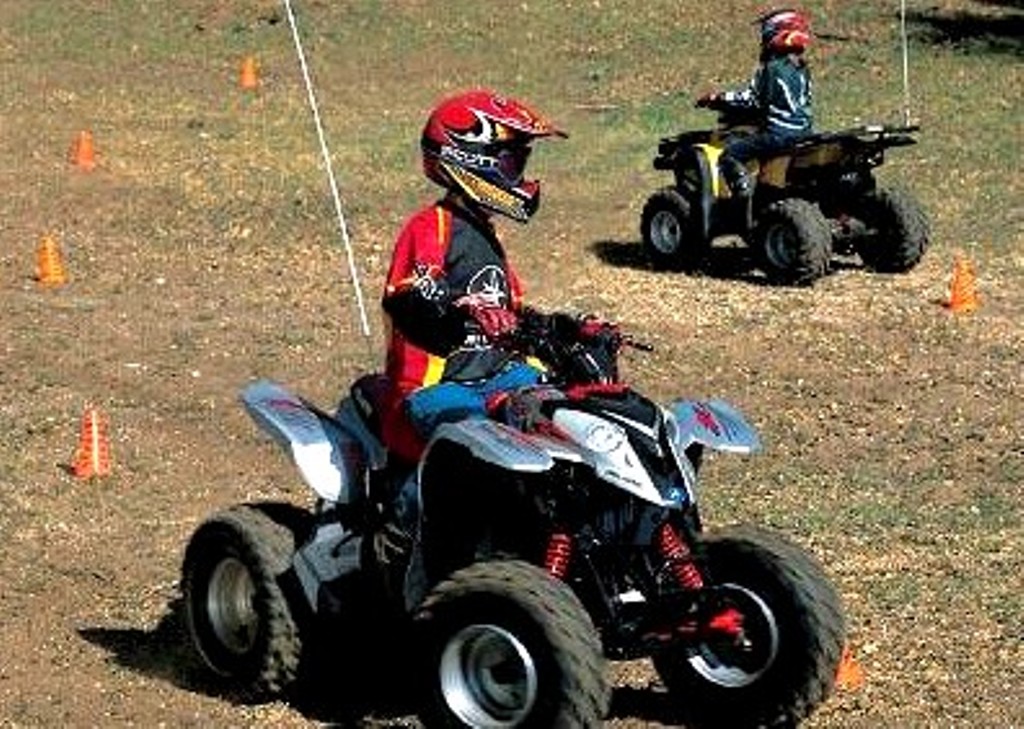
ATV Safety Course Photo

(Photo Source: Specialty Vehicle Institute of America, ATV Safety Institute)

Use the following format to cite this article:

Youth ATV safety. (2012) Farm and Ranch eXtension in Safety and Health (FReSH) Community of Practice. Retrieved from http://www.extension.org/pages/62259/youth-atv-safety.


Youth operate all-terrain vehicles (ATVs) on farms and ranches and for recreational use. ATVs can be useful for work and a fun mode of transportation; however, injuries from ATV incidents continue to be problematic for farm and rural youth. In 2008, more than 37,000 youth under the age of 16 were treated in hospital emergency rooms across the country due to ATV-related injuries (Consumer Product Safety Commission).

Many of these incidents can be prevented by evaluating the youth’s readiness to operate an ATV by:

  • identifying the correct size of ATV;
  • using personal protective equipment;
  • giving the youth safety instruction, and
  • providing adult supervision. 

Adult supervision of youth ATV operators is essential to ensure that the youth adheres to rules, wears the proper protective equipment, and correctly operates the ATV. Controls such as throttle limiters, exhaust restrictors, and remote shut-off switches are available to assist adults when regulating beginning ATV operators.

Youth Readiness and Size of ATV

Children under 6 should never be on an ATV, according to the U.S. Consumer Product Safety Commission. Most ATVs are labeled with a recommended age for that model. The recommended ages for Y-6 models (under 70cc engines) are 6 to 11 years old. The Y-12 models (70 to 90 cc engines) are 12 to 15 years old. However, some states many have specific rules regarding allowable age for operation of ATVs, so it is important to check your state for rules, and while the actual age is the easiest to identify, it should not be the only factor in determine when youth can ride.

Children develop at different rates, so consider each child’s cognitive and physical development when making a decision about their ability to operate an ATV. Cognitive and emotional development is related to the youth’s reasoning ability, memory, discipline, focus, and decision-making skills. Do not overestimate your child’s abilities when it comes to making decisions that will affect his safety. When assessing your child’s cognitive development, determine her level of discipline and her understanding of cause and effect. Be sure that your child understands that if his behavior is unsafe or reckless, the consequence may be an injury or death. Discuss safety scenarios with your youth to ensure that he can provide sensible and safe reactions to the situation.

Physical development includes the youth’s size, strength, visual acuity, and coordination. The following are a few measures you can take to determine if your child is physically ready to operate an ATV:

  • If your child stands on the footrests of the ATV with his hands on the handle bar, are there at least 3 inches of clearance between the ATV seat and the seat of the child’s pants?
  • Can your child operate the throttle and brake lever with one hand?
  • Can your child shift the weight of the ATV side to side by shifting her weight? 

Youth should only operate a four-wheeled ATV because these are more stable and present less risk for a side overturn compared to a three-wheeled ATV.

For beginning riders, choose an ATV with a single speed automatic transmission, and do not equip the ATV with a carrier rack. A load on a carrier rack can shift and possibly alter the ATV’s center of gravity and decrease its stability. There is only one seat for the operator; therefore, passengers are not permitted on an ATV. The following chart is a guideline for the most appropriate-sized ATV engine compared to the youth’s age.  

Figure 1: Operator Age and ATV Engine Size
Age of Operator ATV Engine Size
Under 6 years of age No operation recommended
Age 6 to 11 Under 70cc
Age 12 to 15 70 – 90cc
16 years and older Over 90cc

Different Sized ATVs

Different Sized ATVs. Photo Source: Penn State Ag Safety & Health

(Left to right: 700cc, 90cc, and 50cc. Photo Source: Pennsylvania State University. Agricultural Safety and Health)


Protective Gear for ATV Operators

The most important piece of personal protective equipment for an operator is a helmet approved for ATV use.  Helmets should be the correct size for the operator and approved for ATV use by the American National Standards Institute (ANSI), U.S. Department of Transportation, or the Snell Memorial Foundation to ensure that it has been safety tested. If the helmet is not equipped with a face shield, wear an ANSI-approved pair of goggles or glasses with hard-coated polycarbonate lenses. When operating an ATV, the child should also wear gloves, boots, long-sleeved shirt or jacket, and long pants.

Maintenance, Specifications, and Operation

Teach your youth the location of the following ATV parts: parking brake, brakes, throttle, engine stop switch, and shift lever (if equipped). Prior to operating the ATV, follow these steps:

  • Check the air pressure in the tires, controls and cables, ignition switch, and oil and fuel levels.
  • Lubricate chains and/or drive-shaft chassis. 
  • Make sure that all nuts and bolts are tightly secured. 

Teach youth the acronym BONE-C which outlines the following steps to properly start an ATV:

  1. BBrake – Make sure the parking brake is set.
  2. OOn – The ignition and fuel are on.
  3. NNeutral – ATV should be started in neutral (if equipped)
  4. EEngine – The stop switch should be in the run or start position.
  5. CChoke – Choke should be on when starting a cold engine. 

Safety Instruction

Youth should learn to safely operate an ATV in an approved safety training program. 

Click HERE to be directed to ATVSafety.gov to do an online ATV safety training. ATVSafety.gov provides safety information, legislation regarding ATV use, state-specific information about regulations, and contact information for ATV safety training for adults and teens.  

Click HERE to be directed to the ATV Safety Institute for more information about ATV safety and safety training classes in your area.

Click HERE to view a below from the ATV Safety Institute to learn more about their ATV safety training classes.

Additional Safety Recommendations

  • Check your riding area to make sure it is free from hazards such as rocks, stumps, branches, and fences.
  • Know and obey the laws in your area related to ATV operation.
  • Ask permission before riding on private property.
  • Use lights, reflectors, and flags to increase the ATV’s visibility.
  • Do not show off, perform stunts, or speed.
  • ATV tires are not designed for road travel so avoid public roads and paved surfaces because road travel affects the handling and control of the ATV. 
  • Keep the feet on the footrests at all times.
  • Remember that certain ATV parts such as the engine, exhaust pipe, and muffler are hot and can cause burns.
  • Keep the hands and feet away from all moving parts on the ATV.
  • Maintain proper riding posture to help properly operate the controls.   

Resources

  • Click HERE to be directed to the Youth Agricultural Work Guidelines that provides questions designed to help you determine whether your child is ready to operate an ATV or UTV and have a positive agricultural work experience. 
  • Click HERE to be directed to the Children’s Safety Network’s publication titled ‘Focus on All-Terrain Vehicle Safety: Resource Guide 2012’.


Use the following format to cite this article:

Youth ATV safety. (2012) Farm and Ranch eXtension in Safety and Health (FReSH) Community of Practice. Retrieved from http://www.extension.org/pages/62259/youth-atv-safety.


Sources

2008 annual report of ATV-related deaths and injuries. (2010). Consumer Product Safety Commission. Retrieved from https://www.cpsc.gov/s3fs-public/pdfs/atv2008.pdf.

Youth agricultural work guidelines. (2017)National Children’s Center for Rural and Agricultural Health and Safety. Retrieved from https://cultivatesafety.org/safety-guidelines-search/?category=familyyouth.

Murphy, D. & Harshman, W. (2005). ATVs and youth: Matching children and vehicles. Penn State College of Agricultural Sciences Cooperative Extension. Retrieved from https://extension.psu.edu/atvs-and-youth-matching-children-and-vehicles.

Parents, youngsters, and all-terrain vehicles (2010) ATV Safety Institute. Retrieved from https://www.cohv.ca/wp-content/uploads/2014/11/parents-youngsters-atvs-2….

Schwab, C., Miller, L. & Satre, S. (2008) ATV safety for farm work, recreation. Iowa State University Extension and Outreach Safe Farm. Retrieved from https://store.extension.iastate.edu/ItemDetail.aspx?ProductID=5065


Reviewed and Summarized by:
Linda M. Fetzer, Pennsylvania State University – lmf8@psu.edu
S. Dee Jepson, Ohio State University – jepsen.4@osu.edu 
Dennis J. Murphy, Pennsylvania State University – (Has since retired)
Michael Pate, Pennsylvania State University – mlp79@psu.edu
Aaron M. Yoder, University of Nebraska Medical Center – aaron.yoder@unmc.edu