Ag Safety and Health Upcoming Events

Ag safety at FFA Convention


Agricultural safety and health (ASH) events allow you to meet other ASH professionals, learn about current research projects, and explore ways to collaborate with others. The following is a list of upcoming national or regional ASH events:

AgrAbility National Training Workshop
March 16 – 19, 2026
Location: Traverse City, MI

International Society of Agricultural Safety and Health Conference (ISASH)
June 15 – 18, 2026
Location: Saskatoon, SK

National Association of Extension 4-H Agents
October 27-29 – 30, 2026
Location: Kansas City, MO

2025 National FFA Convention
October 21 – 24, 2026
Location: Indianapolis, Indiana

Agricultural Safety and Health Council of America Safety Summit
TBD
Location: TBD

Midwest Rural Agricultural Safety and Health Conference
TBD
Location: TBD

Summarized and Reviewed by:

  • Linda M. Fetzer, Pennsylvania State University – lmf8@psu.edu
  • Dennis J. Murphy, Pennsylvania State University (has since retired)
  • Aaron M. Yoder, University of Nebraska Medical Center – aaron.yoder@unmc.edu

Injury Risk Assessment for Supervised Agricultural Experiences


Injury Risk Assessment

(Source: Utah State University)

A supervised agricultural experience (SAE) is one of the three key components of an agricultural education program for high school students. An SAE provides a student with an experiential learning opportunity and is based on one or more of the following categories: entrepreneurship, placement, research and experimentation, or exploration.

Importance of an Injury Risk Assessment Protocol for SAEs

The SAE is a broadly defined experience for students and can include but is not limited to working in a job or an internship on a farm or ranch, owning and operating an agricultural business, planning and conducting a scientific experiment, or exploring agricultural career opportunities. The Injury Risk Assessment for SAEs protocol is a resource for evaluating work sites to assess risks for individuals involved with production-based SAEs on those work sites. Production-based SAE safety evaluations and risk assessments must be integral parts of agricultural educators’ visits to production-based SAE sites. Click here to learn more about the importance of safety in production-based SAEs.

Components of the Injury Risk Assessment for SAEs Protocol

The Injury Risk Assessment for SAEs protocol includes the following components:

SAE Safety Daily Lesson Plan – The daily lesson plan provides agricultural educators with a complete 30-minute lesson that includes an SAE Safety slide presentation.

SAE Code of Practice for Safety Risk Assessment – Educators, employers, and/or parents can have students review and sign this agreement form to state that they will represent their school and FFA Chapter positively with regard to promoting and strengthening student safety while completing an SAE. The Code of Practice should be completed at the beginning of a student’s SAE or the beginning of each school year or as an assignment related to a unit of instruction in an SAE.

Student Self-Assessment of SAE – Students complete this self-evaluation to assess an SAE in relation to supervision, working conditions, and emergencies. The self-assessment should be completed by students as an assignment within the first two weeks of an SAE. An administrator of the SAE should file the completed form for future reference.

Teacher/Parent/Employer Safety Assessment of Student’s SAE – This easy-to-use assessment form was developed specifically for a teacher, a parent, or an employer to conduct a safety assessment of a student’s SAE, based on the job, working conditions, and injury preparedness. Ideally, this form should be completed after the student completes the SAE Code of Practice and Student Self-Assessment documents and after or in conjunction with a scheduled SAE visit. Again, an administrator of the SAE should file the completed form for future reference.

Items that score a 4 or higher should be addressed prior to allowing the student to participate. The goal would be to lower the injury risk for the student in cooperation between mentoring adults responsible for supervision. Planning comments can be made and a hazard control plan implemented to reduce risk exposure to the student.

Return to the Safety in Agriculture for Youth (SAY) page.

Reviewed and Summarized by:
Linda M. Fetzer, Pennsylvania State University – lmf8@psu.edu
Michael Pate, Utah State University – michael.pate@usu.edu
Rebecca G. Lawver, Utah State University – Rebecca.lawver@usu.edu
Dennis J. Murphy, Penn State University (Has since retired)

Riding Lawnmower Safety


Use the following format to cite this article:

Riding lawnmower safety. (2025). Ag Safety and Health Community Community of Practice. Retrieved from https://ag-safety.extension.org/riding-lawnmower-safety/.

There are approximately 10,000 injuries to youth/children each year from lawnmower incidents. Of those injuries, about 5% of the injuries result in an amputation. Most fatalities involved a machine rolling over or running over someone or a person being thrown from or falling off the mower. The following list outlines common mower hazards:

Contact with Mower Blade – A mower is designed to cut grass with a cutting edge that can turn at speeds up to 200 miles per hour. At these speeds, the blade can damage anything or anyone in its path. Some injuries occur when the operator completes maintenance or cleans the discharge chute while the engine is still running. Avoid contact with a turning blade by always turning off the engine and allowing moving parts to completely stop before attempting any work on the mower.

Projectiles – Objects in the yard (e.g., toys, stones, etc.) can become projectiles when struck by the blade, causing the object to travel up to 200 miles per hour after leaving the discharge chute. These projectiles can cause property damage or serious injuries to people in the area. The discharge chute is equipped with a protective guard or deflector to stop objects from becoming projectiles. However, for the deflector to be effective, it must remain in place. The dangerous practice of bungee strapping the deflector up or removing it to increase grass flow from the mower chute defeats the purpose of reducing projectiles.

Mower Discharge Chute

(Source: Penn State Agricultural Safety and Health)

Overturns – Typically, an overturn incident can occur with a riding lawnmower when the operator is mowing on a steep slope or embankment. During this type of incident, the operator can be pinned under the mower or can come into contact with the mower’s blades.

Runover Incidents – This type of incident typically occurs when the operator does not look behind the mower when backing up on a riding lawnmower and accidentally runs over a child.

Burns – Burns can occur when an operator comes in contact with a muffler or cylinder that was heated during operation and has not cooled. In addition, careless refueling when an engine is hot can result in a fire that can cause serious burns.

Safe Practices for Mowing

Check the area for hazards each time before you mow. Look for objects that could become projectiles (e.g., dog bones, sticks, etc.) and immovable objects (e.g., pipes or partially buried rocks) that could cause damage to your mower deck or break apart and become a projectile.

Do not mow in an area where young children are playing because they may not understand the dangers of the mower and the operator may not be able to hear them approaching the machine.

Never point the mower discharge chute toward people, pets, homes, structures, streets, or vehicles.

Do not allow extra riders on a mower (even if you are not mowing).

Never leave a running mower unattended.

Always allow the mower to cool before refueling it to reduce the risk of a flash fire. Most mowers are fueled by gasoline, which is a highly explosive and flammable material. If you accidentally spill gasoline when refueling, quickly and carefully wipe up the fuel.

Start the mower outside or in a well-ventilated garage area to reduce the risk of carbon monoxide gas buildup.

Disconnect the spark plug wire to prevent the mower from accidentally starting before you complete any type of maintenance on the mower.

Avoid mowing wet grass because it is slippery and the machine’s tires can lose traction and slide. Mowing wet grass can also cause problems because of clogged grass in the discharge chute.

Know which way to mow when you are mowing on an incline. If you are mowing with a riding lawnmower, mow up and down the slope to reduce the risk of a rollover incident. When using a walk-behind mower, mow across the slope to reduce the risk of contact with the mower blade (e.g., sliding down the hill and getting your feet caught in the mower).

A slower speed is a safer speed.

Only mow when operating in a forward gear.

Personal Protective Equipment

► Choose the right clothing and protective equipment. Clothing that is close-fitting is less likely to get caught in moving parts than loose-fitting clothing. Long pants can provide some protection against projectiles not deflected by the rear guard.

Wear sturdy leather shoes with good traction to protect your feet.

► Always wear hearing protection (e.g., ear muffs or ear plugs) when mowing to reduce your risk of noise-induced hearing loss.

► To protect exposed skin, apply sunscreen (SPF 15 or greater) before mowing, then reapply it every two hours. Wear a wide-brimmed hat.

General Lawn Mower Safety Recommendations

Do not bypass, disconnect, or remove safety features or controls. Manufacturers continue to make safety improvements to mowers with special features or controls. These safety improvements are designed to reduce your risk of injury.

Always keep all shields in place.

When shopping for a new mower, look for the volunteer safety standard (ANSI/OPEI B71.1-2003) for walk-behind and ride-on mowers to ensure that you are purchasing a mower with currently recommended safety features.

Read, understand, and follow the manufacturer’s recommendations in the owner’s manual for maintenance, operation, and safe operating procedures.

Keep your mower in good working condition by completing routine maintenance, checking fluid levels, and sharpening the blades.

Empty grass catchers when partially full to reduce strain on your back.

Use the following format to cite this article:

Riding lawnmower safety. (2025). Ag Safety and Health Community of Practice. Retrieved from https://ag-safety.extension.org/riding-lawnmower-safety/.

Sources:

Lawn mower safety. (n.d.) University of Arkansas Division of Agriculture. Cooperative Extension Service. Retrieved from https://www.uaex.uada.edu/publications/PDF/FSA-1005.pdf.

Schwab, C. (n.d.) Lawnmower safety: Practice lawnmower safety on farms. Iowa State University Extension and Outreach. Retrieved from https://icash.public-health.uiowa.edu/wp-content/uploads/2023/05/Safe-Farm-ISU-Mowing-Safety-1.pdf-1.pdf.

Mowing projectiles. (2020) Mississippi State University Extension Service. Retrieved from https://extension.msstate.edu/newsletters/dawg-tracks-safety-talk/2020/mowing-projectiles.

Lawn mowing campaign. (n.d.) National Children’s Center for Rural and Agricultural Health and Safety – Child Ag Safety Network. Retrieved from https://cultivatesafety.org/campaigns/mowing/.


Reviewed and Summarized by:
Linda M. Fetzer, Pennsylvania State University – lmf8@psu.edu
Jimmy Maass, Virginia Farm Bureau (Has since retired)
Dennis J. Murphy, Pennsylvania State University (Has since retired)
J. Samuel Steel, Pennsylvania State University (Has since retired)
Aaron M. Yoder, University of Nebraska Medical Center – aaron.yoder@unmc.edu

Mechanical Hazards: Pinch Points


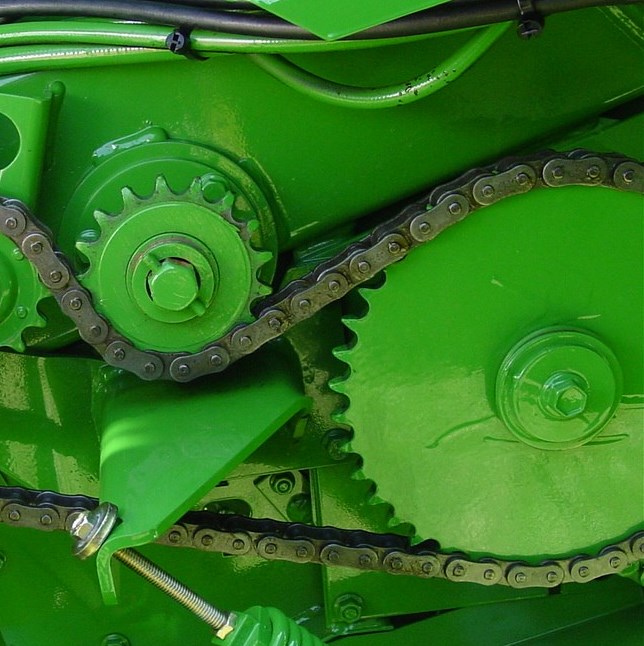
Chain Sprocket

(Source: Penn State Ag Safety and Health)

Use the following format to cite this article:

Mechanical hazards: Pinch points. (2025). Ag Safety and Health Community of Practice. Retrieved from https://ag-safety.extension.org/mechanical-hazards-pinch-points/.

A pinch point is an area where two or more rotating parts move together with at least one part moving in a circle. These rotating parts may move at high rates of speed, making it difficult for an individual to pull free once caught. Injuries can occur when a person touches a belt or chain, tries to clear debris from drive wheels, or falls into or brushes against a belt or pinch point, or when loose clothing becomes entangled, drawing fingers, hands, and feet into a pinch point.

Examples of pinch points on farms and ranches include the following:

  • Chain drives
  • Feed rollers
  • Gears
  • Sprockets
  • Belt drives
  • Pulley drives
  • Conveyors

Potential Injuries

The types of injuries that can be sustained when working around pinch points include the following:

  • Amputations
  • Lacerations
  • Contusions
  • Crushing of tissues or bones
  • Broken bones

Safety Precautions

Listed below are ways that you can reduce your risk of a pinch point incident:

  • Identify machines that might have pinch points.
  • Make sure all shields are securely in place to cover pinch point areas. Replace heavily worn or broken shields.
  • Watch your footing and move slowly around pinch point areas.
  • Wear clothing that fits well because close-fitting clothing is less likely to be pulled into moving parts.
  • Remove any jewelry, tie or secure long hair under a hat, and remove drawstrings on hoods or jackets when working around pinch point areas.
  • Turn off the machine and wait for any rotating parts to come to a complete stop before beginning any type of maintenance.
  • If a shield is removed to complete maintenance, make sure the shield is securely in place prior to operating the equipment.
  • Place and maintain warning labels near pinch point hazards.

Resources

Click here to view a video about pinch point hazards from the Pennsylvania State University’s Agricultural Safety and Health Program.

Use the following format to cite this article:

Mechanical hazards: Pinch points. (2025). Ag Safety and Health Community of Practice. Retrieved from https://ag-safety.extension.org/mechanical-hazards-pinch-points/.

Sources

Agricultural equipment and machine hazards. (2016). The Ohio State University. Retrieved from http://agsafety.osu.edu/programs/cfaes-osha/ag-equipment-machine-hazards.

American Society of Agricultural and Biological Engineers (ASABE), 2008. ANSI/ASAE S493.1. Guarding for agricultural equipment. St. Joseph, MI. Retrieved from http://elibrary.asabe.org.

National Safe Tractor and Machinery Operation Program Student Manual. Penn State Extension.

Safety note #22: Pinch point hazards. (2004) University of California Agriculture and Natural Resources Environmental Health and Safety. Retrieved from http://safety.ucanr.org/files/1413.pdf.

Reviewed and Summarized by:
Linda M. Fetzer, Pennsylvania State University – lmf8@psu.edu
Ron C. Jester, University of Delaware (Has since retired)
Gail Lapierre, University of Vermont (Has since retired)
Dennis J. Murphy, Pennsylvania State University (Has since retired)
Aaron M. Yoder, University of Nebraska Medical Center – aaron.yoder@unmc.edu

Mechanical Hazards: Shear or Cutting Points


Guarded Auger
Guarded Auger. Photo Source: Penn State Ag Safety & Health

Use the following format to cite this article:

Mechanical hazards: Shear or cutting points. (2025). Ag Safety and Health Community of Practice. Retrieved from https://ag-safety.extension.org/mechanical-hazards-shear-or-cutting-points/.

A shear point hazard exists when the edges of two machine parts move across each other or move closely enough together to cut another object or move a relatively soft material. In a typical shear point hazard, one part moves while the other part is either stationary or moving. Cutting points occur when a single object moves forcefully or rapidly enough to cut another object.

Examples of shear or cutting points include the following:

  • Hedge trimmers
  • Windrow cutter bars
  • Grain augers
  • Sickle bar mowers
  • Forage harvester cutter heads
  • Rotary mower blades

Potential Injuries

Potential injuries from shear or cutting point hazards include amputation, lacerations, contusions, crushing of tissue, and broken bones. Due to the speed of mechanical parts, injury is inevitable when a body part comes in contact with a shear or cutting point. Projectile injuries can occur if an object is thrown from a cutting-type machine such as a rotary mower.

Shear and Cutting Point Safety Precautions

Follow the precautions below to reduce the risk of a shear point incident:

  • Identify those types of machines that may have shear or cutting points.
  • Make sure all covers and protective shields are in place on machinery and equipment. Replace heavily worn or broken shields.
  • Wear clothing that fits well because close-fitting clothing is less likely to be pulled into moving parts.
  • Remove any jewelry, tie or secure long hair under a hat, and remove drawstrings on hoods or jackets when working around shear point hazards.
  • Turn off machines and wait for any rotating parts to come to a complete stop before beginning any type of maintenance.
  • If a shield is removed to complete maintenance, make sure the shield is securely in place again prior to operating the equipment.
  • Replace damaged manufacturer-installed warning labels and place warning labels on unlabeled areas.
  • Never reach across a shear or cutting point hazard.

Resources:

Click here to view a video about shear point hazards from Pennsylvania State University’s Agricultural Safety and Health Program.

Click here to use the Farm/Agriculture/Rural Management—Hazard Analysis Tool (FARM-HAT) to determine the protection level of your auger.

Use the following format to cite this article:

Mechanical hazards: Shear or cutting points. (2025). Ag Safety and Health Community of Practice. Retrieved from https://ag-safety.extension.org/mechanical-hazards-shear-or-cutting-points/.

Sources:

Agricultural equipment and machine hazards. (2016) The Ohio State University. Retrieved from http://agsafety.osu.edu/programs/cfaes-osha/ag-equipment-machine-hazards.

American Society of Agricultural and Biological Engineers (ASABE). (2008) ANSI/ASAE S493.1. Guarding for agricultural equipment. St. Joseph, MI. Retrieved from http://elibrary.asabe.org.

Farm/Agriculture/Rural Management—Hazard Analysis Tool (FARM-HAT). (2010) Pennsylvania State University. Department of Agricultural and Biological Engineering. Agricultural Safety and Health. Retrieved from https://extension.psu.edu/farm-agriculture-rural-management-hazard-analy….

Reviewed and Summarized by:
Linda M. Fetzer, Pennsylvania State University – lmf8@psu.edu
Ron C. Jester, University of Delaware (Has since retired)
Gail Lapierre, University of Vermont (Has since retired)
Dennis J. Murphy, Pennsylvania State University (Has since retired)

Aaron M. Yoder, University of Nebraska Medical Center – aaron.yoder@unmc.edu

Mechanical Hazards: Wrap Points


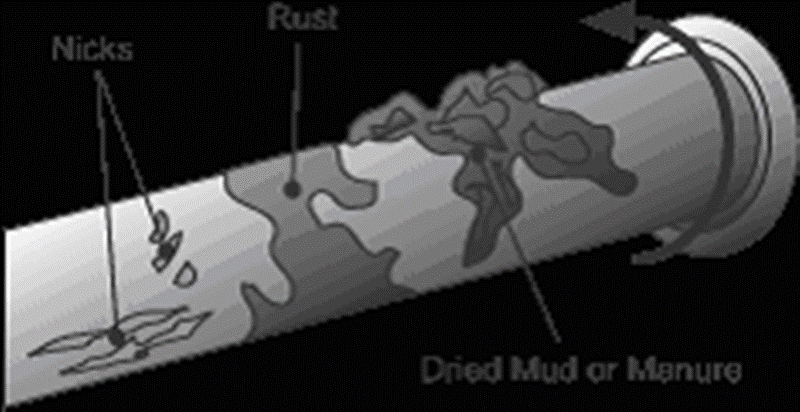
Wrap Point Hazard. Source: University of Minnesota

(Wrap Point. Source: University of Minnesota)

Use the following format to cite this article:

Mechanical hazards: Wrap point. (2025). Ag Safety and Health Community of Practice. Retrieved from https://ag-safety.extension.org/mechanical-hazards-wrap-points/.

Any type of exposed rotating machine component can pose a wrap point or entanglement point hazard. Almost all field and stationary machines on a farm or ranch have one or more rotating parts, many of which present wrap point hazards. Examples of wrap points include power take-off (PTO) and secondary shafts on any machine, post-hole diggers, augers, and tines or blades on manure spreaders.

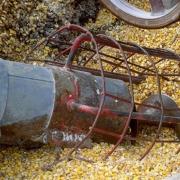
One of the most common wrap point hazards is the PTO unit, which rotates at a speed of at least 540 rpm, or nine rotations per second, when operating at full recommended speed. If a piece of a person’s clothing or a shoelace is caught in a PTO rotating at this speed, the person could be entangled around the shaft in less than a second. A smooth shaft can be an entanglement hazard because force from the rotating shaft may be adequate to hold clothes against the shaft. Because clothing is more likely to catch on an uneven surface, the hazard increases when the shaft is not round; when there is dirt or debris such as mud, rust, or manure on the shaft (as shown in the image above); or when the shaft is nicked. Clothing can also become snagged on universal joints, keys, and fastening devices.

Potential Injuries

Wrap point incidents can result in the following injuries:

  • Severe contusions
  • Cuts
  • Burns
  • Dislocations
  • Broken bones
  • Amputations
  • Scalping

Incidents can result in fatalities if injuries are sufficiently severe.

Safety Precautions

You can reduce the risk of a wrap point incident by taking the actions that follow:

  • Identify machines that may have wrap points.
  • Be aware that fatigue, carelessness, and haste contribute to entanglement incidents.
  • Make sure the PTO shaft, driveline, and universal joint are properly shielded and maintained.
  • Wear clothing that fits well because close-fitting clothing is less likely to be pulled into moving parts.
  • Remove all jewelry and tie back long hair or secure it under a hat when working near a machine that has a wrap point.
  • Before dismounting a tractor, always take the PTO out of gear and shut down the engine.
  • Turn off the machine and wait for rotating parts to come to a complete stop before starting any type of maintenance.
  • If a shield has been removed to complete maintenance, make sure the shield is securely in place prior to operating the equipment.
  • Replace damaged manufacturer-installed warning labels and place warning labels on unlabeled areas.
  • For better visibility of wrap point hazards, consider painting those areas a bright color to provide an additional alert to the hazard.
  • Choose equipment that is properly guarded rather than using older equipment that may lack guards such as PTO master shields.

Resources

Click here to view a video about wrap point hazards from Pennsylvania State University’s Agricultural Safety and Health Program.

Use the following format to cite this article:

Mechanical hazards: Wrap point. (2025). Ag Safety and Health Community of Practice. Retrieved from https://ag-safety.extension.org/mechanical-hazards-wrap-points/.

Sources

Agricultural equipment and machine hazards. (2016). The Ohio State University. Retrieved from http://agsafety.osu.edu/programs/cfaes-osha/ag-equipment-machine-hazards.

American Society of Agricultural and Biological Engineers, 2009. ANSI/ASABE S604. Safety for power take-off (PTO), implement input drivelive (IID), implement input connection (IIC), and auxiliary power take-off (aux. PTO) for agricultural field equipment. St. Joseph, MI. Retrieved from https://elibrary.asabe.org/.

American Society of Agricultural and Biological Engineers, 2011. ANSI/ASABE AD500-1:2004. Agricultural tractors – Rear-mounted power take-off types 1,2 and 3 – Part 1: General specifications, safety requirements, dimensions for master shield and clearance zone. St. Joseph, MI. Retrieved from https://elibrary.asabe.org/.

FARM-HAT. (2010). Pennsylvania State University, Department of Agricultural and Biological Engineering, Agricultural Safety and Health. Retrieved from https://extension.psu.edu/farm-agriculture-rural-management-hazard-analy….

National Safety Tractor and Machinery Operation Program student manual. Third edition. Penn State Extension.

Safety note #11: Power take-off safety. (2004) University of California, Agriculture and Natural Resources, Environmental Health and Safety. Retrieved from http://safety.ucanr.org/files/1364.pdf.

Reviewed and Summarized by:
Linda M. Fetzer, Pennsylvania State University – lmf8@psu.edu
Kerri Ebert, Kansas State University  kebert@k-state.edu
Jason Lamm, Donegal Insurance Group  jgl134@gmail.com
Dennis J. Murphy, Pennsylvania State University (Has since retired)
Aaron M. Yoder, University of Nebraska Medical Center – aaron.yoder@unmc.edu

Mechanical Hazards: Crush Points


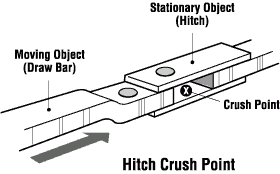
Crush Hazard. Source: Virginia Tech.

(Photo Source: Virginia Cooperative Extension)

Use the following format to cite this article:

Mechanical hazards: Crush points. (2025). Ag Safety and Health Community of Practice. Retrieved from https://ag-safety.extension.org/mechanical-hazards-crush-points/.

A crush-point hazard exists when two objects move toward each other or when a moving object approaches a stationary object. The most common crush point agricultural producers encounter is the attachment of an implement to a tractor’s drawbar (shown above). The space between the tractor’s drawbar and the implement’s hitch decreases as the tractor moves toward the implement.

Additional crush-point hazards exist when equipment is raised or lowered with a three-point hitch and when components are moved by hydraulic cylinders. The area between a tractor loader bucket and a concrete wall is also a potential crush point. A crush-point incident can occur when a piece of equipment is not properly secured with blocks, allowing the equipment to roll.

Potential Injuries

Examples of nonfatal injuries associated with crush-point incidents include crushed tissue, cuts, and broken bones, typically in the extremities. Depending on the part of the body that is crushed, fatalities can also result from crush-point incidents.

Safety Precautions

The list below outlines ways of reducing the risk of a crush-point incident.

  • Identify machines that may have crush points.
  • Do not allow anyone to stand or place any body parts in the space between two objects that form a crush point.
  • When hitching an implement, wait until the tractor has completely stopped before approaching the hitch point.
  • If possible, hitch a tractor and implement by backing the tractor into position without having a person positioned between the tractor and the implement.
  • As a backup in case of a mechanical failure such as a jack slipping or an overhead support breaking, use blocks to secure any equipment before working under it.
  • Block the wheels of an implement to prevent the implement from rolling.

Resources

Click here to view a video about crush-point hazards from Pennsylvania State University’s Agricultural Safety and Health Program. (Note: When a piece of equipment comes into contact with a person or body part, that is also considered a crush point).

Click here to order a copy of the booklet Safe Implement Hitching: A Guide for Safe Connection of Agricultural Tractors to Implements from the Association of Equipment Manufacturers (AEM).

Use the following format to cite this article:

Mechanical hazards: Crush points. (2025). Ag Safety and Health Community of Practice. Retrieved from https://ag-safety.extension.org/mechanical-hazards-crush-points/.

Sources

Agricultural equipment and machine hazards. (2016) The Ohio State University. Retrieved by http://agsafety.osu.edu/programs/cfaes-osha/ag-equipment-machine-hazards.

National Safe Tractor and Machinery Operation Program Student Manual – Third Edition. Penn State Extension.

Reviewed and Summarized by:
S. Dee Jepsen, Ohio State University  jepsen.4@osu.edu
Linda M. Fetzer, Pennsylvania State University – lmf8@psu.edu
Jimmy Maass, Virginia Farm Bureau (Has since retired)
Dennis J. Murphy, Pennsylvania State University (Has since retired)
Charles V. Schwab, Iowa State University  cvschwab@iastate.edu
Aaron M. Yoder, University of Nebraska Medical Center – aaron.yoder@unmc.edu

Power Take-Off Safety


Using PTO Implements

(Source: Pennsylvania State Ag Safety and Health)

Use the following format to cite this article:

Power take-off safety. (2025) Ag Safety and Health Community of Practice. Retrieved from https://ag-safety.extension.org/power-take-off-safety/.

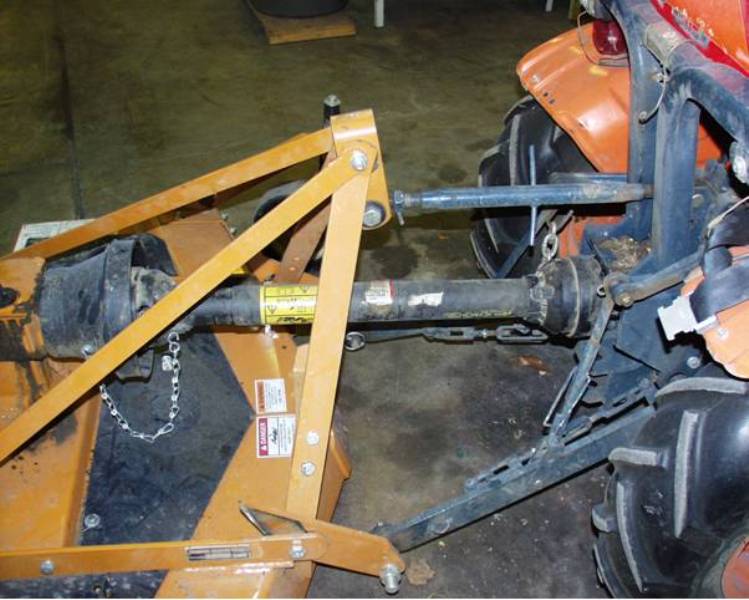
A power take-off (PTO) shaft transfers mechanical power from a tractor to an implement (shown above). Some PTO-driven equipment is operated from the tractor seat, but many types of farm equipment, such as elevators, grain augers, silage blowers, and so on, are operated in a stationary position, enabling an operator to leave the tractor and move in the vicinity of the implement.

A PTO shaft rotates at a speed of either 540 rpm (9 rotations per second) or 1,000 rpm (16.6 rotations per second). At these speeds, a person’s limb can be pulled into and wrapped around a PTO stub or driveline shaft several times before the person, even a person with extremely fast reflexes, can react. The fast rotation speed, operator error, and lack of proper guarding make PTOs a persistent hazard on farms and ranches.

Injuries that can be sustained from PTO incidents include severe contusion, cuts, spinal and neck injuries, dislocations, broken bones, and scalping. Some incidents can result in fatalities.

PTO Hazards

The main PTO hazards involve the PTO stub and driveline.

PTO Stub

The tractor’s stub output shaft, referred to as a PTO stub, transfers power from the tractor through a drive shaft to the implement or PTO-driven machine. The PTO stub rotates at rate of 540 or 1,000 rpm, and most incidents involving the PTO stub are entanglement incidents.

Entanglement incidents can occur when the operator is unaware that the PTO clutch is engaged, when the operator does not understand the dangers of the spinning PTO stub, or when the operator deliberately works close to an unguarded stub shaft that is in motion. Clothing, such as a pant leg, shoelace, thread from a jacket, and so on, is easily caught by the spinning shaft. Once caught, both the clothing and the wearer can quickly wrap around the stub shaft.

PTO Driveline

A PTO driveline or implement input driveline (IID) is the part of the implement drive shaft that connects to the tractor. When unguarded, the entire shaft of the driveline is considered a wrap-point hazard. Some drivelines have guards covering the straight part of the shaft, leaving the universal joints, PTO coupling, and the rear connector, or implement input connection (IIC), as wrap-point hazards. Clothing can catch on and wrap around the driveline. When clothing is caught on the driveline, the tension on the clothing from the driveline pulls the person toward and around the shaft. When a person caught in the driveline instinctively tries to pull away from wrap hazard, he or she actually creates a tighter wrap.

Driveline Separation

In addition to injuries caused by entanglement incidents with the PTO stub and driveline, injuries can occur when shafts separate while the tractor’s PTO is engaged. The IID shaft telescopes, meaning that one part of the shaft slides into another. The sliding sleeve on the shaft allows for easy hitching of PTO-powered machines to tractors and allows telescopic movement when the machine turns or is operated on uneven ground. If the IID is attached to a tractor by only the PTO stub, the tractor can pull apart the IID shaft. If this occurs and the PTO is engaged, the tractor shaft can swing wildly, striking anyone in range and possibly breaking a locking pin, allowing the shaft to become a projectile. This type of incident is not common, but it is more likely to occur with three-point hitched equipment that is not properly mounted or aligned.

Safety Recommendations

The first line of defense to prevent a PTO entanglement incident is to make sure that your tractor and machinery have the proper shields.

PTO Master Shield

PTO Guard

(PTO Master Shield. Source: Pennsylvania State University. Agricultural Safety and Health)

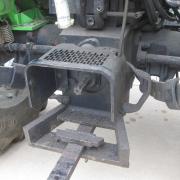
The above photo shows a master shield that covers and extends over the tractor PTO stub on three sides. The master shield provides protection from the PTO stub and front joint of the drive shaft when the PTO stub is connected to the tractor.

Before operating PTO-powered machinery, always make sure that the master shield for the tractor PTO stub and front joint is secured properly. Replace a damaged master shield immediately.

Driveline Shield

PT Shielding Photo

(PTO Master Shield and Driveline Shield. Source: University of Georgia. College of Agricultural and Environmental Sciences)

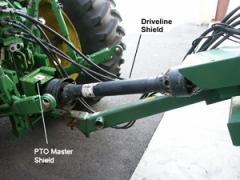
A PTO driveline shield (shown above) is constructed of plastic or metal and completely encloses the shaft. The bell-shaped ends cover the universal joints on the shaft. The shield is mounted on bearings so that it rotates with the shaft but stops spinning when a person touches it.

Check the driveline shield by spinning it to make sure that it rotates freely. If the shield is damaged or does not rotate independently, it does not provide protection and must be replaced.

Additional Safety Precautions

In addition to having the proper shields in place, taking the following precautions can reduce your risk of a PTO incident:

  • Never step over a rotating shaft.
  • Do not wear loose fitting clothing around PTO-driven equipment.
  • Tie back long hair or secure it under a hat before operating equipment.
  • Ensure that safety decals, such as “Rotating Driveline: Contact can cause death,” are readily visible. Replace decals that are obscured or incomplete.
  • Always disengage the PTO and shut off the tractor before dismounting the tractor.
  • Never work on machinery or equipment while the engine is running or is energized.
  • Keep universal joints in phase.
  • Do not switch drivelines between machines.
  • To reduce driveline stress and separation, position the tractor’s drawbar appropriately for each piece of machinery.
  • Reduce PTO shaft abuse by avoiding tight turns, reducing excessive telescoping, engaging power to the shaft gradually, and avoiding over-tightening the slip clutch on PTO-driven machines.
  • Examine the driveline for protruding pins or bolts and debris such as mud that has dried onto the driveline shield. Clothing snags easily on such protrusions, resulting in entanglement incidents.
  • As part of the preoperation inspection, if the driveline shield is equipped with a tether, ensure that the tether is attached and in good condition and that the driveline shield rotates freely on its bearings.

Resources

Click HERE to view a video by the Alabama Cooperative Extension that explains how to install and maintain a shaft cover on a tractor PTO.

Use the following format to cite this article:

Power take-off safety. (2025) Ag Safety and Health Community of Practice. Retrieved from https://ag-safety.extension.org/power-take-off-safety/.

Sources

American Society of Agricultural and Biological Engineers. (2009) ANSI/ASABE S604. Safety for Power Take-off (PTO), Implement Input Driveline (IID), Implement Input Connection (IIC), and Auxiliary Power Take-off (aux. PTO) for Agricultural Field Equipment. St. Joseph, MI. Retrieved from http://elibrary.asabe.org.

FARM-HAT. (n.d.) Pennsylvania State University Department of Agricultural and Biological Engineering, Agricultural Safety and Health. Retrieved from https://extension.psu.edu/farm-agriculture-rural-management-hazard-analysis-tool-farm-hat.

National Safe Tractor and Machinery Operation Program – Student Manual – Third Edition. Penn State Extension.

Murphy, D. (2023) Power take-off (PTO) safety. Penn State College of Agricultural Sciences Cooperative Extension. Retrieved from https://extension.psu.edu/power-take-off-pto-safety.

Reviewed and Summarized by:
Linda M. Fetzer, Pennsylvania State University – lmf8@psu.edu
Glen Blahey, Canadian Agricultural Safety Association  Has since retired
Jesse Laprade, Auburn University  laprajc@auburn.edu
Dennis J. Murphy, Pennsylvania State University (Has since retired)
Aaron M. Yoder, University of Nebraska Medical Center – aaron.yoder@unmc.edu

Mechanical Hazards: Pull-in Points


Pull-in Hazard. Source: The Ohio State University

(Pull-in Point Hazard. Source: The Ohio State University)

Use the following format to cite this article:

Mechanical hazards: Pull-in points. (2025). Ag Safety and Health Community of Practice. Retrieved from https://ag-safety.extension.org/mechanical-hazards-pull-in-points/.

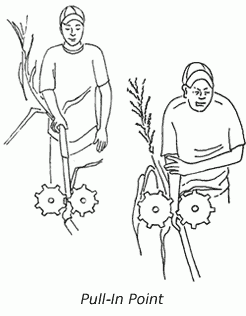
A pull-in point hazard is typically associated with crops being fed into a harvesting machine. Harvesting machinery has rotating parts, such as feed rolls, that form pull-in points where they come together. Most pull-in incidents occur when a person attempts to remove material from a machine while the machine is still running—for example, pulling a corn stalk out of corn picker rolls—or to feed material manually into a machine such as a feed roller.

The following pieces of equipment have pull-in points:

  • Combine headers
  • Feed or bale chambers
  • Pull-behind corn pickers
  • Windrow pickups
  • Forage chopper headers
  • Grinders

Potential Injuries

Potential injuries that can result from getting caught in a pull-in point include amputation of extremities, crushed tissue, and broken bones. Severe incidents can be fatal.

Safety Precautions

The list below outlines ways of reducing the risk of pull-in point incidents.

  • Identify machines that may have pull-in points.
  • Always shut off the engine and power source, including any power take-off (PTO), before attempting to clear any plugged areas or completing any repairs.
  • Remember that machines are always faster than people.

Resources

View video about pull-in point hazards from Pennsylvania State University’s Agricultural Safety and Health Program.

Sources

Agricultural equipment and machine hazards. (2016) The Ohio State University. Retrieved from http://agsafety.osu.edu/programs/cfaes-osha/ag-equipment-machine-hazards.

Grisso, R., Stone, B., & Hetzel, G. (2009) Machinery safety on the farm. Virginia Cooperative Extension. Retrieved from http://pubs.ext.vt.edu/442/442-092/442-092_pdf.pdf.

National Safe Tractor and Machinery Operation Program – Third Edition. Penn State Extension.

Reviewed and Summarized by:
Linda M. Fetzer, Pennsylvania State University – lmf8@psu.edu
LaMar J. Grafft, East Carolina University (Has since retired)
William C. Harshman, Pennsylvania State University (Has since retired)
Dennis J. Murphy, Pennsylvania State University 9Has since retired)
Aaron M. Yoder, University of Nebraska Medical Center – aaron.yoder@unmc.edu

Mechanical Hazards: Stored Energy


Hydraulic Line Check

(Source: Pennsylvania State University. Agricultural Safety and Health)

Use the following format to cite this article:

Mechanical hazards: Stored energy. (2025). Ag Safety and Health Community of Practice. Retrieved from https://ag-safety.extension.org/mechanical-hazards-stored-energy/.

Stored-energy hazards occur when confined energy is unintentionally released. A spring is a classic example of the release of stored energy: A compressed spring expands with great force when released, and a stretched spring quickly contracts. Springs, hydraulics, and pneumatics move and control machines and implements that are part of agricultural equipment. The sudden pressurization or depressurization of such stored-energy systems can result in incidents that cause serious injury or death.

There are many examples of stored energy in agricultural equipment:

  • Compressed air
  • Pressure washers
  • Springs
  • Winches
  • Hydraulic, pneumatic, and electrical systems

Compressed air and fluids are used for tire inflation and power washing and in hydraulic cylinders. Springs are used as shock absorbers and as a means of keeping belts tight. Winches and hydraulic systems are used to lift or change the position of implements.

Potential Injuries

Injuries that can result from the unintentional release of stored energy include burns, contusions, abrasions, lacerations, injection injuries (as from hydraulic fluid), and crushing injuries. Amputation of a limb may be required if an injection injury is not immediately treated at a hospital.

Safety Precautions

The list below outlines ways of reducing the risk of a stored-energy incident.

  • Identify machines that may have stored energy.
  • Before operating a machine that uses hydraulic or water pressure, examine the hoses and fittings for wear.
    • Pass a piece of cardboard (shown above) or flat board along the hydraulic hoses to check for leaks. Do not use a hand to check for leaks. Gloves do not provide protection from hydraulic leaks under pressure.
  • Turn off the engine and relieve hydraulic pressure before disconnecting hydraulic hoses or completing repairs.
  • Lower hydraulic components to the ground before shutting off the engine and dismounting the equipment.
  • Never walk under an implement or component supported by hydraulics or winches.
  • Regularly check winch cables for wear.
  • Before executing maintenance on hydraulic implements, put in place supports, jacks, stands, or blocks to prevent unintentional movement of the implements.
  • Know what direction a spring will move when released and how it might affect other machine parts, and stay out of the spring’s path.
  • Wait for free-wheeling parts such as flywheels, cutter heads, hammer mills, rotary mower blades, and fans to come to a complete stop before touching them.
    • This may take up to two and a half minutes.
  • Never try to stop a free-wheeling winch handle by catching it.
  • Never point a compressed-air nozzle or pressure-washer nozzle toward a person, including yourself.
    • Make sure others are well out of range of flying debris when using such equipment.

Resources

Click HERE to view a video about stored energy from Pennsylvania State University’s Agricultural Safety and Health Program.

Click HERE to purchase a video from the Fluid Power Safety Institute on managing hydraulic oil injection injuries.

Use the following format to cite this article:

Mechanical hazards: Stored energy. (2025). Ag Safety and Health Community of Practice. Retrieved from https://ag-safety.extension.org/mechanical-hazards-stored-energy/.

Sources

Agricultural equipment and machinery hazards. (2016) The Ohio State University. Retrieved from http://agsafety.osu.edu/programs/cfaes-osha/ag-equipment-machine-hazards.

Cyr, D. & Johnson, S. (2002) Dangers of agricultural machinery. Maine Farm Safety Program. Retrieved from http://umaine.edu/publications/files/2015/04/2316.pdf.

National Safe Tractor and Machinery Operation Program – Student Manual – Third Edition. Penn State Extension.

Safety note #16: Hydraulic safety. (2004) University of California, Agricultural and National Resources, Environmental Health and Safety. Retrieved from http://safety.ucanr.org/files/1406.pdf.

Reviewed and Summarized by:
Linda M. Fetzer, Pennsylvania State University – lmf8@psu.edu
Willard Downs, University of Missouri (Has since retired)
Dennis J. Murphy, Pennsylvania State University (Has since retired)
Robert A. Schultheis, University of Missouri  SchultheisR@missouri.edu
Aaron M. Yoder, University of Nebraska Medical Center – aaron.yoder@unmc.edu