
(Photo Source: Virginia Cooperative Extension)
Use the following format to cite this article:
Mechanical hazards: Crush points. (2025). Ag Safety and Health Community of Practice. Retrieved from https://ag-safety.extension.org/mechanical-hazards-crush-points/.
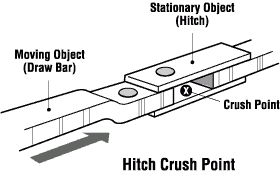
A crush-point hazard exists when two objects move toward each other or when a moving object approaches a stationary object. The most common crush point agricultural producers encounter is the attachment of an implement to a tractor’s drawbar (shown above). The space between the tractor’s drawbar and the implement’s hitch decreases as the tractor moves toward the implement.
Additional crush-point hazards exist when equipment is raised or lowered with a three-point hitch and when components are moved by hydraulic cylinders. The area between a tractor loader bucket and a concrete wall is also a potential crush point. A crush-point incident can occur when a piece of equipment is not properly secured with blocks, allowing the equipment to roll.
Potential Injuries
Examples of nonfatal injuries associated with crush-point incidents include crushed tissue, cuts, and broken bones, typically in the extremities. Depending on the part of the body that is crushed, fatalities can also result from crush-point incidents.
Safety Precautions
The list below outlines ways of reducing the risk of a crush-point incident.
- Identify machines that may have crush points.
- Do not allow anyone to stand or place any body parts in the space between two objects that form a crush point.
- When hitching an implement, wait until the tractor has completely stopped before approaching the hitch point.
- If possible, hitch a tractor and implement by backing the tractor into position without having a person positioned between the tractor and the implement.
- As a backup in case of a mechanical failure such as a jack slipping or an overhead support breaking, use blocks to secure any equipment before working under it.
- Block the wheels of an implement to prevent the implement from rolling.
Resources
Click here to view a video about crush-point hazards from Pennsylvania State University’s Agricultural Safety and Health Program. (Note: When a piece of equipment comes into contact with a person or body part, that is also considered a crush point).
Click here to order a copy of the booklet Safe Implement Hitching: A Guide for Safe Connection of Agricultural Tractors to Implements from the Association of Equipment Manufacturers (AEM).
Use the following format to cite this article:
Mechanical hazards: Crush points. (2025). Ag Safety and Health Community of Practice. Retrieved from https://ag-safety.extension.org/mechanical-hazards-crush-points/.
Sources
Agricultural equipment and machine hazards. (2016) The Ohio State University. Retrieved by http://agsafety.osu.edu/programs/cfaes-osha/ag-equipment-machine-hazards.
National Safe Tractor and Machinery Operation Program Student Manual – Third Edition. Penn State Extension.