Utility Vehicle Safety


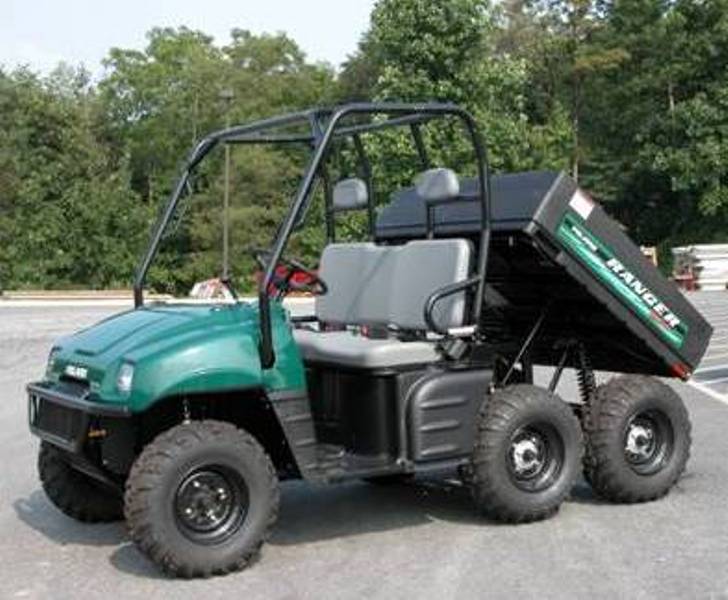
Polaris Ranger UV

(Polaris Ranger. Source: Pennsylvania State University. Agricultural Safety and Health)

Use the following format to cite this article:

Utility vehicle safety. (2024). Ag Safety and Health Community of Practice. Retrieved from https://ag-safety.extension.org/utility-vehicle-safety/.

The use of utility terrain vehicles (UTVs) on farms and ranches continues to grow because of the versatility, power, and capability these machines offer when completing agricultural tasks. UTVs have four or six wheels powered by diesel, gasoline, electricity, or a hydrogen fuel cell. One advantage of a UTV is the cargo bed, which can haul various items such as feed, supplies, and newborn calves, making it ideal for small jobs. Cargo beds can be equipped with hydraulic bed lifts to reduce the physical strain of unloading materials. UTVs have additional features that, compared to all-terrain vehicles (ATVs),  increase their value in agricultural settings. For example, UTVs feature easy access to the seat, power steering, an acceleration pedal and brake pedal, seating space to safely transport a passenger, an enclosed cab, a heater, and various seating options (bucket or bench seats).

Remember that utility vehicles are power tools, not toys. Read the owner’s manual and follow the manufacturer’s recommended maintenance, usage, and operation guidelines. Ensure that all UTVs have appropriate safety decals. Follow the additional safety recommendations outlined below to reduce the risk of injury.

Passengers

A passenger should ride only in their seat, and that person should be tall enough to reach the handholds correctly in the passenger seat. Operators and passengers should keep their legs and arms inside the UTV when the vehicle is in motion. Passengers and drivers must always fasten their seat belts (when seat belts are available).

Overturn Incidents

To reduce the risk of an overturn incident, decrease speed when traveling on rough terrain—this lowers the risk of the operator or passenger being thrown from the vehicle. The UTV’s center of gravity is raised when hauling loads in the cargo bed. It is important to drive slowly and smoothly when taking turns to reduce the risk of overturning, especially when carrying a heavy load. When driving on an incline, remember that driving up or down the slope is safer than driving across. If turning on a sloped area, drive entirely up or down the hill before turning.

Another way to avoid an overturn incident is to avoid driving near ditches or embankments. The recommendation is that if a ditch is six feet deep, stay at least six feet from its edge.

Operator Responsibility

  • Always be aware of your surroundings and look behind you, especially for young children, before backing up. 
  • As with any machinery, never use drugs or alcohol before or while operating a UTV.
  • Secure loads in the cargo bed to prevent them from shifting during transportation.
  • Even if your utility vehicle is equipped with a roll bar, remember that the seat belts for you and your passenger must be securely buckled to protect in the event of a rollover.
  • Avoid driving near ditches or embankments – for example, if there is a ditch that is 6’ deep then you should stay 6’ away from the edge.
  • UTVs were designed to haul loads in the cargo bed but it is important to check the operator manual to know the recommended weight limit and to properly secure the load in the cargo bed.

Resources

  • Click HERE to be directed to the Youth Agricultural Work Guidelines that provides questions designed to help you determine whether your youth is ready to operate an UTV and have a positive agricultural work experience.

Use the following format to cite this article:

Utility vehicle safety. (2024). Ag Safety and Health Community of Practice. Retrieved from https://ag-safety.extension.org/utility-vehicle-safety/.

Sources

National Safe Tractor and Machinery Operation Program Student Manual Section 6.2 (2020) The Pennsylvania State University Agricultural and Biological Engineering Department.

Jepsen, S.D. & Henwood, K. (2010) Safe operation of utility type vehicles (UTVs). The Ohio State University Extension. Retrieved from http://ohioline.osu.edu/aex-fact/pdf/0597_1.pdf.

Reviewed and Summarized by:
Kerri Ebert, Kansas State University  kebert@k-state.edu
Linda M. Fetzer, Pennsylvania State University – lmf8@psu.edu
Jimmy Maass, Virginia Farm Bureau (Has since retired)
Dennis J. Murphy, Pennsylvania State University – (Has since retired)
Aaron M. Yoder, University of Nebraska Medical Center – aaron.yoder@unmc.edu

Preventing Tractor Overturn Incidents


Use the following format to cite this article:

Preventing tractor overturn incidents. (2024). Ag Safety and Health eXtension Community of Practice. Retrieved from https://ag-safety.extension.org/preventing-tractor-overturn-incidents/.

Tractor overturn incidents can result in major injuries (crushing injuries, broken bones, and so on) and even death. The first step in preventing an injury or death is to make sure that your tractor is equipped with a rollover protective structure (ROPS) that, if used in conjunction with a seat belt, keeps the operator in a protective zone in the event of a rollover incident. Most rollover incidents can be prevented by understanding the causes of overturns and following safe operating practices.

There are two types of tractor rollover incidents: side and rear overturns.

Side Overturns

Ag Rescue Demo at APD

(Source: Pennsylvania State University, Ag Safety & Health)

Side overturns are the most common type of tractor overturn incident. In a side overturn incident, a tractor rolls onto its side. Preventing this type of incident is possible if the operator understands specific hazards and knows the appropriate time to apply safety precautions.

The two major factors at play in side overturn incidents are center of gravity and centrifugal force. The center of gravity (sometimes referred to as CG) is the location where all of the tractor’s weight is equally balanced. This point can change due to attachments and weight from a load, as when material is carried in a front-end loader. The center of gravity must remain within the tractor’s stability baseline for the tractor to remain in an upright position. A tractor’s stability baseline is found by drawing lines between the tractor’s four tires where the tires touch the ground. Centrifugal force is the force that pushes out on a tractor as the tractor makes a turn. (Click here to link to an eXtension article on tractor stability.)

Ways of preventing a side rollover incident include, but are not limited to, the following:

  • Braking properly
  • Avoiding shear line hazards
  • Keeping buckets low during transport
  • Driving at appropriate speeds
  • Using caution on sloped areas

Braking Properly

Before driving at transport speeds, lock the brake pedals together to provide even brake pressure. If you do not lock the brake pedals together and use only one brake pedal, the tractor could swerve and potentially roll over. When traveling with a load down a steep hill, shift your tractor to a lower speed before you begin your descent so that the engine does the majority of the braking.

Avoiding Shear Line Hazards

The soil on a bank or the shoulder of a ditch can be weak due to patterns of freezing and thawing or prolonged wet weather. Weak soil can collapse under pressure. The point at which soil is vulnerable to collapse is called a shear line. A shear line hazard exists when large vehicles such as combines operate close to a bank, putting pressure on soil inside the shear line and putting the vehicle at risk should the soil collapse. To avoid this overturn risk, drive your tractor as far back from the edge of the ditch or bank as the ditch is deep (see below). Maintain more distance for tractors pulling wide tillage or planting equipment (should a collapse occur under such equipment, the equipment could pull over the tractor or combine). When operating your tractor near a ditch or bank, always keep your tractor behind the shear line.

Shear Line

(Image Source:Safety Management for Landscapers, Grounds-care Business, and Golf Courses, John Deere Publishing, 2001. Illustration reproduced by permission. All rights reserved)

Keeping Buckets Low during Transport

Always keep the bucket of a front-end loader as low as possible during transport. A loader’s center of gravity in relation to the stability baseline changes drastically when the bucket is too high, especially on sloped areas, placing the loader at risk for an overturn.

Driving at Appropriate Speeds

Drive at a speed that is appropriate for a the given road or environmental conditions because increased speed reduces the stability of the tractor. By going at a slower speed, you will have greater time to spot obstructions in the path of the tractor and maintain better traction with the road (see below). It is also important to decrease your speed when you are pulling rear-mounted equipment to maintain stability.
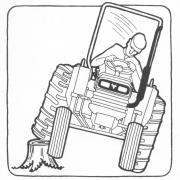
Tipping Hazard

(Source: Pennsylvania State University, Ag Safety & Health)

Using Caution on Sloped Areas

Do not drive your tractor across steep slopes because the risk of a tractor overturn increases as the angle of the slope increases. If a task must be completed on a steep slope, use a tractor that has a wide front end and rear tires that are spaced as far apart as possible. When possible, back the tractor up a steep slope rather than driving uphill. When going down a steep hill, never travel at a speed faster than the speed you used going up. Centrifugal force is a significant factor when turning on slopes. When you need to make a turn while traveling on a steep slope, reduce your speed and turn downhill rather than uphill.

Pay close attention to any bumps or depressions when driving on a sloped surface, and keep your speed low when traveling on a sloped area. If you are using a side-mounted attachment on your tractor, make sure that the piece of equipment is on the uphill side of the tractor.

Rear Overturns
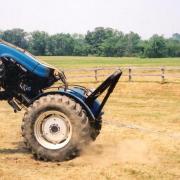
Rear Tractor Overturn Demo

Rear Tractor Overturn Demo

(Source: Pennsylvania State University, Ag Safety & Health)

Rear overturns occur when the front end of a tractor flips backward, landing the top of the tractor on the ground. The incidents are dangerous because they happen very quickly. A tractor typically reaches the “point of no return” in less than a second, and the entire rear rollover incident can occur in one and a half seconds. This gives the operator little to no time to react to the situation.

A critical factor involved in rear rollover incidents is rear-axle torque. When the clutch is engaged on a two-wheel tractor, a twisting force (torque) to the rear axle results. This force is transferred to the tractor tires. Normally the rear axle and tires rotate and the tractor moves. However, if the rear axle is unable to move in response to the torque, the tractor chassis rotates about the axle. This energy transfer between the engine and the rear axle can result in the front-end of the tractor lifting off the ground until the tractor’s center of gravity passes the rear stability line. Once the center of gravity passes this point, the tractor continues rearward until it comes in contact with the ground.

Tractors with four-wheel drive are less susceptible to rear overturns because torque is applied to both the front and rear axles, and the center of gravity is moved forward because more weight is carried on the front axle. However, there is little difference between a two- and four-wheel drive tractor once the front end of the tractor begins to lift.

Operators face an increased risk of rear overturn in the following situations:

  • Freeing a stuck tractor
  • Raising rear-mounted equipment
  • Using a front-end loader
  • Hitching above the drawbar
  • Operating on an incline

Note that this list is not comprehensive.

Freeing a Stuck Tractor

On occasion, tractors become stuck in mud or in frozen ground. When this happens, first try to free the tractor by backing out. To aid in this process, you may need to dig dirt or mud from behind the rear wheels and unhitch equipment. If you are unable to back out, enlist the help of another tractor to pull the stuck tractor out from behind. If this is not possible, use the other tractor to pull the stuck tractor out from the front. When trying to free a stuck tractor, never place boards or blocks in front of the rear wheels because the wheels could suddenly catch and stop turning, possibly causing the tractor to rear up and tip backwards. 

Raising Rear-Mounted Equipment

Add front-end weight to counteract the weight from raising heavy rear-mounted equipment.

Using a Front-End Loader

If you are installing a front-end loader, always use a loader designed specifically for your tractor. When moving materials in a front-end loader, the tractor becomes heavy toward the front, placing it at risk for an overturn incident. Due to the added weight from the loader and materials, you may need to add rear counterweights to the tractor or liquid ballast in the rear tires. Rear overturn incidents can be reduced by keeping the loader bucket as low as possible when transporting materials, especially when operating on a sloped area.

Hitching above the Drawbar

The risk of a rear overturn incident increases when you hitch above the tractor drawbar, which is specifically designed and located to pull loads. When you hitch to a location other than the drawbar (see below), you raise the angle at which the load pulls down and back, reducing the safety design of the tractor and increasing your risk of an overturn.
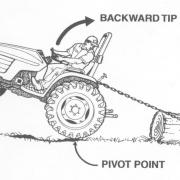
Drawbar hitching

(Image Source:Safety Management for Landscapers, Grounds-care Business, and Golf Courses, John Deere Publishing, 2001. Illustration reproduced by permission. All rights reserved)

Operating on an Incline

When pulling something up a hill with a tractor, both the slope and the pull on the drawbar make the tractor less stable. During operation, it is important to smoothly operate the clutch and throttle. Avoid stopping or shifting gears while on the hill because extra power is needed to restart the tractor and the tractor could drift backwards.

Resources

Click HERE to be directed to the Canadian Agricultural Safety Association website, where you can review actual tractor incidents and identify causes and safe operating procedures.

For more information about safe tractor operation and hazards, click on a title below to be directed to the article:

Power Take-Off Safety

Preventing Tractor Runover Incidents

Rollover Protective Structures

Use the following format to cite this article:

Preventing tractor overturn incidents. (2024). Ag Safety and Health eXtension Community of Practice. Retrieved from https://ag-safety.extension.org/preventing-tractor-overturn-incidents/.

Sources

Agricultural tractor safety. (2011) Safe Workplace Promotion Services Ontario. No longer available online.

Baker, D. (2021) Safe tractor operation. University of Missouri Extension. Retrieved from https://extension.missouri.edu/publications/g1960.

Murphy, D. (2022) Tractor stability and instability. Penn State Extension.  Retrieved from https://extension.psu.edu/tractor-stability-and-instability.

Smith, D. (2010) Safe tractor operation: Rollover prevention. Texas A & M System AgriLIFE Extension. Retrieved from http://agsafety.tamu.edu/files/2011/06/SAFE-TRACTOR-OPERATION-ROLLOVER1.pdf.

Tractors: Roll-over prevention. (2002) Canadian Centre for Occupational Health and Safety. Retrieved from http://www.ccohs.ca/oshanswers/safety_haz/tractors/rollover.html.

Reviewed and Summarized by:
Linda M. Fetzer, Pennsylvania State University – lmf8@psu.edu
Tom Karsky, University of Idaho (Has since retired)
Dennis J. Murphy, Pennsylvania State University (Has since retired)
Robert A. Schultheis, University of Missouri schultheisr@missouri.edu
Aaron M. Yoder, University of Nebraska Medical Center – aaron.yoder@unmc.edu

Safety and Health Management Planning for General Farmers and Ranchers

Safety and Health Management Manual Cover

(Source: Penn State College of Agricultural Sciences)

Agriculture continues to be one of the most dangerous occupations in the United States. Penn State’s Agricultural Safety and Health Program has developed a best practices manual titled Safety and Health Management Planning for General Farmers and Ranchers. This manual assists farm owners and managers in developing health and safety management plans for their agricultural operations. The following five units of the manual outline the reasons a safety and health plan is needed along with hands-on activities and steps to take to develop a successful safety and health plan:

  1. Establishing Safety Policies and Procedures
  2. Identifying and Assessing Hazards and Risks
  3. Preventing and Controlling Hazards and Risks
  4. Educating and Training Employees
  5. Evaluating Training Programs and Resources

A complete copy of Safety and Health Management Planning for General Farmers and Ranchers is available through Penn State College of Agricultural Sciences Publications.

Click HERE for learning objectives and evaluation questions for each unit.

Reviewed and Summarized by:
Linda M. Fetzer, Penn State University – lmf8@psu.edu
Dennis J. Murphy, Penn State University (Has since retired)
Sam Steel, Penn State University (Has since retired)

Heat-Related Illnesses and Agricultural Producers

Sunset photo

Sunset Photo

(Source: Penn State Ag Safety and Health)

Use the following format to cite this article:

Heat-related illnesses and agricultural producers. (2024) Ag Safety and Health eXtension Community of Practice. Retrieved from https://ag-safety.extension.org/heat-related-illnesses-and-agricultural-producers/.

Farmers and ranchers perform job responsibilities in all types of weather conditions including excessive heat and humidity. It is important for agricultural producers to understand risks associated with working in high heat work environments, potential heat-related illnesses, precautionary steps, and appropriate medical responses.

Understanding the Body’s Response to Heat

Our body’s primary defense against heat is through sweating. Sweating allows moisture to collect on the skin and evaporate. Sweating happens when the surrounding environment becomes greater than skin temperature. When this occurs, an internal body system called the sympathetic nervous system releases a chemical called acetylcholine which turns on sweat glands in the skin in an area called the dermis. The sweat glands release moisture and move it to the outer surface of the skin for cooling. However, in hot, humid weather, the moisture does not always evaporate and can collect on the skin causing the body to warm up and the heart to pump more blood to the skin. When this happens, the body starts to sweat excessively and depletes the body of water and electrolytes, which can lead to a heat-related illness.

The range for normal body temperature is between 96° to 100°F. Hard exercise, strenuous work, or fever will usually put the body in a range between 101° to 105°F. At 105° to 107°F, cooling treatment or fever therapy may be needed, and at even higher body temperatures, heat exhaustion and heat stroke usually occur. Heat exhaustion and heat stroke indicate a serious impairment to the body’s cooling system and is a definite signal for medical assistance. Heat stroke or body temperatures beyond 110°F may result in death.

Risk Factors for Heat-Related Illnesses

Everyone is at risk for heat-related illness if they do not follow standard precautionary measures. The following factor(s) can increase the chance for developing one of the five main heat-related illnesses:

  • Being elderly or an infant.
  • Having certain medical conditions such as circulatory problems, heart conditions, or pregnancy.
  • Being physically unfit or overweight.
  • Consuming alcohol and/or drugs (including prescription medication; for example. the medication atropine interferes with the ability to sweat).
  • Having lower heat tolerance levels or not becoming acclimated to working in high heat and humidity.
  • High temperatures and humidity levels in the environment (as well as sun radiation or heat-conducting surfaces like black asphalt).
  • Not having adequate fluid intake levels needed to hydrate the body.
  • Limited air flow or breeze to aid in the cooling process.

Breakdown of Common Heat-Related Illnesses

There are five heat-related illnesses: heat rash, syncope, cramps, exhaustion, and stroke. Heat exhaustion and heat stroke are typically the most severe and require immediate medical attention. Figure 1 outlines each illness, typical symptoms, and treatment.

Fig. 1: Breakdown of Heat-Related Illnesses
Heat-Related Illnesses Cause Symptoms Treatment
Heat rash Excessive sweating during humid weather Red, blotchy skin rash; clusters of pimples or small blisters Keep the affected area dry, and treat with cornstarch or powder.  Work in a cooler, less humid work environment.
Heat syncope Prolonged standing or rising suddenly from a sitting or lying position Light-headedness, dizziness, or fainting Move person to a cool place to lie down, elevate the feet, and give liquids to drink.
Heat cramps Loss of body salts and fluids from sweating during strenuous activity Pain in stomach, arms, and/or legs Stop activity, drink clear or sports beverage. Massage affected muscles.
Heat exhaustion Excessive loss of body salts and water from sweating Cool, pale skin, dizziness, headache, cramps, nausea, sweating, weakness, confusion, high body temperature, and unconsciousness Have the person drink plenty of cool fluids, remove excess clothing, and apply cool compresses. Call for medical attention.
Heat stroke System that regulates body temperature fails and the body temperature rises to critical levels High temperature, hot dry skin, slurred speech, confusion, loss of consciousness, and seizures Immediately call for medical assistance. Move the person to a cool place, and slightly elevate the head and shoulders. Remove outer clothing, and cool the body with water, wet towels, or sheets.

Recommendations to Avoid Heat-Related Problems

  • Do not wait until you are thirsty – drink approximately 8 oz. (1 cup) of water every 15 to 30 minutes.
  • Take a 15-minute break in a shaded area every two hours.
  • Monitor the weather, and schedule strenuous work activities accordingly to reduce exposure to high heat situations.
  • Wear light-colored, lightweight, and loose-fitting clothing.
  • Avoid the use of alcohol, drugs, caffeine, and large amounts of sugar when exposed to heat because they can increase your rate of dehydration.
  • Check your prescriptions and over-the-counter medications to determine if there are any side effects when you are exposed to heat.
  • Appropriately wear specialized protective gear such as cooling vests to reduce your risk of a heat illness;  if used inappropriately, heat illness can actually increase.
  • Learn about prevention of heat illness and teach your workers about health and safety instructions related to working in hot weather and appropriate responses to heat-related illnesses.
  • Gradually build up a tolerance to working in the heat. If a person has a severely low tolerance to heat, that person may need to perform tasks that limit exposure to the heat.
  • Certain types of personal protective equipment (PPE) can increase the risk of heat stress, such as protective suiting. Schedule jobs that require PPE during cooler times of the day.
  • Recognize the conditions that can affect body heat such as fever, physically strenuous work, and even time of day (for example, body temperature is higher in late afternoons).
  • Talk to your physician if you have a chronic health condition or disability (e.g., spinal cord injuries, multiple sclerosis) before working in the heat.

View the U.S. Agricultural Safety and Health Centers video below to learn about the risk of heat-related illnesses for outdoor workers.

Sources

Heat stress. (2022). Centers for Disease Control and Prevention. Retrieved from https://www.cdc.gov/niosh/topics/heatstress/heatrelillness.html.

Jepsen, S.D., McGuire, K. & Poland, D. (2011) Secondary injury prevention: Heat stress. The Ohio State University. Retrieved from http://ohioline.osu.edu/factsheet/AEX-981.4-10.

Murphy, D. & Fetzer, L. (2024.). Heat illness and agriculture. Pennsylvania State University College of Agricultural Science Cooperative Extension. Retrieved from https://extension.psu.edu/heat-illness-and-agriculture.

Porth, C.M. (2010). Pathophysiology, 8th ed. Lippincott-Williams.

Protecting workers from the effects of heat. (2023). Occupational Safety and Health Administration Fact Sheet. Retrieved from https://www.osha.gov/sites/default/files/publications/OSHA3743.pdf.

Reviewed and Summarized by:
Linda M. Fetzer, Pennsylvania State University – lmf8@psu.edu      
Karen Funkenbusch – University of Missouri – funkenbuschk@missouri.edu
Dennis J. Murphy, Pennsylvania State University (Has since retired)
Carla Wilhite, University of New Mexico – CWilhite@salud.unm.edu
Aaron M. Yoder, University of Nebraska Medical Center – aaron.yoder@unmc.edu

Hearing Loss and Protection for Agricultural Producers

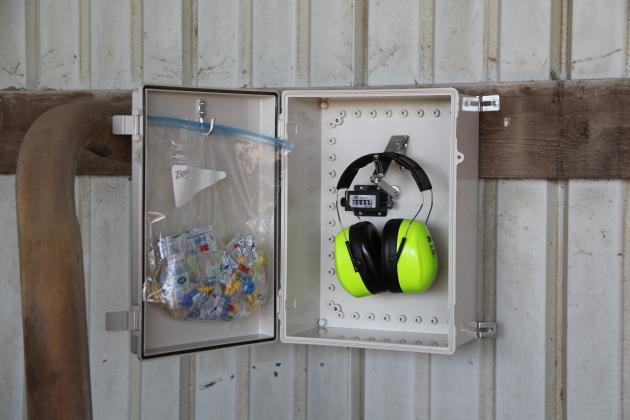
Hearing protection

Photos provided by the Central States Center for Agricultural Safety and Health (CS-CASH)

Use the following format to cite this article:

Hearing loss and protection for agricultural producers. (2024) Ag Safety and Health eXtension Community of Practice. Retrieved from https://ag-safety.extension.org/hearing-loss-and-protection-for-agricultural-producers/.

Farmers and ranchers are exposed to loud noises in their work environment on a daily basis. Gradual hearing loss is common during the aging process, but noise-induced hearing loss can occur at any age. Noise-induced hearing loss is a result of exposure to high-intensity noise without proper hearing protection. Noise-induced hearing loss is preventable by reducing the level of noise at its source and correctly wearing appropriate personal protective equipment (PPE).

Mechanics of Hearing and Hearing Loss

Sound goes into the ear canal and strikes the eardrum causing it to vibrate. The vibrations create waves that travel to the middle ear forming waves in the cochlea. The cochlea contains small hairlike cells called cilia that wave when they come in contact with the vibration. Once the vibration enters the cochlea, these waves send a signal to the brain which interprets them as sounds. Hearing loss occurs when the cilia become flattened and eventually destroyed  from overstimulation of sound that is too loud or that lasts too long. Once  these hair cells (cilia) are destroyed they can never be replaced causing permanent hearing loss.

Noise Levels and Duration

Sound loudness or intensity is measured in decibels (dB). In the United States, the Occupational Safety and Health Administration (OSHA) establishes guidelines regarding exposure to high levels of noise and recommends that hearing protection be used when you are exposed to a minimum sound level of 90 dB for eight hours. However, some individuals have developed noise-induced hearing loss at lower levels. The following table shows the noise exposure levels, maximum time durations set by OSHA, and examples of home and farm equipment with those sound levels.

 
Duration per day (hours) Sound level dB Examples of noise source at sound levels
8 90 Tractor, combine, or ATV
6 92 Tractor or combine
4 95 Tractor, grain grinding, combine, or air compressor
3 97 Tractor, combine, or shop vacuum
2 100 Tractor, pigs squealing, or table saw
1 1/2 102 Tractor, combine, or riding lawnmower
1 105 Tractor, combine, chickens, or irrigation pump
1/2 110 Tractor or leaf blower
1/4 115 Chainsaw

Four Ways to Prevent Noise-Induced Hearing Loss

  1. Noise reduction – An easy way to reduce noise levels on your farm or ranch is to pay close attention to equipment maintenance such as regular lubrication and replacement of parts. Operating  larger equipment at a lower speed can also reduce noise levels. The installation of vibration isolation pads under the legs of noisy equipment can reduce the noise from equipment vibration on a cement floor. Newer models of certain handheld equipment are equipped with flexible mountings to reduce noise from vibration.
  2. Noise isolation – When purchasing equipment, consider buying a tractor or skid-steer that is equipped with sound-reducing cabs and tightly fitting cab doors and windows. These changes can reduce the amount of noise that you hear inside the cab when operating the equipment.
  3. Administrative Controls – As an employer, you can control your workers’ exposure to noise by rotating their workstations to limit their exposure time to jobs with high noise levels. Set up a rotation that allows a worker to operate a noisy machine for a specific period of time and then rotate that person to a less noisy task. If a person already has a hearing problem, he or she should not work in high noise areas.
  4. Personal Protective Equipment (PPE) – Use and require your employees to use personal protective equipment such as earplugs and ear muffs to reduce noise exposure.

Personal Protective Equipment (PPE)

Hearing personal protective equipment (PPE) is measured according to its noise reduction rating (NRR) which is a single number that indicates the reduction in decibels when the PPE is properly used. Hearing PPE should have a noise reduction rating of at least 25 decibels. Remember that the rating is achieved only when the equipment is properly fitted and worn for the recommended period of time. Earplugs and ear muffs are the most widely used personal protective equipment to reduce noise levels.

Earplugs

Earplugs are either disposable or reusable.

Disposable earplugs:

  • Are designed to fit into the ear opening.
  • Should never be shared with others to reduce the risk of ear infections.
  • Should be disposed of once removed from the ear.

Reusable earplugs:

  • Are either pre-molded, moldable, or custom fit.
  • Have a limited usage period.
  • Should be disposed of when they are cracked, dirty, no longer pliable, or permanently deformed.

Ear Muffs

Ear muffs are designed to cover the ear and ear canal, so it is important to use muffs that are comfortable and fit properly. They can be used for years, and certain models can be used in combination with other safety equipment such as goggles, a hard hat, or respiratory protection. Remember that hearing protection needs to be used whenever you are exposed to loud noises.

When to Visit the Audiologist

An audiologist can perform a specialized hearing test called an audiogram to detect and diagnose hearing loss. You cannot fix hearing loss once it has started, but you can prevent the damage to your hearing from getting worse. The following are a few signs that you may have a problem with your hearing:

  • You are turning up the volume on the TV or radio.
  • You have difficulty understanding consonants in words and high notes of music.
  • You have difficulty hearing a person’s voice when they are standing only a few feet away.
  • Sound may be muffled after noise is stopped.
  • You have ringing in your ears.
  

Use the following format to cite this article:

Hearing loss and protection for agricultural producers. (2024) Ag Safety and Health eXtension Community of Practice. Retrieved from https://ag-safety.extension.org/hearing-loss-and-protection-for-agricultural-producers/.

Sources

Murphy, D., Harshman, W. & Fetzer, L. (2022) Noise induced hearing loss in agriculture. Penn State College of Agricultural Sciences Cooperative Extension.  Retrieved from https://extension.psu.edu/noise-induced-hearing-loss-in-agriculture.

Hearing loss prevention (n.d.) AgriSafety. Retrieved from  https://www.agrisafe.org/healthcare/hearing-loss-prevention/.

Hearing loss among farmers and agricultural workers (n.d.) Great Plains Center for Agricultural Health. Retrieved from https://gpcah.public-health.uiowa.edu/fact-sheets/hearing-loss/.
Reviewers, Contributors and Summarized by:
Linda M. Fetzer, Pennsylvania State University – lmf8@psu.edu
Karen Funkenbusch, University of Missouri – funkenbuschk@missouri.edu
Dennis J. Murphy, Pennsylvania State University (Has since retired)

Charles V. Schwab, Iowa State University (Has since retired)

Aaron M. Yoder, University of Nebraska Medical Center – aaron.yoder@unmc.edu

Tire Safety: Expiration Dates

Did you know your tires have an expiration date?

The fact is that all tires have an expiration date. Surprisingly, many consumers and sellers of tires do not know about tire expiration dates. An uninformed consumer thinks he or she purchased brand new tires when in reality those tires may have been sitting on the shelf for years. Even though the tires were never used on a vehicle, they are still several years old. Every tire has a birth date—the day it was manufactured—and an expiration date that is six years from that manufacture date. Most automobile manufacturers warn drivers to replace vehicle tires after six years. To wait any longer than that is a gamble with tire integrity and is risky for drivers.

So what can you, as a driver, do to protect yourself?  When buying new tires, ask for the newest tires available, and look at the tire’s manufacture date. The manufacture date is part of a Department of Transportation (DOT – Tire Identification Number ) The DOT ( TIN ) is embossed on the side of the tire near the rim (see Figure 1).  The letters DOT are followed by a ( TIN ) that is eight to thirteen letters and or numbers that identify where the tire was manufactured, tire size and the manufacturer’s code, along with the week and year the tire was manufactured.

Figure 1. The DOT- TIN number is shown in the red box. With the date in the yellow box

The TIN found on this tire ( Figure 1 ) The numbers in the yellow box are the most important piece of information about a tire. These last four numbers of the DOT- TIN represent the manufacture date of the tire. The last two numbers refer to the year the tire was produced, and the first two identify the week number within that year. The tire shown in ( Figure 1) was manufactured on the 49th week of the year 2021..

The majority of people who take the gamble of keeping outdated tires do so to save money. Driving on outdated tires is risky not only for the driver of the car having those tires but also for other drivers. Take the initiative and change vehicle tires every six years, or sooner, to diffuse a potentially dangerous situation.

Authored by:
Matt Deskevich, Student Assistant at Penn State University
Revised February 2024.
Reviewed by:
Bill Harshman, Penn State University (Has since retired)
Dennis Murphy, Penn State University (Has since retired)
Aaron M. Yoder, University of Nebraska aaron.yoder@unmc.edu
Kerri Ebert, Kansas State University kebert@ksu.edu

Agricultural Safety and Health Mobile Apps

Chicken ROPS Run iOS & Android App

Mobile apps—computer applications that run on mobile devices such as smartphones—can be educational, fun, and easy-to-use, and they can help users improve agricultural safety and health. The number of safety and health mobile apps continues to grow in number and functionality. Below is a list of mobile apps that may be useful for agricultural safety and health:

Ag Safety & Health Apps

  • CSP Quiz Game Plus: These quiz games are designed to help industrial hygienists prepare for the Board of Certified Safety Professionals comprehensive exam.
  • Decibel 10th: This app turns an Apple mobile device into a sound meter.
  • FallClear LITE – Fall Arrest Clearance Calculators: This app provides fall arrest clearance calculators, tools for supervisors and workers trained in fall protection.
  • FarmPAD Mobile App: This app can be used to store farm records, equipment service logs, and spray records or to take notes and pictures.
  • Heat Safety Tool: The US Department of Labor, Occupational Safety and Health Administration (OSHA) released this app to enable workers and supervisors to calculate the heat index for their worksites and learn about protective measures to reduce the risk of heat-related illnesses.
  • Ladder Safety: The National Institute for Occupational Safety and Health released this app to improve extension-ladder safety.
  • Safety Data Sheets: Database for material safety data sheets; enter a product name to find related MSD. (Android devices)
  • NIOSH Pocket Guide to Chemical Hazards for iPad: This app provides a source for general information about industrial hygiene.
  • Sound Meter: Easy to use sound meter that measures SPL (sound pressure level) in decibels (db). (Android devices)

Ag Education Apps

Chemical and Biological Material Safety Publications


Topic Title Organizaton Pub Date
Anhydrous Ammonia Safety: Play it Safe with Anhydrous Ammonia Iowa State University Extension and Outreach 2008
Farm Family Exposure to Pesticides: A Discussion with Farm Families Purdue Extension 2007
Handling Pesticides Safely University of Maine Extension 2020
Laundering Pesticide-Contaminated Clothing University of Missouri Extension 2010
Laundering Pesticide-Contaminated Clothing University of Maine Extension 2002
Learn about Pesticides and Clothes Iowa State University Extension and Outreach 2002
Master Gardeners’ Safety Precautions for Handling, Applying, and Storing Biochar Iowa State University 2012
Pesticides and Their Toxicity University of Maine Extension 2020
Personal Protective Equipment for Pesticide Handlers University of Maine Extension 2020
Personal Protective Equipment for Working with Pesticides University of Missouri Extension 2001
Pesticide Poisoning Symptoms and First Aid University of Missouri Extension 2002
Using Pesticides Safely Around the Home University of Missouri 2007

Funding Resources for Assistive Technology for Farmers and Ranchers

Aftermarket Steps on Tractor

Aftermarket Steps on Tractor

Aftermarket steps can improve tractor accessibility.

(Source: AgrAbility for Pennsylvanians)

 
Use the following format to cite this article:
Funding resources for assistive technology for farmers and ranchers. (2022) Ag Safety and Health in eXtension Community of Practice. Retrieved from https://ag-safety.extension.org/funding-resources-for-assistive-technology-for-farmers-and-ranchers/

Individuals can have difficulty locating and qualifying for funding for assistive technology. Farmers and ranchers with disabilities who seek assistive technology can face even more challenges because of their work statuses, their farm or ranch assets, and the types of accommodations they may need to continue working in production agriculture. Assistive technology for those involved in production agriculture may need to be more durable than that needed for people working in other occupations because of the type of work and the work environment. The table that follows provides information about possible funding resources for farmers and ranchers with disabilities.

Funding Source Information Example Notes
National AgrAbility Project

State and Regional AgrAbility Projects (SRAPs)

Currently, more than 20 SRAPs provide direct services to farmers and ranchers with disabilities for their agricultural operations. SRAPs can provide farmers and ranchers who have disabilities with information about modifications for their farm operations. SRAP staff members are knowledgeable about funding options for assistive technology and other opportunities within their state. If you are from a state that does not have a SRAP, contact the National AgrAbility Project.
State vocational rehabilitation agencies The Rehabilitation Services Administration (RSA) of the US Department of Education provides funding to states to help individuals with disabilities obtain or retain employment. These federal dollars go to the vocational rehabilitation agency within a state. Services, including assistive technology, restoration services, and training, are provided to eligible individuals through an approved Individualized Plan for Employment (IPE). Examples of available assistive technology include gators/utility vehicles, steps onto a tractor, air suspension seats for a tractor, automatic hitching systems, and hand controls on skid steers. The Workforce Innovation and Opportunity Act puts an emphasis on transition for students with disabilities. There is also emphasis on serving individuals with the most significant disabilities.
US Department of Veteran Affairs Both the Veterans Health Administration and the Veterans Benefits Administration provide assistive technology to veterans. All veterans who have an honorable discharge are eligible for some services, whether the disability is service-related or not. The Veterans Health Administration can provide durable medical equipment, glasses, hearing aids, Home Improvements and Structural Alterations (HISA) benefits, and grants for veterans who are blind. The Veterans Benefits Administration can provide vehicles (including tractors), home adaptations, and Specially Adapted Housing grants. A veteran must be registered at his or her local Veterans Affairs Medical Center.
Home and Community-Based Services Waivers programs The US Department of Health and Human Services provides funding to states to provide services to people with disabilities in the community. These services are designed to help individuals be independent, safe, and included in the community. Available devices and services include adaptations to vehicles, home modifications, hearing aids, and other assistive technology (environmental controls, specialized computers and software). There are both financial and functional eligibility requirements. Waivers can be used to support farm family members who want to participate in farming activities, live at home, or participate in community activities.
Health insurance

Medicare

Health insurance plans, including private plans, Medicaid, and Medicare, provide Durable Medical Equipment (DME) for enrollees. DME includes canes, walkers, wheelchairs, hospital beds, oxygen equipment, and in-home dialysis equipment. Assistive technology provided by health insurance coverage is directly related to medical need.
Statewide Assistive Technology Programs Every state and territory has a program that incorporate activities for learning about and acquiring assistive technology. Most state assistive technology programs provide information about devices, assistive technology demonstrations, equipment lending libraries, and reuse programs. Some have state financing programs. Some of the states include alternative financing programs (AFPs) as part of their assistive technology programs; some provide other allowable programs, including Telecommunication Device Distribution Programs (TDDP).
Alternative Financing Programs (AFPs) The majority of the states and territories (at least 42) have financing programs for the purchase of assistive technology. As part of the Assistive Technology Act, AFPs provide flexible financing terms for people with disabilities and their families. Depending on the state’s program, borrowers have the ability to purchase adapted vehicles, home modifications, hearing aids, computers, tablets, and adapted farm equipment. AFPs provide direct loans, guaranteed loans, interest buy-downs, and traditional loans. Some of the programs are embedded within the state assistive technology project; others are non-profit organizations.
US Department of Agriculture (USDA) loan programs The USDA has several loan programs, along with partial grants, available to eligible low-income homeowners to repair, improve, or modernize their homes. A variety of financing packages (including grants) are available to individuals, non-profits, consumer cooperatives, and others. These programs can make it possible for a farmer to make repairs on his or her home. Basic repairs (such as a roof repair) are not considered assistive technology and so do not qualify for an AFP loan.
Housing Financing Agencies Every state and territory has a housing financing agency. These agencies incorporate a number of programs that expand affordable, accessible housing options for people with disabilities. States have the ability to develop their own programs. Many states provide flexible financing for home ownership, renovation and repair programs, and programs that finance assistive technology (home modifications) for individuals who have disabilities or long-term health conditions. Many states have created Housing Trust Funds to support the expansion of housing programs. Several states have expanded the funding for these programs with fees or taxes from gas production.
Local service clubs and disability service clubs Many disability and service clubs provide grants to individuals for assistive technology or labor to build, renovate, or repair structures. Local affiliates of United Cerebral Palsy provide grants for computers and specialized software; many organizations serving individuals with multiple sclerosis provide small grants for home modifications; many agencies serving individuals with ALS have equipment loan closets; Lions Club affiliates provide eyeglasses; and Eagle Scouts work on projects on farms. Also, many Grange and local Farm Bureau organizations and 4H programs have service learning projects and small grant programs. Because there are a variety of small grant programs, it is important to research local resources.
Options Counseling
The Administration for Community Living within the US Department of Health and Human Services is responsible for creating Options Counseling programs in every state. Options Counselors help individuals—primarily those who are aging or who have a disability or health-related diagnosis—develop a plan for addressing long-term services and supports and assist these individuals in connecting with public and private funding, as needed.
Options Counselors are being trained and will have the resources necessary (including state-specific information via the Internet) to help individuals learn about the resources they need to work, live in their own homes, and participate in their communities. Options Counselors are being trained on resources that will help farmers and ranchers with disabilities continue in production agriculture.
Cooperative Extension System The Cooperative Extension System, which is funded in part by the National Institute of Food and Agriculture within the USDA, has a network of local and regional offices that are staffed by experts who provide information and training opportunities for farmers, ranchers, and farm families interested in topics related to agriculture. Through a network of statewide and local resources, Extension teams can provide farmers, gardeners, and producers with the information needed to start or expand a business, health and safety protocols, and connections to peers, vendors, and information related to emerging businesses. The Extension system is well-coordinated, and Extension staff members have the ability to research and share information that is useful to individual farmers and ranchers.
State Departments of Agriculture Every state and territory has a Department of Agriculture that is staffed by knowledgeable employees and funded with a combination of state and federal dollars. There are a variety of grant-funded programs available for farmers or others who are interested in production agriculture. Programs cover such topics as business planning, transitions to organic farming, improving soil health, and protecting water quality. Funding for specific programs may not be available every year.  It is important to research what is available within a specific state.
National Center for Appropriate Technology (NCAT) A non-profit, NCAT hosts a number of programs that promote sustainable agriculture. NCAT’s agriculture work has recently focused on small-scale intensive farming, urban farming, and local foods, and assistance to small farmers, beginning and new farmers, and veterans wishing to become farmers. NCAT has staff members who can assist farmers and ranchers with information and training opportunities. NCAT developed and manages the National Sustainable Agriculture Information Service (ATTRA).
Kiva Zip Kiva provides 0% interest micro-loans to eligible small business owners in the United States. Kiva Zip provides small business loans of up to $10,000 to farmers when other sources of funds are not available. A few programs are working with foundations to expand lending opportunities to entrepreneurs. A program in Philadelphia is designed to expand urban gardening/production. Borrowers must have a viable business or business plan. The loan must be expected to have a positive social impact (for example, food production for urban areas).
Weatherization Assistance Programs The US Department of Energy (DOE) provides grants to states for weatherization assistance. Under DOE guidelines, states give preference to people over 60, families with one or more members having a disability, and low-income families with children. The local weatherization assistance agency carries out an energy audit, makes recommendations, and depending on the needs, provides the necessary work (energy-related). Weatherization assistance programs do not assist with new roofs or siding or similar structural improvements.  However, agencies may be able to coordinate with organizations that provide such assistance.
National Resources Conservation Service (NRCS) NRCS is part of the USDA. NRCS financial and technical projects relate to air quality, groundwater conservation, erosion reduction, and so on. NRCS offers programs to eligible landowners and agricultural producers to help sustainably manage natural resources.
Sustainable Agriculture Research & Education (SARE) SARE has grant opportunities available to producers, students, community organizations, and others. Grants for producers may help with the costs of hosting field days, samples and analyses, labor, and so on (see grant guidelines). Grants are very competitive. For producers, grant funds cannot be used to buy equipment or to start or expand an operation. Funds can be used for outreach, materials for the funded project, and so on.

Use the following format to cite this article:

Funding resources for assistive technology for farmers and ranchers. (2022) Ag Safety and Health in eXtension Community of Practice. Retrieved from https://ag-safety.extension.org/funding-resources-for-assistive-technology-for-farmers-and-ranchers/

Authored by:

Susan Tachau, PA Assistive Technology Foundation – stachau@patf.us
Reviewed by:
Kirk Ballin, Virginia AgrAbility
Linda M. Fetzer, Pennsylvania State University – lmf8@psu.edu
Karen Funkenbusch, University of Missouri – FunkenbuschK@missouri.edu
Dennis J. Murphy, Pennsylvania State University (has since retired)
Aaron M. Yoder, University of Nebraska – aaron.yoder@unmc.edu

Cold-Related Conditions and Agriculture


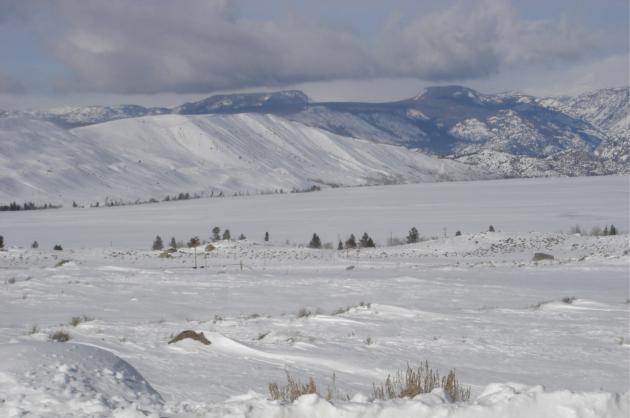
Winter Ranch Scene
Winter Scene

(Source: Wyoming AgrAbility)

Use the following format to cite this article:

Cold-related conditions and agriculture. (2021). Agricultural Safety and Health eXtension Community of Practice. Retrieved from http://ag-safety.extension.org/cold-related-conditions-and-agriculture/.

Farmers and ranchers complete tasks in all types of weather conditions. Extreme weather conditions put agricultural producers at risk for heat-related and cold-related illnesses and injuries. (Click here to view an article about heat-related illnesses) Individuals working in extremely cold or wet weather can experience such occupational health conditions as hypothermia, frostbite, trench foot, and chilblains.

The four environmental factors that cause cold-related illnesses are

  • low temperature,
  • strong and/or cool winds,
  • dampness, and
  • cold water.

The most dangerous factor in winter weather is wind chill, a measure of the rate at which skin exposed to the combined effects of wind and cold loses heat. When wind increases, the body loses heat at a faster rate, which causes body temperature to decrease.

Individuals generate body heat from food and through muscular activity and lose heat through convection, conduction, radiation, and sweating. In general, the processes of generating and losing body heat are balanced, resulting in a constant body temperature. When a person’s body temperature drops below the normal temperature of 98.6°F, he or she may experience blood vessel constriction and decreased peripheral blood flow, putting the person at risk for adverse cold-related conditions.

Cold-Related Conditions

Hypothermia

Hypothermia occurs when a person’s body is unable to produce heat and has used all its stored energy or is losing body heat faster than it can be produced. As a result, a person’s body temperature decreases. When a person’s body temperature drops below 95°F degrees, the heart, nervous system, and other organs can be adversely affected. The most common causes of hypothermia are exposure to cold weather and immersion in cold water.

Early Symptoms

  • Shivering
  • Decreased energy
  • Fatigue
  • Loss of coordination

Symptoms after Prolonged Exposure to Cold

  • Dilated pupils
  • Decreased pulse
  • Shallow breathing
  • Loss of consciousness

First Aid Response

  • Call 911 or emergency medical personnel.
  • Find a warm room or shelter and remove any wet clothing.
  • Drink a warm (nonalcoholic or caffeine-free) beverage if one is available.
  • Stay dry and warm by wrapping up in a blanket.
  • If you are assisting a person with hypothermia, and he or she does not have a pulse, begin cardio-pulmonary resuscitation (CPR). (Click here to be directed to the article “Basic CPR.”)

Frostbite

Frostbite occurs when skin tissue freezes and loses water, leading to the potential for cell damage. Skin can freeze at temperatures of 30°F and below, and wind chill can also cause frostbite. Fingers, toes, cheeks, nose, and ears are the areas of the body most typically affected by frostbite. Frostbitten skin may look white or grayish yellow and may feel cold, hard, and possibly waxy to the touch.

Symptoms

  • Numbness
  • Aching
  • Tingling
  • Stinging

First Aid Response

  • Find a warm room or shelter.
  • Avoid walking if your feet or toes are frostbitten.
  • Soak affected areas in warm (not hot) water.
  • Avoid rubbing the affected area because rubbing could cause tissue damage.
  • Wrap affected area in a soft cloth.
  • Do not use a heating pad, fireplace, or radiator for warming.
  • Do not warm the area if there is a risk of refreezing.

Trench Foot

Trench foot occurs when a person’s feet have prolonged exposure to cold (60°F or less) and wet conditions. This condition is similar to frostbite but is typically less severe.

Symptoms

  • Reddening of the skin
  • Numbness
  • Leg cramps
  • Swelling
  • Tingling pain
  • Blisters or ulcers
  • Bleeding under the skin
  • Gangrene

First Aid Response

  • Remove shoes or boots and wet socks.
  • Dry the feet.
  • Avoid walking to reduce the risk of damage to foot tissue.

Chilblains

Chilblains are painful inflammations in small blood vessels in the skin that result from exposure to cold temperatures. The areas most commonly subject to chilblains include the toes, fingers, ears, and nose.

Symptoms

  • Redness
  • Blistering
  • Itching
  • Inflammation
  • Ulceration (in severe cases)

First Aid Response

  • Avoid scratching the affected skin.
  • Slowly warm the skin.
  • Use corticosteroid creams to relieve itching and swelling.
  • Keep blisters and ulcers clean and covered.

Preventing Cold-Related Conditions

There are several actions you can take to maintain a normal body temperature in cold and/or wet weather.

Clothing

  • Wear a minimum of three layers of clothing: an outer layer that breaks the wind, a middle layer that retains insulation, and an inner layer that allows for ventilation.
  • Have a change of clothes readily available in case your garments become wet.
  • Always protect your head and face because you can lose up to 40% of your body heat through your head.
  • Protect your feet from cold and dampness by wearing layered socks inside comfortable, insulated footwear.
  • Protect your hands with insulated gloves (dexterity can be affected at temperatures below 59ºF).

Environment

  • Use on-site sources of heat, such as air jets and radiant heaters, to provide warmth.
  • Make sure that a heated shelter or vehicle is available for anyone who has experienced prolonged exposure to wind chill temperatures below 20°F.
  • Reduce drafty or windy areas within buildings to shield work areas.
  • If the temperature drops below 30°F, use thermal insulating material on the handles of your equipment.
  • Avoid sitting or kneeling on cold, unprotected surfaces.

Personal Safety

  • If you suffer from a medical condition such as diabetes, atherosclerosis, spinal cord injury, arthritis, and so on, you may need to take special precautions when working in cold environments because you could be especially susceptible to cold-related illness and injury.
  • If you take prescription medication (heart medication, sedatives, and so on), check with your physician to determine whether you need to take any special precautions when working in the cold.
  • Never use alcohol or drugs when working in a cold environment because such substances increase heat loss and can impair judgment.
  • Know the signs and symptoms of cold-induced conditions and how to respond appropriately with first aid.
  • Seek warm shelter if you experience symptoms (heavy shivering, severe fatigue, drowsiness, and so on) of cold-induced illnesses.
  • Avoid tasks that may cause excessive sweating.
  • Maintain energy and hydration by drinking warm caffeine-free, nonalcoholic beverages.
  • Stay in good physical condition.

Farm and Ranch Managers’ Responsibilities

If you are a farm or ranch manager, take the following precautions to keep your workers safe in cold and/or wet weather:

  • Allow workers to complete tasks at a comfortable pace and take extra breaks if needed.
  • In cold environments, be sure that workers always work in teams of two or more.
  • If a job needs to be completed outside, schedule the job for the warmest part of the day.
  • When possible, move outdoor jobs to an enclosed area.
  • Discourage workers from sitting or standing for prolonged periods during cold weather.
  • Allow workers to acclimate themselves to the cold before they begin a task.

Use the following format to cite this article:

Cold-related conditions and agriculture. (2021). Agricultural Safety and Health eXtension Community of Practice. Retrieved from http://ag-safety.extension.org/cold-related-conditions-and-agriculture/.

Sources

Chilblains. (2020) Mayo Clinic. Retrieved from http://www.mayoclinic.org/diseases-conditions/chilblains/home/ovc-20165478.

Cold stress guide. (n.d.) United States Department of Labor. Retrieved from https://www.osha.gov/SLTC/emergencypreparedness/guides/cold.html.

Frostbite: First aid. (2020) Mayo Clinic. Retrieved from http://www.mayoclinic.com/health/first-aid-frostbite/FA00023.

Hypothermia. (2020) Mayo Clinic. Retrieved from https://www.mayoclinic.org/diseases-conditions/hypothermia/symptoms-causes/syc-20352682.

Jepsen, S., McGuire, K., & Poland, D. (2012) Injury Prevention: Types of Cold Stress. The Ohio State University Extension. Retrieved from http://ohioline.osu.edu/factsheet/AEX-981.13.

Preventing cold-related illnesses in agricultural workers. (2011) Wyoming AgrAbility. Retrieved from https://wyomingagrability.wordpress.com/2012/01/20/preventing-cold-related-illnesses-in-agriculture-workers/.

Reviewed and Summarized By:
Linda M. Fetzer, Pennsylvania State University – lmf8@psu.edu
Karen Funkenbusch, University of Missouri  FunkenbuschK@missouri.edu
Dennis J. Murphy, Pennsylvania State University – (Has since retired)
Ron Odell, Cactus Feeders  ron.odell@cactusfeeders.com
Aaron M. Yoder, University of Nebraska Medical Center – aaron.yoder@unmc.edu