Mechanical Hazards: Stored Energy


Hydraulic Line Check

(Source: Pennsylvania State University. Agricultural Safety and Health)

Use the following format to cite this article:

Mechanical hazards: Stored energy. (2025). Ag Safety and Health Community of Practice. Retrieved from https://ag-safety.extension.org/mechanical-hazards-stored-energy/.

Stored-energy hazards occur when confined energy is unintentionally released. A spring is a classic example of the release of stored energy: A compressed spring expands with great force when released, and a stretched spring quickly contracts. Springs, hydraulics, and pneumatics move and control machines and implements that are part of agricultural equipment. The sudden pressurization or depressurization of such stored-energy systems can result in incidents that cause serious injury or death.

There are many examples of stored energy in agricultural equipment:

  • Compressed air
  • Pressure washers
  • Springs
  • Winches
  • Hydraulic, pneumatic, and electrical systems

Compressed air and fluids are used for tire inflation and power washing and in hydraulic cylinders. Springs are used as shock absorbers and as a means of keeping belts tight. Winches and hydraulic systems are used to lift or change the position of implements.

Potential Injuries

Injuries that can result from the unintentional release of stored energy include burns, contusions, abrasions, lacerations, injection injuries (as from hydraulic fluid), and crushing injuries. Amputation of a limb may be required if an injection injury is not immediately treated at a hospital.

Safety Precautions

The list below outlines ways of reducing the risk of a stored-energy incident.

  • Identify machines that may have stored energy.
  • Before operating a machine that uses hydraulic or water pressure, examine the hoses and fittings for wear.
    • Pass a piece of cardboard (shown above) or flat board along the hydraulic hoses to check for leaks. Do not use a hand to check for leaks. Gloves do not provide protection from hydraulic leaks under pressure.
  • Turn off the engine and relieve hydraulic pressure before disconnecting hydraulic hoses or completing repairs.
  • Lower hydraulic components to the ground before shutting off the engine and dismounting the equipment.
  • Never walk under an implement or component supported by hydraulics or winches.
  • Regularly check winch cables for wear.
  • Before executing maintenance on hydraulic implements, put in place supports, jacks, stands, or blocks to prevent unintentional movement of the implements.
  • Know what direction a spring will move when released and how it might affect other machine parts, and stay out of the spring’s path.
  • Wait for free-wheeling parts such as flywheels, cutter heads, hammer mills, rotary mower blades, and fans to come to a complete stop before touching them.
    • This may take up to two and a half minutes.
  • Never try to stop a free-wheeling winch handle by catching it.
  • Never point a compressed-air nozzle or pressure-washer nozzle toward a person, including yourself.
    • Make sure others are well out of range of flying debris when using such equipment.

Resources

Click HERE to view a video about stored energy from Pennsylvania State University’s Agricultural Safety and Health Program.

Click HERE to purchase a video from the Fluid Power Safety Institute on managing hydraulic oil injection injuries.

Use the following format to cite this article:

Mechanical hazards: Stored energy. (2025). Ag Safety and Health Community of Practice. Retrieved from https://ag-safety.extension.org/mechanical-hazards-stored-energy/.

Sources

Agricultural equipment and machinery hazards. (2016) The Ohio State University. Retrieved from http://agsafety.osu.edu/programs/cfaes-osha/ag-equipment-machine-hazards.

Cyr, D. & Johnson, S. (2002) Dangers of agricultural machinery. Maine Farm Safety Program. Retrieved from http://umaine.edu/publications/files/2015/04/2316.pdf.

National Safe Tractor and Machinery Operation Program – Student Manual – Third Edition. Penn State Extension.

Safety note #16: Hydraulic safety. (2004) University of California, Agricultural and National Resources, Environmental Health and Safety. Retrieved from http://safety.ucanr.org/files/1406.pdf.

Reviewed and Summarized by:
Linda M. Fetzer, Pennsylvania State University – lmf8@psu.edu
Willard Downs, University of Missouri (Has since retired)
Dennis J. Murphy, Pennsylvania State University (Has since retired)
Robert A. Schultheis, University of Missouri  SchultheisR@missouri.edu
Aaron M. Yoder, University of Nebraska Medical Center – aaron.yoder@unmc.edu

Mechanical Hazards: Burn Points


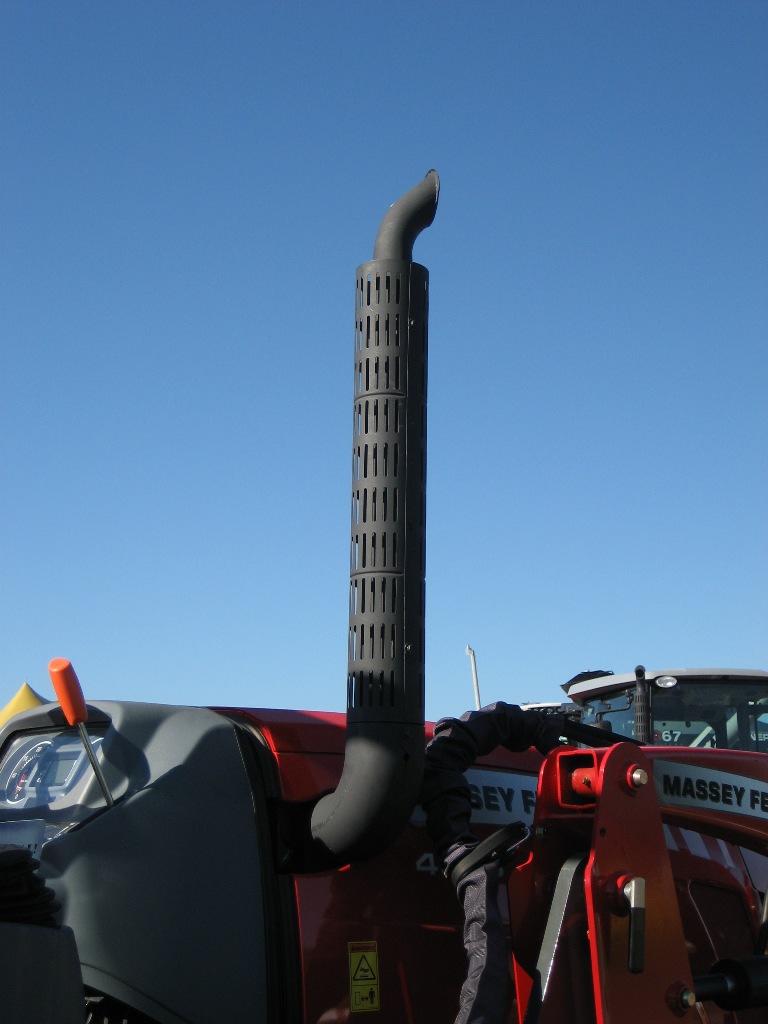
Massey Ferg Tractor Exhaust

(Source: Penn State Agricultural Safety & Health)

Use the following format to cite this article:

Mechanical hazards: Burn points. (2025). Ag Safety and Health Community of Practice. Retrieved from https://ag-safety.extension.org/mechanical-hazards-burn-points/.

Burn-point hazards are associated with tractors, self-propelled equipment, and pull-type machinery. These pieces of equipment have components that can cause burns when they come into contact with skin. The most common activities that result in burn-point incidents include maintenance, inspection, fueling, and servicing of machines.

The following components and machinery elements can be burn points:

  • Mufflers
  • Manifolds
  • Engine blocks
  • Gear cases
  • Pipes
  • Hot fluids (fuel, oil, chemicals, and so on)

Potential Injuries

Burns are the most obvious type of injury sustained due to burn-point hazards. However, additional injuries can occur if operators are startled by contact with burn points. For example, a producer might contact a hot muffler and fall back onto a toolbox, getting a back injury in addition to the burn.

Safety Precautions

The list below outlines ways of reducing the risk of a burn-point incident.

  • Check machinery for burn points and avoid those areas.
  • Shut down the engine and allow time for fluids and parts to cool before completing any fueling, inspections, or maintenance.
  • Do not touch the engine or machine parts during an inspection.
  • Determine whether a part is hot by holding your hand near the surface of the part.
  • Wear leather gloves to protect your hands.

Resources

Click here to view a video about burn-point hazards from Pennsylvania State University’s Agricultural Safety and Health Program.

Use the following format to cite this article:

Mechanical hazards: Burn points. (2025). Ag Safety and Health Community of Practice. Retrieved from https://ag-safety.extension.org/mechanical-hazards-burn-points/.

Sources

Agricultural equipment and machine hazards. (2016) The Ohio State University. Retrieved from http://agsafety.osu.edu/programs/cfaes-osha/ag-equipment-machine-hazards.

Grisso, R., Stone, B., & Hetzel, G. (2009) Machinery safety on the farm. Virginia Cooperative Extension. Retrieved from http://pubs.ext.vt.edu/442/442-092/442-092_pdf.pdf.

National Safe Tractor and Machinery Operation Program – Student Manual – Third Edition. Penn State Extension.

Reviewed and Summarized by:
Linda M. Fetzer, Pennsylvania State University – lmf8@psu.edu
LaMar Grafft, East Carolina University (has since retired)
Jimmy Maass, Virginia Farm Bureau Insurance (Has since retired)
Dennis J. Murphy, Pennsylvania State University (Has since retired)
Aaron M. Yoder, University of Nebraska Medical Center – aaron.yoder@unmc.edu

Ag Safety and Health Community Information

The Ag Safety and Health Community of Practice (CoP) is a collaborative effort between universities, industry, and government to provide user-friendly information for the general rural population, agricultural producers, and agricultural safety and health professionals. Financial support for this project is provided by the United States Department of Agriculture, National Institute of Food and Agriculture; eXtension; and CHS Inc.

The CoP has more than 90 members who work together to provide, produce, and review agricultural safety and health information. The following information provides an overview of the site content and links to usable resources.

  • Ag Safety & Health Resources: Various types of resources are available from the homepage (https://ag-safety.extension.org/), including options for self-paced and instructor-led learning, training and resources for instructors, videos, publications, and topic pages on various safety and health topics.
  • Online Safety Course: Click here to learn how to enroll in an online agricultural-safety certificate course.
  • Upcoming Events: Click here to locate professional education opportunities.
  • Webinars: Click here to locate upcoming agricultural safety and health webinar opportunities.

If you would like join the CoP, contact Linda Fetzer at lmf8@psu.edu.

Mechanical Hazards: Thrown Objects


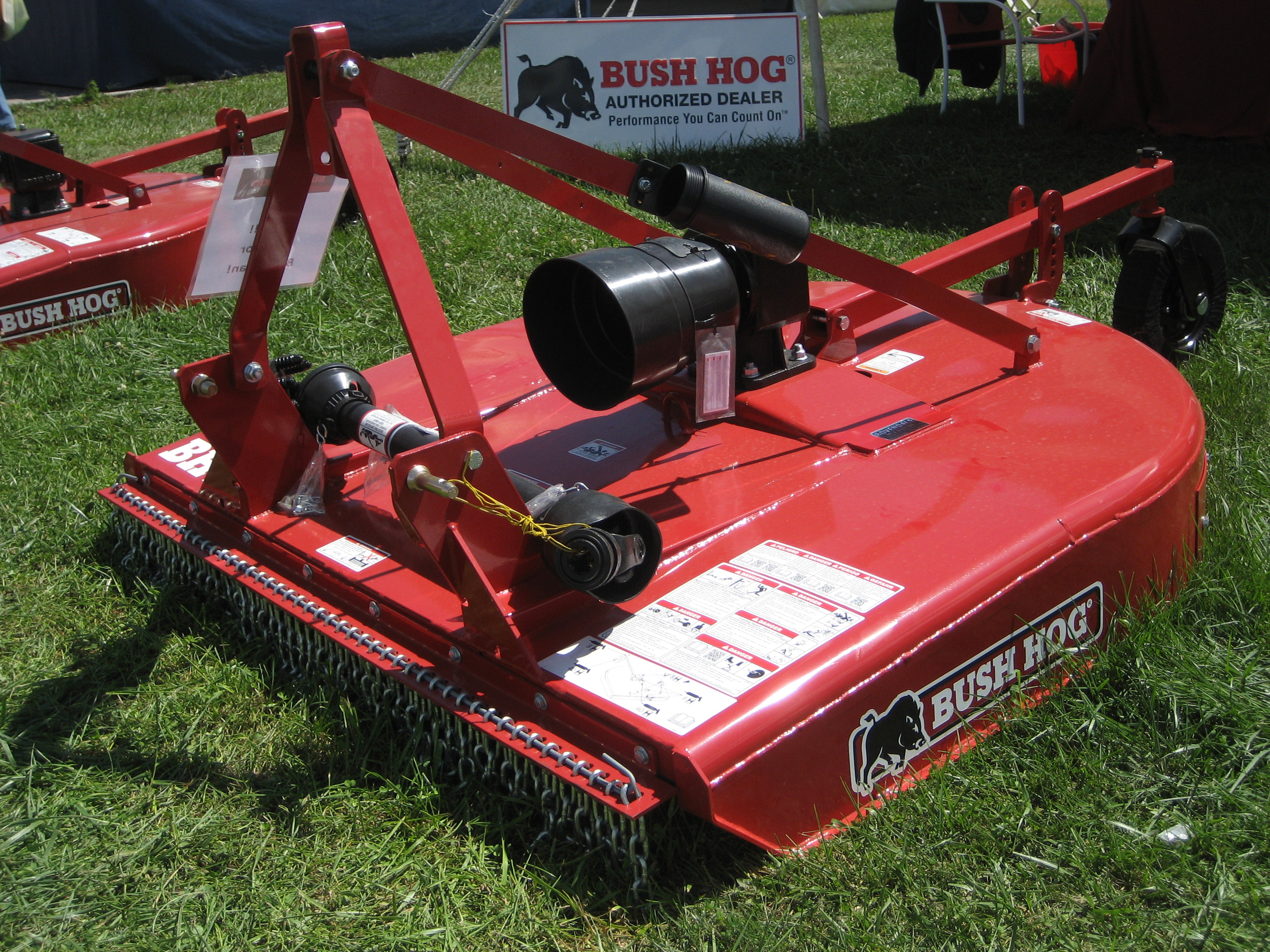
Bush Hog Mower
Bush Hog Mower. Photo Source: Penn State University

Use the following format to cite this article:

Mechanical hazards: Thrown objects. (2025). Ag Safety and Health Community of Practice. Retrieved from https://ag-safety.extension.org/mechanical-hazards-thrown-objects/.

A thrown-object hazard is typically associated with equipment that mows, chops, or cuts crops in an open field, barnyard, or yard. Thrown-object hazards typically exist with pieces of equipment, such as rotary mowers, cutters, and shredders, that have rotating fans or knife blades. Machines that chop or grind feed can pose a hazard as well. Thrown-object incidents have also occurred with manure spreaders.

When equipment passes over pieces of metal or wire, sticks, rocks, and so on, the objects can become projectiles that fly a great distance with extreme force. An object can be thrown from the discharge chute of a rotary mower, for example, at speeds of up to 200 mph.

Thrown objects can cause property damage and serious injury to people or animals in the vicinity. Potential injuries from thrown objects include contusions, abrasions, lacerations, bruises, and eye and head injuries.

Safety Precautions

Listed below are ways that you can reduce the risk of a thrown-object incident:

  • Identify those types of machines that may throw objects.
  • Make sure machine guards or shields are securely in place and properly maintained.
  • Make sure a machine and all its moving parts are completely stopped before nearing the discharge area.
  • Never point a mower discharge chute toward people, pets, homes, structures, streets, or vehicles.
  • Always wear eye protection when working with machinery that cuts, grinds, or chops material.
  • Be aware of the distance and direction of potential thrown objects.
  • When you are working with machinery that can throw objects, do not allow others in the area.

Resources

Click here to view a video about thrown objects from the Pennsylvania State University’s Agricultural Safety and Health Program.

Use the following format to cite this article:

Mechanical hazards: Thrown objects. (2025). Ag Safety and Health Community of Practice. Retrieved from https://ag-safety.extension.org/mechanical-hazards-thrown-objects/.

Sources

Agricultural equipment and machine hazards. (2016) The Ohio State University. Retrieved from http://agsafety.osu.edu/programs/cfaes-osha/ag-equipment-machine-hazards.

American Society of Agricultural and Biological Engineers, 2008. ANSI/ASAE S493.1. Guarding for agricultural equipment. St. Joseph, MI. Retrieved from https://elibrary.asabe.org/.

Reviewed and Summarized by:
Linda M. Fetzer, Pennsylvania State University – lmf8@psu.edu
Liz Kenton, University of Vermont  ekenton@uvm.edu
Dennis J. Murphy, Pennsylvania State University (Has since retired)
Michael Pate, Pennsylvania State University  michael.pate@usu.edu
Aaron M. Yoder, University of Nebraska Medical Center – aaron.yoder@unmc.edu

Skid Steer Safety

Use the following format to cite this article:

Skid Steer Safety. (2025) Ag Safety and Health Community of Practice. Retrieved from https://ag-safety.extension.org/skid-steer-safety/.

A skid steer is one of the most versatile pieces of equipment on a farm or ranch because it is designed to maneuver easily in tight spaces and has a variety of attachments to complete multiple jobs. Injuries from skid steer incidents can be extremely severe and include amputations, crushing injuries, mangled limbs, and death. Operators may recognize specific hazards but often fail to consider secondary factors, such as ice, mud, and slick work areas, that may increase the risk of an incident.

The most common types of incidents from skid steer usage include:

  • running over bystanders, including children or the operator
  • entrapment or crushing, which can happen when the operator or helper is caught between an attachment and the frame of the skid steer
  • entrapment of the operator when a load rolls or drops onto him or her while he or she is in the operator station
  • rollover, which can occur when the skid steer is operated on a steep slope or uneven terrain
  • tipping of the skid steer due to a heavy load or attachment in the front
  • falls while improperly mounting or dismounting the skid steer
  • injection injuries caused when pressurized hydraulic fluid is injected into a person’s body
  • crushing or pinching injuries to hands and fingers as a result of improper hooking and unhooking of an attachment

Center of Gravity
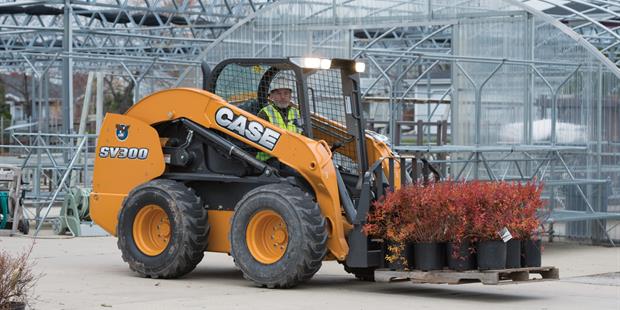
Case IH Skid Steer

Photo Source: CASE Construction Equipment/CASE IH

The center of gravity for a skid steer constantly shifts depending on the job and attachment. Typically, the weight of the skid steer is concentrated at the rear of the machine between the wheels. However, weight at the front of the skid steer, as when moving items with a bucket or an attachment, shifts the center of gravity forward and higher.

Precautions

  • When you are carrying a load, whether in the bucket or an attachment, carry the load low to maintain a lower center of gravity and to increase stability and improve visibility.
  • When traveling uphill, remember to keep the heavy part of the machine and load pointed uphill.
  • If you have an empty bucket, you should back up a hill, but if the bucket is full, drive forward up the hill.
  • Recommended travel for a skid steer is up and down a slope rather than across.

Recommended Safety Features

The “zone of protection” on a skid steer includes the rollover protective structure (ROPS), a falling object protective structure (FOPS), side screens, and an operator restraint. All of these features are meant to reduce the risk of operator injury or death. The ROPS protects the operator in the event of an overturn, and the FOPS provides protection from objects that fall on top of the operator cab. Side screens are designed to protect the operator from being caught between the lift arms and the skid steer frame and to keep protrusions (e.g., limbs) from striking the operator. When the seat belt or seat-bar restraint is used, the operator remains securely in the operator seat. If your skid steer is an older model, contact your local dealer to discuss the possibility of retrofitting your skid steer with these safety features.

Some skid loaders used on farms or ranches may not have reverse signal alarms and beacon lights. However, these safety features can be installed after-market. These features provide notice of your skid steer movement to other workers in the area, possibly preventing a run-over or pinning incident.

Interlocks and Attachments

An interlock device is an electrical or hydraulic system lock that is tied in to the operator restraint system to mechanically lock the lift arms. Never disable this interlock, and require everyone to use it, because it prevents the engine from starting or they hydraulics from engaging if the operator restraint is not properly fastened or positioned. To avoid the potential risk of a crushing injury, ensure that all operators engage the hydraulic cylinder lift-arm lockout device when the boom is in the upright position for any repairs or maintenance. The lockout can be engaged from inside or outside the operator’s cab and should be inspected regularly to maintain proper operation.

A farmer or rancher may change attachments on the skid steer multiple times per day to complete different tasks. The safest way to secure the attachments to the skid loader is to turn off the skid loader, properly exit the machine, and secure the locking levers. If another person plans to secure the locking lever, you still must shut off the machine to avoid the potential risk of an injury to the helper.

All skid steer operators should be trained to properly secure the locking levers. If the locking levers are not properly locked, the attachment can become unfastened while in use or when the arms are raised, posing a risk to the operator and other workers.

Hydraulic System

The hydraulic pressure system, which often exceeds 2,000 psi, is an often overlooked hazard. Hydraulic hoses can develop pinhole leaks. Never use your hands to search for a leak because hydraulic oil injected into a person’s skin requires immediate emergency medical treatment. Amputation of a hand or an arm may result from lack of medical attention. The recommended method is to use a piece of cardboard or mirror to pass over the suspected leak.

Fix all leaks immediately, but remember that hydraulic hoses and fittings can be hot enough to cause burns. Sense for excessive heat by placing your gloved hand near the component.

When connecting hydraulic hoses, they should be routed to avoid pinching of the hose between the lift arms and the bucket or attachment.

Always shut down the skid steer and relieve the system pressure before connecting or disconnecting hoses.

Personal Protective Equipment

The use of personal protective equipment (PPE) is a necessary part of your safety plan for your farm or ranch. Anyone operating a skid steer should wear a bump cap or hard hat, steel-toed shoes, long pants, and gloves. Depending on the job and the machine, hearing and eye protection may also be necessary. Eye protection should be worn when checking hydraulic hoses and connections or any other components that generate the potential for flying particles or sprayed or splashed liquids.

Operating a Skid Steer

  • If you must operate a skid steer inside a building, increase the ventilation by opening doors and windows and using exhaust fans to reduce exposure to exhaust fumes. Shut off the machine and take frequent breaks outside the building.
  • Do not allow riders anywhere on the skid steer (e.g., in the bucket, on the operator’s lap, and so on). Skid steers are a one-person machine.
  • Read, understand, and follow recommendations in the manufacturer’s owner’s manual for your skid steer.
  • Never bypass or modify safety devices.
  • Know your blind spots because in those blind spots could be people, vehicles, equipment, or buildings.
  • Never swing, lift, or move a load over a person.
  • Wear snug-fitting clothing that will not catch on levers.
  • Always keep your hands, arms, legs, and head inside the operator’s cab during operation.
  • Learn and use standard hand signals. Click here to access “Use of Hand Signals in Production Agriculture” for more information about hand signals.
  • Learn to operate the skid steer smoothly and to position yourself where you will not inadvertently bump levers.
  • Provide safety training to all skid steer operators at your farm or ranch. Require that they follow standard operating procedures.
  • Know the material you are loading, and remember that some objects can roll back into the operator’s cab.
  • To reduce the risk of a fall, always use the three-point method to enter and exit the skid steer. Two hands and one foot or one hand and two feet should always be in contact with the machine. Remember to use footpads and handholds and to keep the steps, pedals, and floor clean of slippery substances.
  • Never use drugs, alcohol, or medication while operating a skid steer as these can impair your ability to operate and react.
  • When transporting a skid steer, always use tie-down attachments to secure it to the trailer.
  • When finished with a skid steer, park it with the bucket or attachment lowered to the ground.
  • When possible, avoid operating a skid steer on slopes, ditches, or embankments.
  • Check your work areas for obstacles to smooth operation prior to beginning your job.
  • Look up and determine whether there are overhead utility wires near your work area.
  • If you are digging, know where underground utilities are located.
  • Avoid working near a pile of material, such as a large silage pile, or an embankment that is higher than the operator’s station. A collapse of the material could result in being buried.
  • Use counterweights as recommended by the manufacturer to ensure a balanced skid steer.
  • Make sure that the seat and floor of the operator’s cab are clear of objects so that nothing can roll beneath foot controls and interfere with machine operation.
  • Decrease speed when driving over rough terrain.

Use the following format to cite this article:

Skid Steer Safety. (2025) Ag Safety and Health Community of Practice. Retrieved from https://ag-safety.extension.org/skid-steer-safety/.

Sources

Ebert, K., Ricketts, M., & Lind, S. (2006) Skid steer loader safety. Kansas State University Research and Extension. Retrieved from http://www.ksre.ksu.edu/bookstore/pubs/MF2711.pdf.

National Safe Tractor and Machinery Operation Program – Student Manual – Third Edition. Penn State Extension.

Murphy, D. & Harshman, W. (2015) Skid-steer safety for farm and landscape. Penn State College of Agricultural Sciences Cooperative Extension. Retrieved from https://extension.psu.edu/skid-steer-safety-for-farm-and-landscape.

NIOSH Alert: Preventing injuries and deaths from skid-steer loaders. (2010). National Institute for Occupational Safety and Health. Retrieved from http://www.cdc.gov/niosh/docs/2011-128/pdfs/2011-128.pdf.

Reviewed and Summarized by:
Linda M. Fetzer, Pennsylvania State University – lmf8@psu.edu
Glen Blahey Canadian Agricultural Safety Association – Has since retired
LaMar Grafft East Carolina University Has since retired
Dennis J. Murphy, Pennsylvania State University (Has since retired)
Aaron M. Yoder, University of Nebraska Medical Center – aaron.yoder@unmc.edu

Mechanical Hazards: Freewheeling Parts


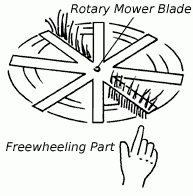
Free Wheeling Hazard

(Source: The Ohio State University Extension)

Use the following format to cite this article:

Mechanical hazards: Freewheeling parts. (2025). Ag Safety and Health  Community of Practice. Retrieved from https://ag-safety.extension.org/mechanical-hazards-freewheeling-parts/.

Freewheeling parts are parts of a machine that continue to move even after power to the machine has been turned off. Freewheeling parts continue to move because some machines require large amounts of rotational energy to operate smoothly in varying conditions, and the freewheeling parts cannot come to an abrupt stop without the application of a braking system of some type. The heavier the rotating part, the faster and longer it will continue to rotate or move after the power is shut off.

Examples of freewheeling parts include:

  • flywheels on small square balers
  • rotary mower blades
  • cutter heads of forage harvesters
  • hammer mills of feed grinders
  • fans on silage blowers

Potential injuries from freewheeling parts include:

  • cuts
  • abrasions
  • bruises
  • entanglement
  • crushing
  • amputations

Safety Precautions When Working around Freewheeling Parts

You can reduce your risk of an incident by adhering to the following safety precautions:

  • Be aware of any freewheeling parts on your equipment and keep guards and shields in place.
  • Before carrying out any activity in proximity to a freewheeling part:
    • shut off the tractor,
    • disengage the power take-off (PTO), and
    • wait for the freewheeling part to come to a complete stop.
  • Never touch a freewheeling part while it is moving, even if it is moving very slowly.
  • Listen to the freewheeling part—most freewheeling parts make a whirring or humming sound when they are rotating.

Resources

View the video about freewheeling parts from the Pennsylvania State University’s Agricultural Safety and Health Program.

Use the following format to cite this article:

Mechanical hazards: Freewheeling parts. (2025). Ag Safety and Health  Community of Practice. Retrieved from https://ag-safety.extension.org/mechanical-hazards-freewheeling-parts/.

Sources

Agricultural equipment and machine hazards. (2016) The Ohio State University. Retrieved from http://agsafety.osu.edu/programs/cfaes-osha/ag-equipment-machine-hazards.

Cyr, D. and Johnson, S. (n.d.) Dangers of agricultural machinery. Maine Farm Safety Program. Retrieved from http://extension.umaine.edu/publications/2316e/.

National Safe Tractor and Machinery Operation Program – Student Manual – Third Edition – Penn State Extension.

Reviewed and Summarized by:
Glen Blahey, Canadian Agricultural Safety Association  Has since retired
Willard Downs, University of Missouri  Has since retired
Linda M. Fetzer, Pennsylvania State University – lmf8@psu.edu
Dennis J. Murphy, Pennsylvania State University (Has since retired)
Aaron M. Yoder, University of Nebraska Medical Center – aaron.yoder@unmc.edu

AgSafety4u Certificate Course

AgSafety4U is a joint effort between the University of Nebraska, Pennsylvania State University, and the Ohio State University who recognized the need for formalized agricultural safety and health education for agricultural workers, has developed an online certificate course that provides an overview of the hazards common to farms and rural agricultural businesses. The course offers a general outline of the measures agricultural workers can take to identify and control such hazards.

AgSafety4u is an online course designed for youth, new and beginning farmers, and for employers and employees of agricultural operations looking to enhance their knowledge and/or to provide professional development with a heavy emphasis on tractor and machinery.  Individuals who take this course and pass the online quizzes will be able to print a certificate of completion.

This program can be used for the classroom portion of the Hazardous Occupations Order for Agriculture (HOOA) safety certification program for youth 14 and 15 years of age who are seeking employment and must be certified to drive or operate tractors and machinery for hire. Additional hands-on training is required for issuing a US DOL certificate.

Website Link

Click HERE to register for the AgSafety4u certificate course.

Click HERE to purchase bulk class enrollments.

Cost

The certificate course costs $10.00 per person. Participants receive a certificate upon completion of the course.

Target Audience

The certificate course was developed for agricultural employees, employers, and other rural workers.

Learning Objectives and Goals

The AgSafety4u certificate course organizes training in six modules, each of which focuses on a particular subject area.

Module 1: Introduction

The introductory module provides an overview of agriculture, types of risks, and regulations related to safety and health.

Module 2: Safety Basics

This module provides information on the following topics:

  • Injuries involving youth
  • Age-appropriate tasks for youth
  • Appropriate clothing for working on the farm
  • Hazard warning signs
  • Hand signals
  • Personal protective equipment (PPE)
  • First aid basics

Module 3: Agricultural Hazards

This module outlines information on the following topics:

  • Mechanical hazards and associated safety considerations
  • Animals
  • Agricultural pesticides
  • Electrical hazards
  • Confined spaces, silos, grain bins, and manure storage areas
  • Anhydrous ammonia
  • Farmstead chemicals

Module 4: The Tractor

This module includes the following topics:

  • Tractor types
  • Tractor hazards
  • Guidelines for age-appropriate tasks for children and youth
  • Tractor instrument panels
  • Tractor controls (stop engine, ground motion, power engagement, and positioning and adjusting)
  • Operation symbols and the location and movement of tractor controls
  • Preventative maintenance and pre-operation checks
  • Jumper cables
  • Tractor stability
  • Lighting and marking

The module also addresses the following activities:

  • Starting and stopping diesel and gasoline engines
  • Mounting and dismounting and starting and stopping a tractor
  • Moving and steering a tractor
  • Operating a tractor in reverse
  • Using a tractor safely
  • Operating a tractor on public roads

Module 5: Connecting and Using Implements with the Tractor

This module provides information on the following topics:

  • Connecting implements to a tractor
  • Using draw bar implements
  • Using three-point hitch implements
  • Making power take-off (PTO) connections
  • Using PTO implements
  • Using implements with hydraulic components
  • Using implements with electrical connections

Module 6: Materials Handling

This module covers the use of the following vehicles:

  • Skid steers
  • All-terrain vehicles (ATVs)
  • Utility vehicles

Evaluation

Participants must complete an online quiz at the end of each module. Once a score of at least 70% is achieved on each module, the participant will be issued a digital certificate and badge.

Reviewed and Summarized by:
Linda M. Fetzer, Pennsylvania State University – lmf8@psu.edu
Dennis J. Murphy, Pennsylvania State University (has since retired)
Aaron M. Yoder, University of Nebraska Medical Center – aaron.yoder@unmc.edu

NSTMOP: Program Overview


HOSTA Logo

(Source: Pennsylvania State University – Ag Safety & Health Program)

The National Safe Tractor and Machinery Operation Program (NSTMOP) was developed through a collaborative effort involving Penn State University, Ohio State University, and the agricultural division of the National Safety Council. The project was funded by the U.S. Department of Agriculture, National Institute of Food and Agriculture. This program is now managed solely by Penn State.

The NSTMOP was originally developed and designed for 14- and 15-year-olds seeking employment in production agriculture. The U.S. Department of Labor’s Hazardous Occupations Order in Agriculture (AgHOs) regulation prohibits 14- and 15-year-olds from operating farm tractors and attached powered equipment unless the youths have successfully completed an approved safe tractor and machinery operation training program. For more information about these regulations, click HERE to visit the website of the U.S. Department of Labor.

Curriculum

In its third edition, this student manual provides in-depth information on what youth can expect when working on a farm, safety basics, agricultural hazards, how to operate a tractor, and how to handle materials, among other important topics. This latest edition features updated regulations, vibrant and detailed illustrations and photos, and an improved user-friendly layout, and includes:

  • An introduction to the NSTMOP
  • A program outline for the six modules
  • A driving test layout and evaluation form
  • A list of core competencies that each student should master
  • Instructional task sheets

The student manual replaces the NSTMOP task sheets. To order the manual, visit Penn State Extension at https://extension.psu.edu/national-safe-tractor-and-machinery-operation-program-manual

 Evaluation

Students must score a minimum of 70% on the written knowledge test and must successfully pass the skills and driving tests administered by the instructor.

Students

Instructors use NSTMOP task sheets for the 24 hours of intensive classroom instruction. After students complete the classroom training and pass the 50-question knowledge test with a minimum score of 70%, they are permitted to take the skills and driving tests. After successfully completing both the classroom and driving components, students receive a formal certificate that allows them to work for hire in agriculture as 14- and 15-year-olds. Click HERE for more information about the NSTMOP and what is expected of students to complete the program and earn a formal certificate.

Instructors

NSTMOP is administered nationally through the Cooperative Extension Service and agricultural education programs. To receive a listing of instructors from your state, send a request to nstmop@psu.edu. Click HERE for more information about becoming a NSTMOP instructor.

Reviewed and Summarized by:
Linda M. Fetzer, Pennsylvania State University – lmf8@psu.edu
Dennis J. Murphy, Pennsylvania State University – (has since retired)
Aaron M. Yoder, University of Nebraska Medical Center – aaron.yoder@unmc.edu

Safety in Agriculture for Youth

Safety in Agriculture for Youth (SAY) is a grant project funded by the US Department of Agriculture (USDA), National Institute of Food and Agriculture to develop a sustainable and accessible national clearinghouse for agricultural safety and health curriculum for youth. For the funding period of 2021 – 2025, the SAY Project now consists of three funded project that each focus on a different aspect of youth farm safety. The projects are housed at the University of Nebraska Medical Center, the Ohio State University and Utah State University and will respectively focus on the SAY National Clearinghouse Project (e.g., SAY Clearinghouse, curricula submission and review, and marketing), Youth Farm Safety Education and Certification (YFSEC) Instructor Training and YFSEC Youth Training.

SAY National Clearinghouse

The SAY National Clearinghouse consists of two different types of educational products: formal curricula and other supporting resources and provides their alignment to Agriculture, Food, and Natural Resources (AFNR) Career Cluster Content Standards related to agricultural safety and health.

Each educational resource has a page that provides you with a description, type of resource, language (English and/or Spanish), website link to resource, and alignment chart to AFRN standards.

2026 SAY Clearinghouse Ag Safety and Health Monthly Planner

Teacher Resource Guides

Teacher resource guides will assist instructors with integrating curricula hosted in the SAY Clearinghouse by providing teaching methods to instructors on preparing students with safety instruction. The following teacher resource guides are available:

Foundational Safety Related Technical Knowledge and Skills – Teacher Resource Guide: Grain Safety Example

Animal Systems Career Pathway Teacher Resource Guide – Right from the Start: Safety Awareness for Livestock Producers

Animal Systems Career Pathway Teacher Resource Guide – Positive Animal Handling (Stockmanship) on Dairy Farms

Power, Structural and Technical System Teacher Resource Guide

Submitting your Ag Safety and Health Curriculum

Click HERE to be directed to submission instructions and link to submit your curriculum through the Curriculum Alignment Submission Tool (CAST) to be reviewed for inclusion in the SAY National Clearinghouse.

Belief Statements & Guiding Principles for Youth Working in Ag

The Safety in Agriculture for Youth (SAY) Project National Steering Committee developed a belief statements document regarding youth working in agriculture. The belief statements outline consensus-based beliefs and principles that promote safety and health for youth working in agriculture. Click HERE for more information.

Injury Risk Assessment for SAE

The injury risk assessment for supervised agricultural experience (SAE) was developed by Utah State University through the SAY Project. Click HERE to access all of the components of the risk assessment.

SAY Project eNews

The SAY Project produces an eNews 3-4 times per year which is sent to those on the listserv and the SAY National Steering Committee. Links to the past eNews are below:

March 2025
December 2024
September 2024
June 2024

OSHA 10-Hour General Industry (Agriculture) Course

CareerSafe is now offering an online training course providing training for entry level workers and employers. Visit the SAY National Clearinghouse for more information about the online training course.

Connecting with SAY

How to get connected? To stay up-to-date on the SAY Project and its objectives, sign up for alerts by subscribing to the listserv at SAY-L-subscribe-request@lists.psu.edu. Follow SAY on Facebook (AgSafety4u) and Twitter (@AgSafety4u). If you have any feedback or suggestions, email Linda Fetzer at lmf8psu.edu.

Project Reports:

Additional Resources

SAY Project Background


Summarized and reviewed by:
Linda M. Fetzer, Penn State University – lmf8@psu.edu

Davis E. Hill, Penn State University (has since retired)
Dennis J. Murphy, Penn State University (has since retired)

Utility Vehicle Safety


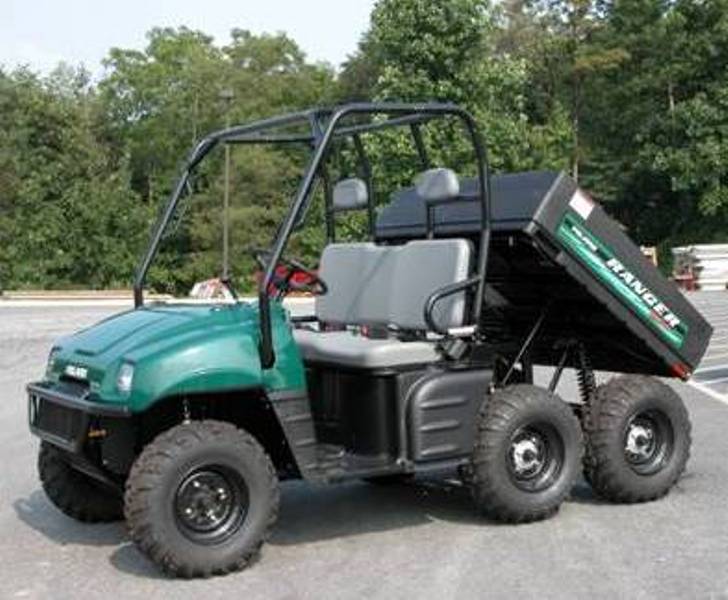
Polaris Ranger UV

(Polaris Ranger. Source: Pennsylvania State University. Agricultural Safety and Health)

Use the following format to cite this article:

Utility vehicle safety. (2024). Ag Safety and Health Community of Practice. Retrieved from https://ag-safety.extension.org/utility-vehicle-safety/.

The use of utility terrain vehicles (UTVs) on farms and ranches continues to grow because of the versatility, power, and capability these machines offer when completing agricultural tasks. UTVs have four or six wheels powered by diesel, gasoline, electricity, or a hydrogen fuel cell. One advantage of a UTV is the cargo bed, which can haul various items such as feed, supplies, and newborn calves, making it ideal for small jobs. Cargo beds can be equipped with hydraulic bed lifts to reduce the physical strain of unloading materials. UTVs have additional features that, compared to all-terrain vehicles (ATVs),  increase their value in agricultural settings. For example, UTVs feature easy access to the seat, power steering, an acceleration pedal and brake pedal, seating space to safely transport a passenger, an enclosed cab, a heater, and various seating options (bucket or bench seats).

Remember that utility vehicles are power tools, not toys. Read the owner’s manual and follow the manufacturer’s recommended maintenance, usage, and operation guidelines. Ensure that all UTVs have appropriate safety decals. Follow the additional safety recommendations outlined below to reduce the risk of injury.

Passengers

A passenger should ride only in their seat, and that person should be tall enough to reach the handholds correctly in the passenger seat. Operators and passengers should keep their legs and arms inside the UTV when the vehicle is in motion. Passengers and drivers must always fasten their seat belts (when seat belts are available).

Overturn Incidents

To reduce the risk of an overturn incident, decrease speed when traveling on rough terrain—this lowers the risk of the operator or passenger being thrown from the vehicle. The UTV’s center of gravity is raised when hauling loads in the cargo bed. It is important to drive slowly and smoothly when taking turns to reduce the risk of overturning, especially when carrying a heavy load. When driving on an incline, remember that driving up or down the slope is safer than driving across. If turning on a sloped area, drive entirely up or down the hill before turning.

Another way to avoid an overturn incident is to avoid driving near ditches or embankments. The recommendation is that if a ditch is six feet deep, stay at least six feet from its edge.

Operator Responsibility

  • Always be aware of your surroundings and look behind you, especially for young children, before backing up. 
  • As with any machinery, never use drugs or alcohol before or while operating a UTV.
  • Secure loads in the cargo bed to prevent them from shifting during transportation.
  • Even if your utility vehicle is equipped with a roll bar, remember that the seat belts for you and your passenger must be securely buckled to protect in the event of a rollover.
  • Avoid driving near ditches or embankments – for example, if there is a ditch that is 6’ deep then you should stay 6’ away from the edge.
  • UTVs were designed to haul loads in the cargo bed but it is important to check the operator manual to know the recommended weight limit and to properly secure the load in the cargo bed.

Resources

  • Click HERE to be directed to the Youth Agricultural Work Guidelines that provides questions designed to help you determine whether your youth is ready to operate an UTV and have a positive agricultural work experience.

Use the following format to cite this article:

Utility vehicle safety. (2024). Ag Safety and Health Community of Practice. Retrieved from https://ag-safety.extension.org/utility-vehicle-safety/.

Sources

National Safe Tractor and Machinery Operation Program Student Manual Section 6.2 (2020) The Pennsylvania State University Agricultural and Biological Engineering Department.

Jepsen, S.D. & Henwood, K. (2010) Safe operation of utility type vehicles (UTVs). The Ohio State University Extension. Retrieved from http://ohioline.osu.edu/aex-fact/pdf/0597_1.pdf.

Reviewed and Summarized by:
Kerri Ebert, Kansas State University  kebert@k-state.edu
Linda M. Fetzer, Pennsylvania State University – lmf8@psu.edu
Jimmy Maass, Virginia Farm Bureau (Has since retired)
Dennis J. Murphy, Pennsylvania State University – (Has since retired)
Aaron M. Yoder, University of Nebraska Medical Center – aaron.yoder@unmc.edu