When baling and handling large round bales, you must recognize and understand potential hazards and follow the manufacturer’s operating recommendations for each piece of equipment you use.
Using a Round Baler
The round baler is a complex machine with multiple moving parts, and an entanglement incident could lead to costly repair bills, injury, or death. Prior to using the baler each season, you must:
thoroughly inspect it,
make any needed repairs, and
review all of the safety precautions in the owner’s manual.
The size and rated power of the tractor you use with your baler must meet the manufacturer’s requirements for towing and powering the baler.
Safety Recommendations
Make sure that safety locks are in place when working on the baler while the bale chamber is open.
When operating the baler, do not leave the tractor seat until the power take-off (PTO) is disengaged and all moving parts have stopped.
Ensure that all the original shields are in place on the power shafts and other moving parts of both the tractor and baler.
Because balers produce flammable dust and are susceptible to overheating due to friction, equip your tractor with a 10-pound dry chemical (ABC) fire extinguisher.
Eject the bales at an angle perpendicular to the slope to reduce the risk of a bale rolling down the incline.
When baling on uneven or hilly terrain, travel slowly and avoid holes and drop-offs. A round baler has a high center of gravity and could tip sideways if a wheel goes into a ditch or hole.
Avoid sharp turns with a baler because the tractor wheels might hit the tongue of the baler.
Refer to the owner’s manual of the baler for additional safety information related to the machine you are using.
Handling Bales
Many producers move bales in the field with front-end loaders. The recommended practice for moving bales with a front-end loader is to remove the bucket and use an attachment designed to handle round bales, such as a grapple hook or bale spear. Using a grapple hook or spear on your front-end loader reduces the potential for the bale to roll back onto the loader arms or operator. Click here to watch a video by Mississippi State University about the danger of lifting unsecured loads with a front-end loader.
Be certain that both the tractor and the attachment are able to safely handle the weight and size of your round bales. The lifting mechanism used to move the bales should have a working load rating that exceeds the size of the bales.
The center of gravity on a tractor changes when it is carrying a bale. Producers tend to lift the load to increase visibility. This action raises the center of gravity and places the tractor at increased risk for a side overturn. The risk of a side overturn also increases when traction is lost because the tractor is operating on rough terrain or wet ground.
When using a rear-mounted three-point lift to move round bales, do not lift bales too high. The center of gravity could shift to the rear of the tractor and cause the front of the tractor to rise. If the front of the tractor rises too much, the front tires lose stability, and steering is impaired. Hauling bales simultaneously with a front-end loader and rear-mounted attachment can reduce the stability problem, but you must take care not to exceed the weight limit for the loader tractor’s tire capacity.
Safety Recommendations
Avoid overhead wires when you are moving bales with a front-end loader. Keep the bale close to the ground.
Use additional weight (within the load capacity of the tires) on the front or rear end of the tractor to ensure stability.
Relieve the hydraulic pressure before disconnecting all hydraulic lines. Examine the lines for leaks and malfunctioning parts.
When moving bales, use a tractor that is equipped with a rollover protective structure (ROPS), and always buckle the seat belt.
Hauling Bales
Specialized bale wagons and trailers that carry multiple bales at a time can save time and reduce the risk of overturns and of overloading a tractor’s hydraulic system.
Safety Recommendations
When using a wagon or trailer to haul bales, choose a tractor that can maneuver and stop a wagon or trailer carrying the weight of the bales.
Ensure that the wagon or trailer is properly hitched to the tractor’s drawbar by using a safety pin and a safety chain.
Properly secure the bales on the wagon or trailer by using straps that have a tensile strength of one-and-half times the weight of the load.
When transporting round bales on a public roadway, remember to follow all traffic laws related to wide loads. The trailer or wagon should be highly visible and equipped with a slow-moving vehicle (SMV) emblem, reflectors, and warning lights.
Grisso, R., Fike, J., Ohanehi, D. & Perumpral, J. (2014). Management Tips for Round Bale Hay Harvesting, Moving, and Storage. Virginia Cooperative Extension. Retrieved from http://pubs.ext.vt.edu/442/442-454/442-454.html.
After an overwhelming response to an article titled “Just Say No, Please Say No” in the September 1990 issue of the Progressive Farmer magazine about farm fatalities and the numbers of children who have been injured or killed during farm and ranch accidents, the publishers of Progressive Farmer magazine took action. In 1995, the Progressive Farmer founded the Progressive Farmer Farm Safety Day Camp program and began sponsoring youth day-camp sessions that focused on issues of farm safety. The camp program began in the South and Midwest. Now called the Progressive Agriculture Safety Day program, the program has grown to include camps in 43 states, two U.S. territories, and Canada.
As interest in the day camps grew, so too did the need to form a nonprofit charitable organization that could accept donations and recognize donors for their sponsorship. In 2002, the Progressive Agriculture Foundation was formed. Oversight for the foundation is provided by a board of directors.
Mission
The mission of the Progressive Agriculture Foundation is to provide education and training to make farm, ranch, and rural life safer and healthier for all children and their communities.
Resources
Click here to learn more about the foundation and find out how you can get involved in coordinating a Safety Day or become a sponsor to support the Safety Day program.
The articles below provide more information about Safety Days and youth safety:
Click here to view the article “Age-Appropriate Tasks for Children on Farms and Ranches.”
Click here to view the article “Progressive Agriculture Safety Day.”
Click here to view the article “Youth ATV Safety.”
A farmer’s or rancher’s life is not always associated with the great outdoors and fresh air. In production agriculture, farmers and ranchers can be exposed to toxic gases and contaminated particulate matter that can cause short- and long-term health problems. The three main respiratory illnesses associated with production agriculture are:
farmer’s lung,
silo filler’s disease, and
organic dust toxicity syndrome.
Farmer’s Lung
Farmer’s lung, or farmer’s hypersensitivity pneumonitis (FHP), is a noninfectious allergic disease that affects normal lung function. It results from the inhalation of mold spores from moldy hay, straw, or grain. The mold spores that cause farmer’s lung are microorganisms that grow in baled hay, stored grain, or silage with high moisture content (30%). Exposure to mold spores is greater in late winter and early spring.
Mold spores, which are not always visible, are so tiny that 250,000 spores can fit on the head of a pin. Because the spores are so small, it is easy for a farmer or rancher to breathe in millions of spores in a few minutes. Due to their size, the mold spores easily move into and settle in the lower part of the lungs.
Symptoms usually begin four to six hours after exposure to mold spores and can include increased coughing, coughs that bring up mucus, fever, chills, shortness of breath, discomfort in the lungs, and a tightness and/or pain in the chest. Symptoms may become most severe from 12 to 48 hours after exposure.
Allergic reaction to mold spores can be acute or chronic. An acute attack typically resembles the flu or pneumonia. Chronic reactions can resemble a nagging chest cold. A producer who has been diagnosed with farmer’s lung should avoid additional exposure to mold spores; otherwise, the producer’s condition could worsen and render him or her inactive. In some cases, farmer’s lung can be fatal.
If you think that you may have farmer’s lung, contact your physician and explain your symptoms and occupation. If your physician is not familiar with farmer’s lung, you may need to request a referral to a specialist for testing, diagnosis, and treatment.
To reduce the risk of contracting farmer’s lung, take the following steps:
Identify and minimize contaminants in your work environment.
Avoid exposure to contaminants and mold spores.
Limit the growth of mold spores by using mold inhibitors.
Harvest, bale, store, and ensile grains at the recommended moisture level to reduce mold growth.
Convert from a manual to a mechanical or automated feeding or feed-handling system to reduce the release of airborne mold spores.
Move work outside and avoid dusty work in confined areas whenever possible.
Mechanically remove air contaminants through ventilation with fans, exhaust blowers, and so on.
Wear appropriate respirators, dust masks, or other personal protective equipment (PPE). Click here to learn more about respiratory PPE.
Silo Filler’s Disease
Silo filler’s disease results from inhaling nitrogen dioxide, a silo gas produced during the silage fermentation process. Although a producer who has been exposed to silo gases may not experience symptoms, damage to the lungs may still have occurred. Fluid can build up in a person’s lungs 12 hours after exposure to nitrogen dioxide. Cough, hemoptysis (coughing up blood from the respiratory tract), dyspnea (shortness of breath), and chest pain can occur after an exposure to 20 ppm, a moderate level of nitrogen dioxide. This concentration has been designated by the National Institute for Occupational Safety and Health (NIOSH) as immediately dangerous to life and health (IDLH). Exposure to higher concentrations (greater than 100 ppm) can result in pulmonary edema (fluid accumulation in the lungs) and in swelling in the lungs, leading to long-term respiratory problems or death. Lower concentrations of 15 to 20 ppm are considered dangerous and can cause respiratory impairment.
If you have been exposed to silo gases, even a small amount, seek immediate medical attention.
To reduce exposure to nitrogen dioxide in silo gases, refrain from entering a silo for ten days to three weeks after filling is complete. If entry is necessary after the three-week period, run the silo blower for a minimum of 30 minutes prior to and during entry, and use a portable gas monitor to continually monitor the gas and oxygen levels in the silo. Click here to learn more about silo gases and how to reduce the risk of exposure.
Organic Dust Toxicity Syndrome
Organic Dust Toxicity Syndrome (ODTS), also called grain fever, toxic alveolitis, or pulmonary mycotoxicosis, is caused by exposure to very large amounts of organic dust. Certain agricultural areas may have large amounts of organic dust: grain storage, hog barns, poultry barns, and cotton-processing areas.
The onset of ODTS can occur four to six hours after exposure, and symptoms can be similar to those of acute farmer’s lung and may include cough, fever, chills, fatigue, muscle pain, and loss of appetite. People who have experienced ODTS and who experience additional exposures to organic dust have an increased risk for respiratory problems and the potential for developing chronic bronchitis. Producers can become very sick from ODTS, but most people completely recover. Occurrences of ODTS are underreported because symptoms often resemble the flu or other mild illnesses.
You can reduce your risk of contracting ODTS by using a respirator to decrease exposure to organic dust. Click here to learn about the different types of respirators used in production agriculture. Implement best management practices to maintain good air quality in confinement buildings for swine and poultry.
Grisso, R., Gay, S., Hetzel, G., and Stone, B. (2009) Farmer’s lung: Causes and symptoms of mold- and dust-induced respiratory illness. Virginia Cooperative Extension. Retrieved from http://www.pubs.ext.vt.edu/442/442-602/442-602.html.
Von Essen, S., Andersen, C., and Smith, L. Organic dust toxic syndrome: A noninfectious febrile illness after exposure to the hog barn environment. Journal of Swine Herd Health and Production. 2005; 13(5): 273-276. Retrieved from http://www.aasv.org/shap/issues/v13n5/v13n5p273.pdf.
Reviewed and summarized by:
Linda M. Fetzer, Pennsylvania State University – lmf8@psu.edu
Farmers and ranchers often work in areas where air quality can be less than ideal. Agricultural producers working in such conditions should wear personal protective equipment (PPE) to decrease their risk of contracting a respiratory impairment. (Click HERE to learn more about respiratory illnesses related to production agriculture.) Individuals who should use respiratory protection are those working around:
dust,
mold spores,
silage,
fish meal,
agricultural chemicals,
solvents, and
toxic gases in confined animal housing.
Respiratory hazards fall into one of three categories:
Particulate contaminants: Dusts, mists, and fumes contaminate the air with particles that can be inhaled.
Gases and vapors: Gases are chemicals that are gaseous at room temperature, such as those found in silos and manure pits. Vapors are released from liquid applications, such as pesticides and adhesives.
Oxygen-deficient atmosphere: Oxygen levels can be almost as low as 5% in such areas as sealed silos, manure storage facilities, and controlled atmospheric storage for fruits and vegetables.
Your respiratory protective equipment must be properly fitted for you, designed for the job that you need to complete, and specific to your work environment. A single type of respiratory protection does not fit all work situations, so it is critical to identify the appropriate type of respiratory protective equipment for each situation.
Nuisance Dust Mask
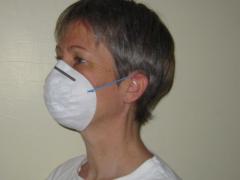
Single Strap Respirator
(Source: Pennsylvania State University. Agricultural Safety and Health)
A nuisance dust mask is constructed of extremely light filter paper. A single thin elastic circles your head to secure the mask. This type of mask provides protection against large dust particles, but provides little to no protection against smaller airborne particles. Wear this type of mask only if you have had no prior respiratory impairment and are completing a short-term task involving nontoxic dust, such as sweeping the floor of a garage or shop. A nuisance dust mask is not a respirator.
Respirators
A respirator is a device that protects the respiratory tract. There are two types of respirators: air-purifyingrespirators and supplied-air respirators.
Air-Purifying Respirators
Air-purifying respirators are useful when working around moldy hay in areas such as barn lofts and during pesticide applications. This type of respirator is also called a “negative-pressure respirator” because the wearer uses his or her own breath to move air through the respirator, inhaling and pulling air through the filter. Producers who have any type of respiratory limitation, such as asthma or cardiovascular problems, should check with their physicians prior to using air-purifying respirators.
The following descriptions will help you determine the type of air-purifying respirator needed for your work.
Disposable Particulate Respirator
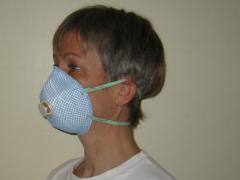
Double Strap Respirator
(Source: Pennsylvania State University. Agricultural Safety and Health)
The disposable particulate respirator is commonly referred to as a dust mask, but it should not be confused with a nuisance dust mask. Main uses for the disposable particulate respirator include protection from dusts, mists, and some fumes in jobs such as haying, applying fertilizer, and grinding feed.
The unit is a molded mask that covers the user’s nose and mouth, held in place by two elastic straps. The filter is made of fibrous material that traps particles as you inhale. This type of respirator can be disposable or reusable, but should be disposed of when saturated with a liquid. Replace the filter of a disposable mask when:
breathing becomes difficult.
the mask loses its shape.
the mask does not seal to your face.
you can taste or smell a substance known to be in the air.
All particulate respirators approved under the most recent testing requirements have a certification label displaying emblems from the National Institute of Occupational Safety and Health (NIOSH) and the Department of Health and Human Services (DHHS).
Chemical Cartridge Respirators
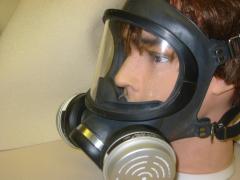
Full Mask Chemical Cartridge Respirator
(Source: Pennsylvania State University. Agricultural Safety and Health)
Chemical cartridge respirators use an absorbent material, such as activated charcoal, to absorb contaminants and filter out low concentrations of toxic gases and vapors. A chemical cartridge respirator consists of a soft, silicone facepiece that covers the nose and mouth and a valve to regulate air movement through the filter. This type of respirator is appropriate for areas that have vapors and dust because these respirators can be equipped with the necessary filters. Half-mask models can be disposable or reusable. Because a full-face mask provides eye and face protection, it offers greater protection against contaminants.
Typically, the filtering cartridge screws into the front of the mask. You can select and insert the correct cartridge for the type of gas or vapor contaminant in your work area. Cartridges are color-coded according to the type of gas or vapor contaminant they filter. Black, for example, indicates a cartridge that filters organic vapors; green, a cartridge that filters ammonia.
Replace cartridges after eight hours of use, when you begin to smell or taste the contaminant (a situation called “breakthrough”), or when dizziness or irritation occurs. Do not use a chemical cartridge respirator in areas that may contain gases designated as immediately dangerous to life or health (IDLH).
Gas Masks
A gas mask is also called a chemical canister respirator. The canister holds more chemical absorbent than a chemical cartridge, and gas masks can be used in areas where gases are extremely toxic and/or highly concentrated. The canister can be mounted on a person’s belt, worn on the back or chest, or screwed onto the mask at the chin and connected to the facepiece via an air hose.
Replace the canister of a gas mask after eight hours of use or when breakthrough occurs. This unit is a full-face piece and should not be worn in areas considered IDLH.
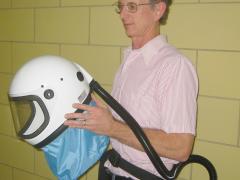
Powered Air-Purifying Respirators (PAPRs)
(Source: Pennsylvania State University. Agricultural Safety and Health)
Unlike a negative-pressure respirator that requires breathing to move air through a respirator, a PAPR is equipped with a motorized blower that forces air through the filtering device. For this reason, PAPRs are also called “positive-pressure respirators.” This type of respirator is recommended for individuals who have respiratory impairments or cardiovascular conditions.
Most PAPRs have a hard helmet and rigid visor, although half-masks and full-face models with nonrigid helmets are also available. A PAPR with a full-face mask or closable hood provides the greatest protection against contaminants. Depending on the filter that you are using, the PAPR can be used to provide protection against dusts, mists, gases, and vapors. With a constant flow of air, the unit is cooler for the user. The power source for a PAPR is either D batteries (disposable or rechargeable) or a 12V or 24V DC adaptor that can be powered from a vehicle battery.
This unit should not be worn in areas considered IDLH.
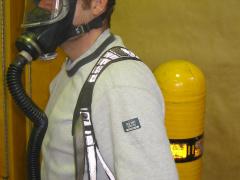
Supplied-Air Respirators
(Source: Pennsylvania State University. Agricultural Safety and Health)
A supplied-air respirator provides the user with fresh, clean air from an outside source. The two types of supplied-air respirators are air-line respirators and self-contained breathing apparatus (SCBA). An air-line respirator provides clean air via a hose (up to 300 ft.) that is connected to a stationary air pump or tank located in a clean-air area. The SCBA has a portable air tank that is carried on the back, similar to the unit carried by a scuba diver or firefighter.
Supplied-air respirators are very expensive and require proper fit and maintenance to operate correctly. In addition, a user should receive instructions for using this type of respirator and should practice its use.
A supplied-air respirator is the only respirator that should be worn in an area considered IDLH, such as a manure pit or sealed silo. Using a supplied-air respirator is the only safe way to enter an area considered IDLH because of potentially dangerous gas levels and lack of oxygen. As an agricultural producer, you risk your life by entering an oxygen-deficient atmosphere without a supplied-air respirator.
Filtering Efficiency
A respirator is rated according to its efficiency in reducing the user’s exposure to dust, mists, and fumes and its time-use limits against oil-based chemicals or pesticides in the air. The filter efficiency is represented by a letter—N, P, or R—followed by a percentage. The letter indicates whether the respirator is resistant to oil and for how long. The percentage indicates the filter efficiency, or the percentage of airborne contaminants the filter removes. Typical efficiencies are 95%, 99%, or 99.97%, with higher percentages having greater efficiencies.
N-series respirators are not resistant to airborne oils and can plug quickly.
R-series respirators are resistant to airborne oils for up to eight hours.
P-series respirators are oilproof and, depending on the given respirator, may be resistant to airborne particles for up to eight hours. P-series filters should be changed every 40 hours or 30 days, whichever comes first.
These ratings appear on respiratory units, prefilters, cartridges, packaging, and advertisements. Some common filter efficiency labeling is shown below:
N95 – Particulate Filter: 95% filter efficiency against particulate aerosols free of oil
R99 – Particulate Filter: 99% filter efficiency against all particulate aerosols
P100 – Particulate Filter: 99.97% filter efficiency against all particulate aerosols
Purchasing and Maintaining Your Respirator
After you have determined the type of respirator that you need for your farm or ranch, locate suppliers in your area. Visit your local farm store, agricultural chemical dealer, or industrial safety equipment distributor to try on different brands and styles in order to select the respirator that fits your needs. If possible, have a trained person teach you how to perform a “fit test” to make sure that you have the best seal with your face.
Check the facial fit of your respirator each time that you use it to ensure that you are getting the maximum protection. Glasses, gum or tobacco chewing, and facial hair can negatively affect the seal of your respirator. If you experience a break in the seal, smell or taste a contaminant, or experience dizziness or irritation while you are wearing the respirator, leave the contaminated area immediately and enter an area with fresh air.
Never wear contact lenses when wearing your respirator because of the potential for exposure to contaminants that can stick to the lenses or damage your eyes. Adaptors for prescription eyewear are available that fit inside the facepiece of full-face respirators.
Maintain your respirator by cleaning it frequently with warm, soapy water. Be sure to remove all cartridges and filters before immersing the respirator in water. Thoroughly dry the unit and store it in a sealed plastic bag to prevent cartridges from absorbing vapors and filters from collecting dust.
Inspect your respirator regularly for damage to the facepiece or head straps, dirt around the facepiece, missing valve covers, and loss of elasticity in the head straps. Replace only those parts, such as filters and head straps, that are designed to be replaced. Contact the manufacturer or dealer concerning major part replacement and repairs.
Resources
View the video below concerning respiratory protection on the farm or ranch.
Metzler, R. and Szalajda, J. (2011) NIOSH approval labels – key information to protect yourself. National Institute for Occupational Safety and Health (NIOSH). Retrieved from http://www.cdc.gov/niosh/docs/2011-179/pdfs/2011-179.pdf.
The North Central Regional (NCR) 197 committee was established in 2000 by the National Institute of Food and Agriculture, to utilize the land-grant research and extension systems, in conjunction with agricultural producers, to reduce agricultural work-related property losses, injuries, illnesses, and deaths. The NCR 197 committee was reappointed and renamed the North Central Education/Extension Research Activity (NCERA) 197 in 2005 and reappointed again in 2011.
The original NCR 197 committee developed the National Land-Grant Research and Extension Agenda for Agricultural Safety and Health: National Agenda for Action, a prioritized list of 12 major issues in agricultural safety and health research and extension. This article outlines the 12 prioritized areas that the NCR 197 committee identified and the NCERA 197 committee continues to address:
Sensors and guarding systems
Operation of agricultural equipment on public roads
Agricultural confined spaces
Emerging technologies
Human factors in engineering and design
Management of agricultural emergencies
Livestock handling and housing systems
Public policy issues
Capital- and management-intensive operations vs. family-labor-intensive operations
Fire detection and suppression
Agricultural safety education and training
Special populations and enterprises
Sensors and Guarding Systems
The National Agenda for Action points out that the majority of agricultural-related injuries and fatalities are due to tractor overturns, incidents involving machinery and equipment, and exposure to toxic environments. Emerging sensor technology needs to be adapted to agricultural workplaces to identify, monitor, and provide warnings about hazards. Examples of sensors and guarding systems include:
enhanced rollover protective structures (ROPSs),
stability indicators,
lockout systems,
machine guarding,
environment monitors, and
global positioning systems (GPSs).
Operation of Agricultural Equipment on Public Roads
Public roads are one of the NCERA 197 committee’s priorities because of the potential for deadly encounters between motor vehicles and agricultural equipment. Areas requiring continued research and education include:
high-speed agricultural equipment,
lighting and marking of equipment,
rural road design,
specialized vehicles (such as horse-drawn buggies), and
hazardous material transportation.
Agricultural Confined Spaces
Confined spaces in production agriculture, such as manure storage areas and fuel storage areas, which continue to increase in scale and use, are accompanied by their own set of safety concerns. The National Agenda for Action calls for a focus on confined spaces that includes:
rescue procedures,
facility design,
fall protection systems,
safe entry procedures,
gas monitoring,
warning systems, and
ventilation systems.
Emerging Technologies
Changes in technology regarding production and efficiency are inevitable, but the potential hazards introduced by such changes need to be examined to develop the most useful and safest product designs. The National Agenda for Action recommends that attention should be given to technologies involving:
automatic pilot,
biosensors,
genetically modified organisms (GMOs),
high-speed equipment,
sludge application,
driverless tractors, and
GPSs.
Human Factors in Engineering and Design
An agricultural operation could not survive without its workforce, so the National Agenda for Action emphasizes the importance of examining workplace safety and working conditions. Potential research areas include, but are not limited to:
accommodations for disabilities,
gender issues,
effects of long-term exposure to vibration and weather,
musculoskeletal disorders, and
the prevention of secondary injuries.
Management of Agricultural Emergencies
Land-grant institutions continue to play a vital role in the development of resources and training for emergency preparedness for all types of emergencies in rural communities. The National Agenda for Action calls for continued attention to such topics as:
decontamination,
severe-weather preparedness,
responses to agroterrorism and chemical spills, and
rural fire prevention and response.
Livestock Handling and Housing Systems
Most agricultural operations have livestock, and the National Agenda for Action notes that focus must be maintained on production practices and their effects on both livestock and humans to reflect the growth in livestock processes and facilities. Potential areas of research include:
ventilation,
livestock-handling equipment,
sanitation,
zoonotic diseases, and
human-and-animal interactions.
Public Policy Issues
Farms and ranches are exempt from some worker safety and health regulations that apply to other workplaces. The NCERA 197 committee will consider how public policy issues relate to youth workers, uninsured workers, and agricultural operations that now employ larger numbers of people. Examples of public policy issues to be addressed include:
funding for safety initiatives,
liability issues,
rural-to-urban interfaces, and
workers’ compensation.
Capital- and Management-Intensive Operations vs. Family-Labor-Intensive Operations
The differences between large corporate farms and family farms continue to pose challenges to research and delivery methods for agricultural safety and health information and training. The Cooperative Extension System continues to bring research-based information from the institution level to the producer level; however, the NCERA 197 committee asserts that delivery and dissemination models require further examination. Some areas that require focus include:
the design of small-scale equipment,
Occupational Safety and Health Administration (OSHA) standards and exemptions,
effects of safety management practices on profitability,
labor issues,
health care, and
disability benefits.
Fire Detection and Suppression
Fires can be devastating for agricultural operations because of the presence of livestock and costly equipment and the distance from local fire protection services. Early detection of fires and preparedness are vital to reducing the financial and human loss associated with a fire. The National Agenda for Action defines the following priority areas:
electrical standards,
extinguishing agents,
fire detection and monitoring, and
training of rural firefighters.
Agricultural Safety Education and Training
Land-grant institutions provide essential safety and health education through the county extension system. The research-based information and programs developed and evaluated at land-grant institutions are delivered through the Cooperative Extension System in effective formats to families, youths, and producers. Potential research topics identified by the National Agenda for Action include:
the development and testing of risk assessment tools,
evaluation of teaching methodologies (computer, Web-based, and so on),
the needs of special populations, and
evaluation of the effectiveness of safety and training curricula.
Special Populations and Enterprises
The farm or ranch workforce, including owners, operators, and workers, continues to diversify in terms of culture, ethnicity, age, gender, and level of education. Due to this diversity, a single approach to education is not feasible. The land-grant institutions continue to explore teaching-delivery systems that will address the needs of a diverse workforce. The NCERA 197 committee notes that further research is needed to:
develop and test culturally sensitive safety and health resources,
understand how gender affects safety, and
address the issues of low literacy rates, secondary injuries, and injuries to youth.
Resources
Click HERE to view the National Agenda for Action for complete details about the 12 priority areas of the committee.
Agriculture, forestry, and fishing continue to have a work-related death rate that is eight times higher than the all-industry average (National Safety Council, 2009). Production agriculture accounted for more than 75% of the work-related deaths within the agriculture, forestry, and fishing category in 2007 (U.S. Department of Labor, Bureau of Labor Statistics, 2009). Injuries and fatalities continue among children, youths, and seniors—age groups that are generally not part of other industries.
A committee called the North Central Education/Extension Research Activity (NCERA) 197 was founded in 2000 to develop strategies to use the land-grant system’s research and extension capacity and the experience of agricultural producers to reduce work-related injuries, illness, and death. The NCERA 197 committee created the National Land-Grant Research and Extension Agenda for Agricultural Safety and Health: National Agenda for Action, a document that prioritized 12 areas with 115 individual topics relating to agricultural safety and health in which research or extension gaps exist (Committee on Agricultural Safety and Health Research and Extension, 2003). The National Agenda for Action was the first agricultural safety and health agenda by the land-grant system since 1943, and it has been used by the Agriculture, Forestry & Fishing (AgFF) Sector Council of the National Institute of Occupational Safety and Health (NIOSH) as a resource document for its National Occupational Research Agenda (NORA) plans and by the Agricultural Safety and Health Council of America (ASHCA). The Canadian government has also used this document as the foundation for its agricultural safety strategic plan.
The following publications were created by the NCERA 197 Committee based on their National Agenda.
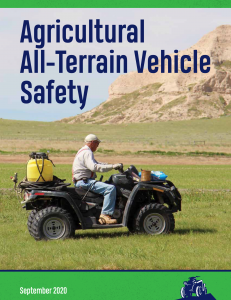
Agricultural All-Terrain Vehicle (ATV) Safety is a topic that covers several of the priorities of the NCERA 197 committee. The following whitepaper is a summary of current research, engineering and education related to ATV safety in agriculture.
Click here to be linked to the white paper titled Agricultural All-Terrain Vehicle Safety (2020).
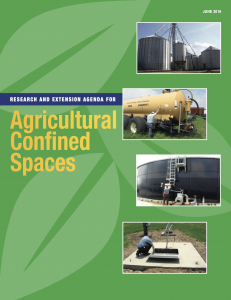
The another priority area for the NCERA 197 committee is agricultural confined spaces.
Click here to be linked to the Research and Extension Agenda for Agricultural Confined Spaces.
The NCERA 197 committee will investigate gaps in extension and research regarding engineering, educational, and legislative controls designed to reduce the frequency and severity of incidents involving confined spaces in agricultural workplaces. The NCERA 197 committee plans to complete the following activities:
Summarize the research literature, engineering needs, and outreach opportunities related to agricultural confined space hazards;
Convene a national conference on this topic;
Encourage additional research and outreach by land-grant universities to reduce hazards of agricultural confined space; and
Encourage increased standards activity by the American Society of Agricultural and Biological Engineers (ASABE) to reduce hazards of agricultural confined spaces.
The NCERA 197 committee was reappointed in 2005—when it was renamed from NCR 197 to NCERA 197—and again in 2011. After the completion of the national agenda, the committee focused efforts on the development of a white paper concerning agricultural equipment on public roads. This effort was designed to do the following:
1. Identify research, policy, and extension and outreach priorities for these agencies:
federal departments of Agriculture and Transportation;
NIOSH;
state departments of agriculture, transportation, and law enforcement;
county governments; and
organizations related to production agriculture.
2. Identify possible design and practice standards, goals, or guidelines for farm equipment manufacturers, standard-setting organizations, and government agencies (Committee on Agricultural Safety and Health Research and Extension, 2009).
Click here to be linked to the NCERA 197 committee’s white paper titled Agricultural Equipment on Public Roads.
The NCERA 197 committee will identify additional topics on the basis of the National Land-Grant Research and Extension Agenda for Agricultural Safety and Health: National Agenda for Action document. The committee members will partner with land-grant universities to increase infrastructure support for agricultural safety and health at land-grant universities.
Ag Safety and Health eXtension Community of Practice
The NCERA 197 committee was instrumental in developing the Ag Safety and Health eXtension Community of Practice (CoP). The Ag Safety and Health CoP is designed to provide agricultural safety and health information in a user-friendly format to agricultural producers through peer-reviewed article summaries, frequently asked questions, and “Ask Extension” opportunities.
Resources
Click here to be directed to a summary of the National Land-Grant Research and Extension Agenda for Agricultural Safety and Health: National Agenda for Action.
Click here to open the NCERA197 Impact Summary (2010-2015),
Agricultural equipment on public roads. (2009) North Central Education/Extension Research Activity Committee (NCERA) 197, Cooperative State Research, Education, and Extension Service. Retrieved from http://nasdonline.org/static_content/documents/2065/d001906.pdf.
Census of fatal occupational injuries (CFOI) – Current and revised data, 2007 census of fatal occupational injuries (revised data). (2009) U.S. Department of Labor, Bureau of Labor Statistics. Retrieved from http://www.bls.gov/iif/oshcfoi1.htm.
Injury facts. (2009 edition) National Safety Council (NSC). Itasca, IL.
Anhydrous ammonia(NH3) is a nitrogen crop fertilizer that can cause severe chemical burns; frostbite to the eyes, skin, and respiratory tract; and death. It is important for all individuals working with this type of fertilizer to understand the potential risks, necessary safety precautions, and proper response in the event of accidental contact.
Anhydrous ammonia is a hygroscopic compound, meaning that it takes up water from the nearest source, which can include the human body—especially the eyes, lungs, and skin because of their high moisture content. Anhydrous ammonia is caustic, corrosive, and damaging to tissue high in moisture content when it contacts the human body. Anhydrous ammonia inhalation incidents are typically severe because the victim’s throat can swell shut, causing suffocation. When vapors or liquid come in contact with a person’s eyes, blindness may occur.
Typically, anhydrous ammonia is stored under pressure, but it vaporizes to a colorless gas. It has a unique odor that can be detected at a low concentration of 5 ppm. The concentration in fertilizer is approximately 1,000,000 ppm, but even brief exposure to a concentration of 2,500 to 6,500 ppm can result in death.
Anhydrous ammonia is transported under pressure as a liquid, so all equipment used for transport must be designed for use under high pressure to avoid ruptures or breaks. Incidents can occur when anhydrous ammonia escapes from transfer hoses or valves, equipment malfunctions and sprays anhydrous ammonia in multiple directions, hoses pull apart during transportation or application, and so on.
PPE and Supplies
It is essential that all workers who use anhydrous ammonia wear the appropriate personal protective equipment (PPE), be equipped with necessary response supplies, and know how to respond in an emergency. PPE should include ventless goggles or a full-face shield, rubber gloves with long cuffs that can be rolled to catch drips, and a long-sleeved shirt. Nonrubber gloves made of ammonia-proof material are acceptable. Because contact lenses can trap the gas and become fused to the eye, it is recommended that individuals not wear contact lenses while working with anhydrous ammonia.
In the event of an exposure emergency, the most important resource is an ample supply of clean water to begin flushing the eyes and skin. If you use a vehicle to transport anhydrous ammonia, you must carry a 5 gal. container of clean water. Each person working with anhydrous ammonia should carry a 6 to 8 fl. oz. squeeze bottle of water at all times for rapid response to an emergency.
Basic First Aid for Anhydrous Ammonia Exposure
The first-response treatment for anhydrous ammonia exposure is to flush the exposed area (skin, nose, throat, eyes, and so on) with clean water for a minimum of 15 minutes.
Flush the exposed area immediately to decrease injury caused by the anhydrous ammonia coming in contact with skin or clothes. Although clean water is the ideal resource for flushing exposed areas of the body, if you do not have water available, other nontoxic liquids, such as cold coffee or orange juice, can be used.
Remove contaminated clothing unless the clothing is frozen to the victim’s skin.
Seek medical attention immediately and inform medical staff of the exposure to anhydrous ammonia so that they will not treat the wounds with oils or ointments that can intensify the damage.
If you find a person who is in a continuous stream of anhydrous ammonia, contact your local emergency service responders or 911. Inform the emergency medical responders about the type of incident so they can bring the proper equipment to the scene. A self-contained breathing apparatus (SCBA) and protective clothing are necessary to remove a person from a continuous stream. Rescue workers will contact a hazardous materials (HAZMAT) disposal team if HAZMAT services are needed at the scene.
Note that these guidelines are not comprehensive, and all individuals working with anhydrous ammonia should receive training in the proper response to exposure emergencies.
Storage and Transportation
Anhydrous ammonia is a strong alkali that, when dissolved in water, readily reacts with copper, zinc, brass, and other alloys. Therefore, the only types of containers, fittings, and piping that should come in contact with anhydrous ammonia should be nongalvanized steel or iron. Do not store other materials, such as propane or liquefied petroleum gas, in a tank that has been used to store anhydrous ammonia.
When filling your anhydrous ammonia tank, do not fill it more than 85% full, and always disconnect the fill hose before moving the tank. Remember to bleed pressurized anhydrous ammonia from the hose before connecting or disconnecting the hose.
When transporting anhydrous ammonia, be sure to adhere to the following precautions and safety rules:
Running Gear: Regularly inspect the wagon’s frame tongue, reach poles, anchor devices, wheel bearings, knuckles, ball joints, and pins for structural damage and wear and make necessary repairs and adjustments.
Tires: Check tires for proper inflation, bald spots, and signs of wear and ensure that lug nuts are tight.
Hoses and Valves: Inspect and replace hoses and valves as needed.
The hydrostatic relief valve should be replaced every five years.
The transfer hose should be replaced five years from the date of manufacture.
Lubrication: Annually lubricate the wagon’s knuckle, wheels, tongues, and so on.
Towing Vehicle: To increase the driver’s ability to control the towing vehicle, ensure that the towing vehicle weighs at least as much as the tank.
A tractor can tow two tanks, but a truck can tow only one tank at a time.
Speed Limit: When towing an anhydrous ammonia tank, observe a speed limit of 25 mph.
Hitch Pin: Use a hitch pin with a safety chain when towing a tank wagon.
Warning Lights: Ensure that the tank is equipped with a seven-terminal breakaway connector plug to properly operate turn signals, flashing warning lights, and a red brake light.
Safety Signage: If operating on a highway, outfit the tank with all required safety markings, including a slow-moving vehicle (SMV) sign. (Click here for more information about SMV signs and increasing the visibility of your agricultural equipment.)
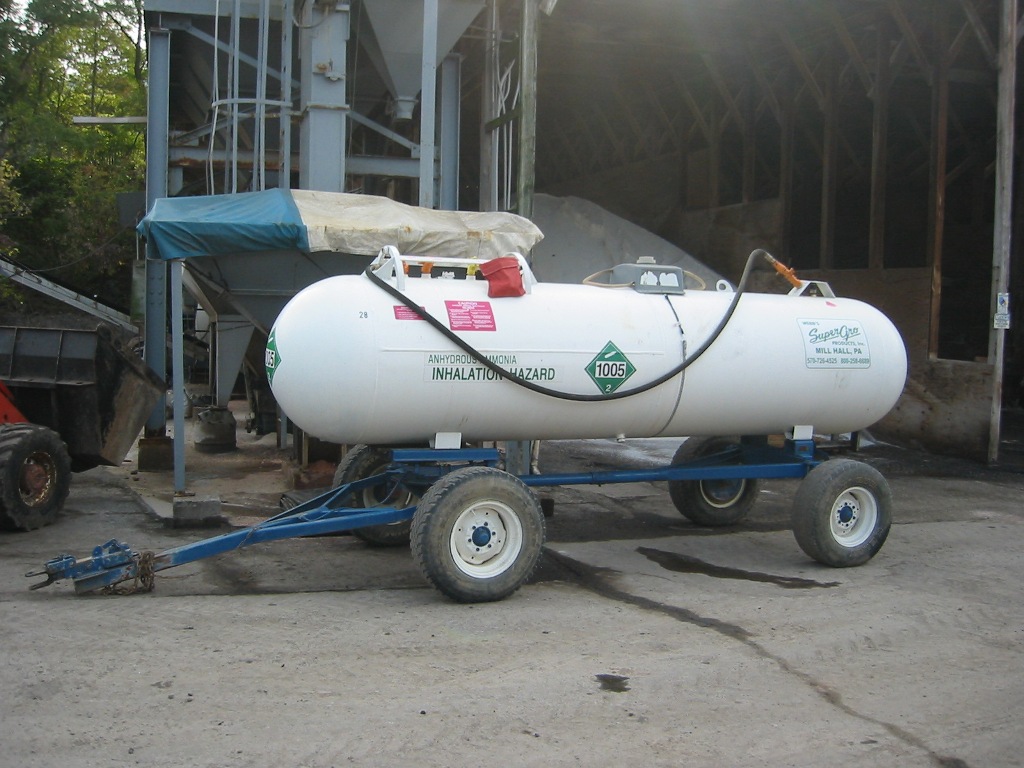
The words Anhydrous Ammonia must appear on both sides of the tank and on the rear of the tank in letters 4 in. high. The words should be in contrast to the tank so that they can be read easily.
Inhalation Hazard must appear on both sides of the tank in letters 3 in. high.
A Department of Transportation (DOT) placard number 1005 for nonflammable gas should be placed on the front, back, and sides of the tank.
Additional Safety Recommendations
Paint the tank with reflective white paint to decrease excessive pressure buildup that can occur when the tank is heated from direct sunlight.
Do not use dented or damaged tanks until they have been checked by an authorized inspector and necessary repairs are completed.
Allow only certified welders to perform welding on the tank.
Regulations and codes regarding towing of anhydrous ammonia and signage may vary, so be familiar with and obey the regulations in your state.
A fire can happen anywhere and at any time in a home. Fires and burns are the main causes of accidental injury deaths at home, with older adults and small children at the greatest risk. Careless smoking is the leading cause of accidental fires.
The recommendations in this article can help you reduce the risk of a home fire and prepare your family in the event of a fire. In addition to these recommendations, make sure that everyone in your house knows how to call 911 in the event of an emergency.
Smoke Detectors/Alarms
Smoke detectors are designed to detect fires and alert building occupants to the presence of smoke. According to the U.S. Fire Administration, the use of smoke detectors can reduce the risk of fire fatality by approximately 50%.
Smoke detectors are necessary on every level of a home and especially outside of sleeping areas. Maintain smoke detectors by testing them every month and changing the batteries twice a year. To help you remember to change the batteries regularly, make a habit of changing smoke detector batteries in the spring and fall when you change your clocks to adjust for daylight saving time. Residential guidelines for smoke detector installation and maintenance vary by state.
Fire Extinguishers
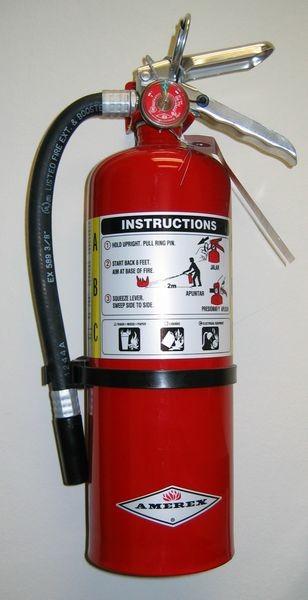
Multiple fire extinguishers should be located strategically throughout your home. Always keep an all-purpose ABC fire extinguisher (rated for ordinary combustibles, grease, and electrical fires) in your kitchen. Place the kitchen extinguisher in a location that is easy to reach in the event of a stove fire. Keep additional fire extinguishers in areas where fires are likely to start, such as the garage or near the furnace.
(Source: Pennsylvania State University. Agricultural Safety and Health)
Everyone in your household should know the location of fire extinguishers, and those family members who are capable should be trained in how to use them properly. To operate a fire extinguisher, remember the acronym PASS:
P – Pull the pin. Hold the extinguisher with the nozzle pointing away from you and release the locking mechanism.
A – Aim low. Point the nozzle of the extinguisher at the base of the fire.
S – Squeeze. Slowly and evenly squeeze the lever.
S – Sweep. Sweep the nozzle from side to side.
Fire extinguishers are affordable and can save lives and property. The most versatile type of extinguisher is a 10 lb., ABC extinguisher, which can be used on different types of fires. Each of the following types of fire extinguishers is designed to put out a specific type of fire.
Fires Extinguishers and Usage
Extinguisher Class
Usage
Class A
Fires of combustible materials such as clothing, wood, rubber, paper, and some plastics
Class B
Fires involving flammable liquids, such as grease, gasoline, oil, and oil-based paints
Class C
Fires that involve appliances, tools, or other types of equipment plugged into an electrical outlet
Class D
Fires involving flammable metals; typically found in factories
Class K
Fires involving vegetable oil, animal oils, or fats in cooking appliances; typically found in commercial kitchens, but the residential market continues to grow
Multipurpose
Different types as described in the categories above (for example, ABC or BC)
Like smoke detectors, fire extinguishers require regular maintenance. You should shake dry chemical extinguishers monthly to prevent the powder from settling. Follow the manufacturer’s directions concerning pressure testing and replace a unit if it will not charge or is damaged.
View the video below about fire extinguisher usage by the Fire Equipment Manufacturers’ Association.
Escape Routes and Plans
Before a fire occurs, develop an escape route with your family. An escape route should be planned for each area of the home and should include a designated family meeting area in an outside location away from the fire. Draw a map and practice the escape route so that every family member is familiar with the plan. Instruct family members to crawl underneath the smoke when escaping a fire and to “stop, drop, and roll” if their clothing is on fire.
If your home has multiple levels, purchase an escape ladder to provide safe exit from upper levels. All family members need to know the location of the escape ladder and be familiar with its use. Sleeping rooms should have two routes of escape, such as a door and a window. If a window is an exit route, make sure that the window opens properly. Once you and your family are out of the house, call 911 and do not go back into the house for any reason.
Resources
Click HERE to visit the U.S. Fire Administration website for information and resources to plan your home fire escape route.
Click HERE to be directed to a Fire Safety for Kids infographic provided by ContractQuotes.us.
AgrAbility is funded by the U.S. Department of Agriculture (USDA) to provide direct services to farmers and ranchers with disabilities or long-term health conditions that impact their ability to work in production agriculture. National, state, and regional AgrAbility Projects are partnerships between land-grant institutions and nonprofit disability services organizations. AgrAbility’s objectives include:
developing service capacity by presenting educational programs designed to increase a producer’s capabilities, adapting new technologies, and delivering program content at educational activities venues;
encouraging networking to foster information sharing; and
providing direct services to agricultural workers.
AgrAbility’s Mission Statement
The vision of AgrAbility is to enable a high-quality lifestyle for farmers, ranchers, and other agricultural workers with disabilities, so that they, their families, and their communities continue to succeed in rural America. For this target audience, success may be defined by many parameters, including:
gainful employment in production agriculture or a related occupation;
access to appropriate assistive technology needed for work and daily living activities;
evidence-based information related to the treatment and rehabilitation of disabling conditions; and
targeted support for family caregivers of AgrAbility customers.
Click here to locate the AgrAbility Project in your area.
Assistive Technology for Agricultural Producers
Agricultural producers with disabilities or chronic health conditions who have difficulties completing their responsibilities on the farm or ranch may benefit from assistive technology (AT). Per the Assistive Technology Act of 1998, AT can be defined as any item, piece of equipment, or product system—whether modified, customized, or acquired commercially off the shelf—that is used to increase, maintain, or improve the functional capabilities of individuals with disabilities. The following list provides examples of assistive technology for agricultural producers:
Extra steps and handrails on a tractor help a producer with arthritis get in and out of the cab of a tractor.
An automatic hitching system enables a producer with mobility impairment to hitch and unhitch wagons while he or she remains in the tractor seat, reducing the strain on the knees and hips.
An automatic feed cart enables a person with a back impairment who can no longer use a wheelbarrow to feed a dairy herd.
Click here to be directed to the searchable online version of “The Toolbox,” a compilation of assistive technology solutions for producers with disabilities developed by the Breaking New Ground Resource Center.
(Source: Pennsylvania State University. Agricultural Safety and Health)
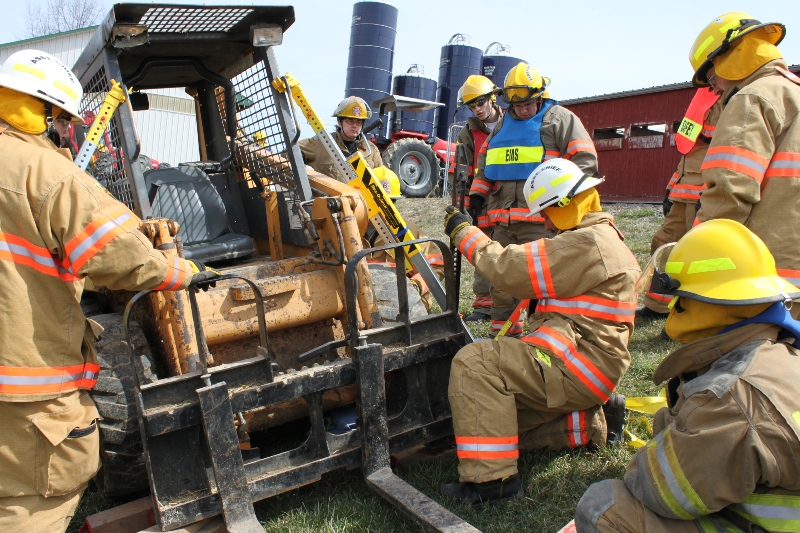
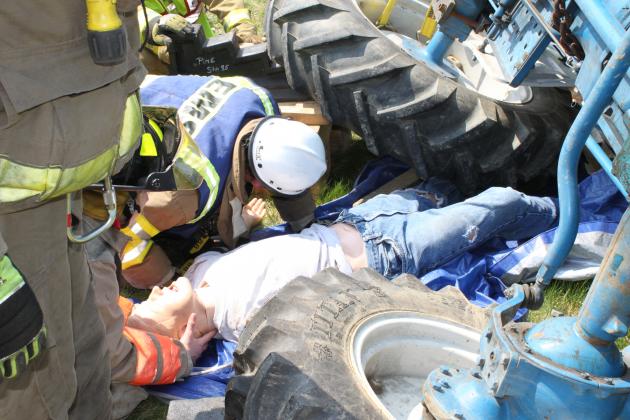
Recognizing the importance of agricultural rescue training and the lack of such training for county and state emergency responders, members of the Pennsylvania State University (Penn State) Agricultural Safety and Health team developed the PA Agricultural Rescue Training program to provide necessary training to emergency service workers so that they can respond effectively to agricultural emergencies.
Website Link
Click here to be directed to the PA Agricultural Rescue Training website.
Target Audience
The training is designed for local emergency service workers, including fire, rescue, emergency medical services (EMS), county animal response team (CART), and police.
Learning Objectives and Goals
The PA Agricultural Rescue Training program at Penn State is concerned with developing and delivering training that will:
help emergency personnel become aware of the many hazards that could happen while managing an agricultural emergency.
help emergency personnel understand the importance of pre-planning for various farm emergencies in their communities.
help fire, EMS, and CART units specialize in various aspects of agricultural rescue—such as incidents involving machinery, chemicals, animals, or confined spaces—and become technically competent in at least one of these areas.
encourage fire, EMS, and CART units to work together to develop effective agricultural rescue strategies that will result in higher quality pre-hospital patient care and animal response.
teach emergency responders to be proficient within their area of expertise (fire, rescue, EMS, CART) while managing farm emergencies.
Learning Activities
(Source: Pennsylvania State University. Agricultural Safety and Health)
PA Agricultural Rescue is divided into module units. Depending on the units, sessions are taught in one or two days of classroom instruction. Many of the training opportunities involve classroom instruction and hands-on experiential learning. The following modules are available:
Agricultural Emergencies Awareness provides an overview of agricultural emergencies.
Emergency Rescue in an Agricultural Environment trains responders about the uniqueness of farm rescues and provides instruction in the application of learned techniques in non-farm emergencies.
Managing Farm Chemical Emergencies trains responders to evaluate and respond to emergencies involving agricultural chemicals.
Farm Confined Space Emergencies Awareness trains responders to recognize and evaluate various farm confined space emergencies. Participants learn to apply OSHA Confined Space Standards to confined space situations and to respond effectively to this type of emergency.
Large Animal Rescue Training trains CART members and emergency responders to better manage emergencies involving large (farm) animals.
Introduction to Grain Elevator and Feed Mill Fires teaches emergency responders about the importance of preplanning for fires and emergencies involving grain elevators and feed mills.
Animals in Barn Fires provides participants with an understanding of farm animal behavior and how animals may react in a fire situation.
Evaluation
Participants are required to complete a pre- and post-test for each module and to perform certain hands-on activities (many of these activities, depending on subject area, are team based). Each participant completes a class evaluation at the end of the training event.
To provide the best experiences, we use technologies like cookies to store and/or access device information. Consenting to these technologies will allow us to process data such as browsing behavior or unique IDs on this site. Not consenting or withdrawing consent, may adversely affect certain features and functions.
Functional
Always active
The technical storage or access is strictly necessary for the legitimate purpose of enabling the use of a specific service explicitly requested by the subscriber or user, or for the sole purpose of carrying out the transmission of a communication over an electronic communications network.
Preferences
The technical storage or access is necessary for the legitimate purpose of storing preferences that are not requested by the subscriber or user.
Statistics
The technical storage or access that is used exclusively for statistical purposes.The technical storage or access that is used exclusively for anonymous statistical purposes. Without a subpoena, voluntary compliance on the part of your Internet Service Provider, or additional records from a third party, information stored or retrieved for this purpose alone cannot usually be used to identify you.
Marketing
The technical storage or access is required to create user profiles to send advertising, or to track the user on a website or across several websites for similar marketing purposes.