
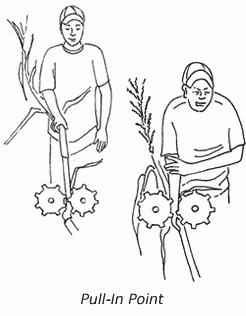
(Pull-in Point Hazard. Source: The Ohio State University)
Use the following format to cite this article:
Mechanical hazards: Pull-in points. (2025). Ag Safety and Health Community of Practice. Retrieved from https://ag-safety.extension.org/mechanical-hazards-pull-in-points/.
A pull-in point hazard is typically associated with crops being fed into a harvesting machine. Harvesting machinery has rotating parts, such as feed rolls, that form pull-in points where they come together. Most pull-in incidents occur when a person attempts to remove material from a machine while the machine is still running—for example, pulling a corn stalk out of corn picker rolls—or to feed material manually into a machine such as a feed roller.
The following pieces of equipment have pull-in points:
- Combine headers
- Feed or bale chambers
- Pull-behind corn pickers
- Windrow pickups
- Forage chopper headers
- Grinders
Potential Injuries
Potential injuries that can result from getting caught in a pull-in point include amputation of extremities, crushed tissue, and broken bones. Severe incidents can be fatal.
Safety Precautions
The list below outlines ways of reducing the risk of pull-in point incidents.
- Identify machines that may have pull-in points.
- Always shut off the engine and power source, including any power take-off (PTO), before attempting to clear any plugged areas or completing any repairs.
- Remember that machines are always faster than people.
Resources
View video about pull-in point hazards from Pennsylvania State University’s Agricultural Safety and Health Program.
Use the following format to cite this article:
Mechanical hazards: Pull-in points. (2025). Ag Safety and Health Community of Practice. Retrieved from https://ag-safety.extension.org/mechanical-hazards-pull-in-points/.
Sources
Agricultural equipment and machine hazards. (2016) The Ohio State University. Retrieved from http://agsafety.osu.edu/programs/cfaes-osha/ag-equipment-machine-hazards.
Grisso, R., Stone, B., & Hetzel, G. (2009) Machinery safety on the farm. Virginia Cooperative Extension. Retrieved from http://pubs.ext.vt.edu/442/442-092/442-092_pdf.pdf.
National Safe Tractor and Machinery Operation Program – Third Edition. Penn State Extension.