
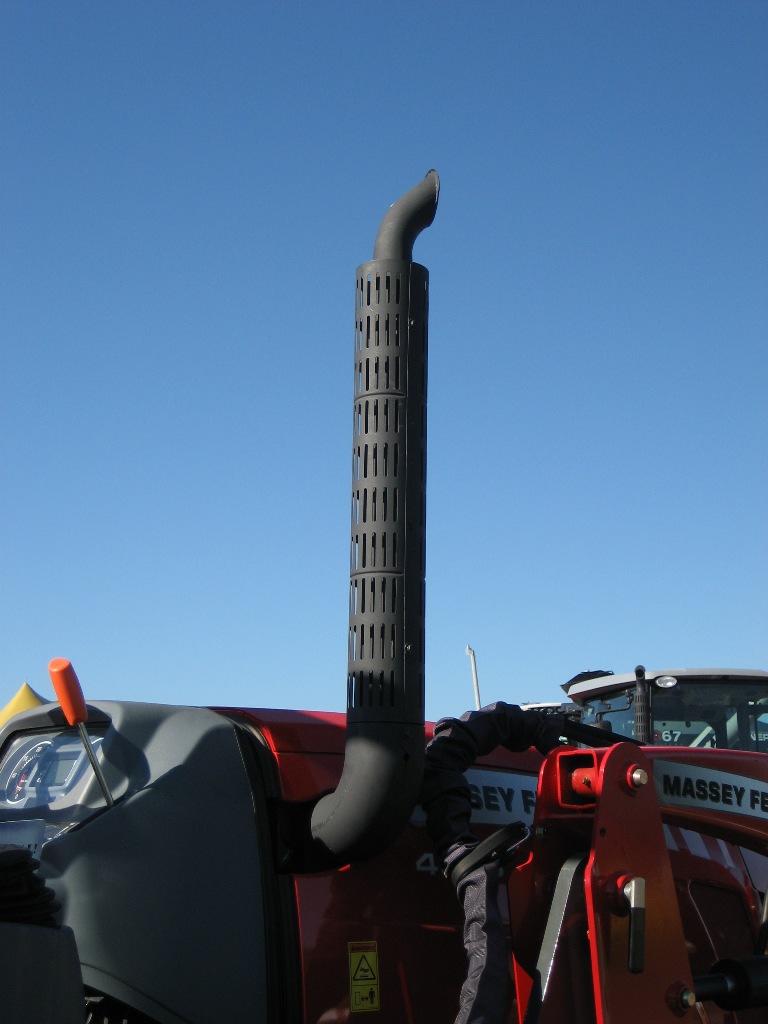
(Source: Penn State Agricultural Safety & Health)
Use the following format to cite this article:
Mechanical hazards: Burn points. (2025). Ag Safety and Health Community of Practice. Retrieved from https://ag-safety.extension.org/mechanical-hazards-burn-points/.
Burn-point hazards are associated with tractors, self-propelled equipment, and pull-type machinery. These pieces of equipment have components that can cause burns when they come into contact with skin. The most common activities that result in burn-point incidents include maintenance, inspection, fueling, and servicing of machines.
The following components and machinery elements can be burn points:
- Mufflers
- Manifolds
- Engine blocks
- Gear cases
- Pipes
- Hot fluids (fuel, oil, chemicals, and so on)
Potential Injuries
Burns are the most obvious type of injury sustained due to burn-point hazards. However, additional injuries can occur if operators are startled by contact with burn points. For example, a producer might contact a hot muffler and fall back onto a toolbox, getting a back injury in addition to the burn.
Safety Precautions
The list below outlines ways of reducing the risk of a burn-point incident.
- Check machinery for burn points and avoid those areas.
- Shut down the engine and allow time for fluids and parts to cool before completing any fueling, inspections, or maintenance.
- Do not touch the engine or machine parts during an inspection.
- Determine whether a part is hot by holding your hand near the surface of the part.
- Wear leather gloves to protect your hands.
Resources
Click here to view a video about burn-point hazards from Pennsylvania State University’s Agricultural Safety and Health Program.
Use the following format to cite this article:
Mechanical hazards: Burn points. (2025). Ag Safety and Health Community of Practice. Retrieved from https://ag-safety.extension.org/mechanical-hazards-burn-points/.
Sources
Agricultural equipment and machine hazards. (2016) The Ohio State University. Retrieved from http://agsafety.osu.edu/programs/cfaes-osha/ag-equipment-machine-hazards.
Grisso, R., Stone, B., & Hetzel, G. (2009) Machinery safety on the farm. Virginia Cooperative Extension. Retrieved from http://pubs.ext.vt.edu/442/442-092/442-092_pdf.pdf.
National Safe Tractor and Machinery Operation Program – Student Manual – Third Edition. Penn State Extension.