Charles Schwab

Charles “Chuck” Schwab is a professor in the Agricultural and Biosystems Engineering department at Iowa State University and an Extension safety specialist. He provides leadership for Safe Farm, an Iowa State University (ISU) Extension and Outreach program helping to make Iowa farms a safer place to work and live. Chuck is currently part of the leadership team for the Farm & Ranch eXtenision in Safety and Health (FReSH) Community of Practice (CoP). Chuck also serves as the Iowa State University point of contact for the Extension Disaster Education Network (EDEN).

Chuck serves on several multi-state and interdisciplinary teams, committees, boards, and organizations that promote injury prevention and foster emergency preparedness. He is active with the International Honor Society Epsilon Pi Tau Board of Directors, Iowa Farm Safety Council Board of Directors and is an active member of ASABE, ASEE, ASSE, ATMAE, ITEEA and ISASH professional organizations.


Contact Information


Phone: 515-294-4131

Dennis J. Murphy

Dennis Murphy Bio Photo

Dennis Murphy (retired 2017) from the Agricultural Safety and Health Program at Penn State University. He is a Professor Emeritus in the Department of Agriculture & Biological Engineering, and a Certified Safety Professional (CSP). Dennis has appointments in extension, research and resident education.  Program areas include applied research and education for: agricultural safety and health management, tractor and machinery safety issues; youth safety; methods of modifying farm worker safety behavior; developing hazard analyses tools; and ventilation of confined-space manure pits to reduce risk of entry into the pits. 

Dennis has developed numerous extension and research publications, reports and programs, and has been awarded over 20 blue ribbons by the American Society of Agricultural & Biological Engineering (ASABE) for excellence in their annual educational aids competition. He was awarded the title of Distinguished Professor by Penn State in 2001 and grade of FELLOW by ASABE in 2009.  In addition to ASABE, he is an active in the Agricultural Safety & Health Council of America, (ASHCA), the International Society for Agricultural Safety & Health (ISASH), and is a professional member of the American Society of Safety Engineers (ASSE). 

Contact Information

Email: djm13@psu.edu

Phone: 814-865-7157

Aaron M. Yoder

Picture of Aaron M. Yoder

Aaron Yoder currently serves as the CoP Leader for the Farm and Ranch eXtension in Safety and Health (FReSH) Community of Practice (www.eXtension.org/AgSafety). He is also an Assistant Professor in the Department of Environmental, Agricultural and Occupational Health at the University of Nebraska Medical Center. As an Assistant Professor at UNMC, Aaron is the Education/Translation Core Director of the Central States Center for Agricultural Safety and Health (www.unmc.edu/publichealth/cscash/) where he is working to improve the health of workers in agriculture and related industries through science based research, product development and outreach.

Preceding this Aaron was at Penn State University as an Instructor and Extension Safety Associate. As an Instructor and Extension Safety Associate for Penn State, Aaron provided national leadership for the National Safe Tractor and Machinery Operation Program by coordinating online instructor training and educational programs for 4-Hers, volunteers and county educators. In addition, he taught within the Department of Agricultural and Biological Engineering and participates in other research and outreach programs for the Penn State Agricultural Safety and Health Program.

Contact Information

email: aaron.yoder@unmc.edu
twitter:@AgSafety4u

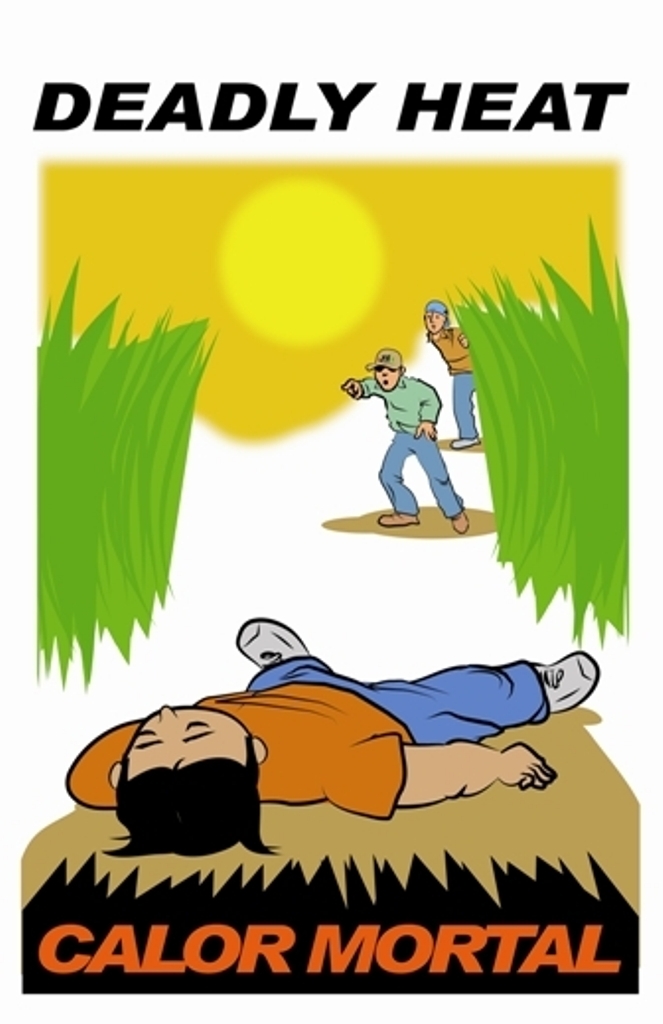
Deadly Heat: Heat-Stress Safety Education Program

Deadly Heat Program Image

(Photo Source: Wake Forest School of Medicine)

Deadly Heat is a heat-stress safety education program for migrant and seasonal farmworkers. The Center for Worker Health in the Wake Forest School of Medicine developed resource materials that an instructor can use to present the program, which consists of an hour-long presentation, to youth and adults. The presentation begins with a story about a heat-stress incident in an agricultural setting, followed by information on preventing heat stress, the health effects of heat stress, treatment, and emergency response.  

The resource materials are divided into four PDF files:

  • Curriculum outline

  • Flip chart pages

  • Cabbage game

  • Brochure

Curriculum Outline

Click HERE to access the Deadly Heat curriculum outline, which outlines the one-hour presentation. The curriculum outline provides objectives, materials, and an agenda of activities. The presentation includes introductions, content instruction for using the flip chart, an explanation of the cabbage game, and a conclusion.

Flip Chart Pages

Click HERE to access the flip chart PDF file that provides 52 ready-made pages to print and compile to make the flip chart used during the presentation. 

Cabbage Game

Click HERE to access the PDF file for game instructions and supplies. The cabbage game is used as the closing activity to review materials presented in during the lesson. Minimal supplies are needed for the game, and text is provided in both English and Spanish on each of the game pages.

Brochure

Click HERE to access the heat-stress brochure to print and distribute to participants after the program. The trifold brochure is written in English and Spanish and can also be used to promote the program event or build general public awareness. On the back of the brochure, the instructor can place a sticker with information or write contact information for local health clinics or other area resources for farmworkers.


Reviewed and Summarized by:
Linda M. Fetzer, Pennsylvania State University – lmf8@psu.edu
Anne E. Kraemer Diaz, Wake Forest  akraemer@wakehealth.edu
Dennis J. Murphy, Pennsylvania State University – djm13@psu.edu
Robin Tutor, East Carolina University  tutorr@ecu.edu
Aaron M. Yoder, University of Nebraska Medical Center – aaron.yoder@unmc.edu
 

A Guide to Teaching Safe Tractor Operation


Tractor Safety Driving Course

(Source: Pennsylvania State University, Agricultural Safety and Health Program)

The Agricultural Safety and Health Program of the Department of Agricultural and Biological Engineering at the Pennsylvania State University has developed a manual called Organizing and Conducting a Safe Tractor Operation Workshop to assist agricultural producers, employers, and other experienced operators in organizing and conducting hands-on workshops that address safety practices for tractor operators. Hands-on tractor operation training is valuable because many new owners, operators, and workers are entering occupations such as production agriculture, agricultural services, forestry, landscaping, and golf-course maintenance that rely on agricultural tractors to complete tasks.

Fewer people grow up learning how to operate tractors and equipment, so the manual is useful for training individuals with varying levels of tractor-driving experience and ability. In addition to training people involved in production agriculture, the manual can also be used to train volunteers who mow places such as schools, churches, cemeteries, community parks, and grounds at civic centers.  The manual is a comprehensive guide that provides information about the following topics:

  • Choosing instructors, tractors, equipment, and driving courses
  • Driving and operating tractors and equipment safely
  • Conducting training workshops

The manual also includes performance evaluation forms.

For a copy, please email Linda Fetzer at lmf8@psu.edu.

Reviewed and Summarized by:

Glen Blahey, Canadian Agricultural Safety Association (has since retired)

Linda M. Fetzer, Pennsylvania State University  lmf8@psu.edu
Dennis J. Murphy, Pennsylvania State University (has since retired)
Michael Pate, Utah State University  michael.pate@usu.edu

Horizontal Silo Safety

Bunk Silo

Bunk Silo

(Source: Penn State Ag Safety and Health)


Use the following format to cite this article:

Horizontal silo safety. (2013). Farm and Ranch eXtension in Safety and Health (FReSH) Community of Practice. Retrieved from http://www.extension.org/pages/68328/horizontal-silo-safety.


The term horizontal silo refers to a storage system in which silage is piled in low, long piles in a space that may or may not have sidewalls. Horizontal silos vary in size depending on the scale of the farm operation. There are several common types of horizontal silos: 

  • A bunker silo (shown above) is a horizontal silo with construction-grade materials for sides.
  • A trench silo is cut into the earth. 
  • Drive-over piles are piles of silage that are dumped on the ground or a hard surface without walls.

Silo Inspection

All types of horizontal silos can have damage from wear and tear, so it is important to inspect bunker silos for cracks in the sidewalls before harvesting silage. Sidewall cracks should be repaired immediately to maintain the integrity of the wall. Sidewalls in a trench silo can slip and the floors in trench silos and drive-over piles can become muddy or rutted.

Sighting rails (shown below) made of iron or steel pipe should be installed and maintained on bunker silos to provide visual clues for the operator as he or she backs up and unloads and packs forages. Note that these railings will not prevent a tractor or truck from overturning, but they can serve as fall protection for workers placing plastic and weights on the packed silage.
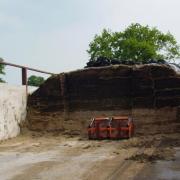
 

Sight Rails on Bunk Silo

Sight Rails on Bunk Silo. Photo Source: Keith Bolsen, Kansas State University


Packing Safety

Silage should be packed tightly, and packing of silage should be completed quickly. Packing in this manner helps to exclude oxygen from the silage, which in turn promotes effective fermentation. In the rush to complete the packing process, especially when multiple trucks and tractors are used, the prevention of rollover incidents is a primary safety concern. To reduce the risk of a rollover incident, packers should use a safe slope or progression wedge (shown below) with a maximum slope of 3:1 (3 ft. of horizontal run to 1 ft. of vertical drop). The slope should be maintained on all sides of drive-over piles. Tractors used for packing silage should be equipped with rollover protective structures (ROPS), and operators should always wear seat belts.
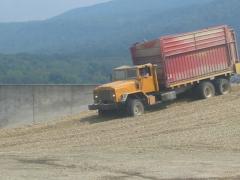
 

Exiting Progressive Wedge Trench

(Source: Pennsylvania State University, Agricultural Safety and Health)

Some farm operations utilize dump trucks to haul forage to the silo. Like tractors, dump trucks can also overturn, so operators should always wear their seat belts and should keep the truck’s center of gravity between the frame rails of the truck. When the dump bed is raised, the truck becomes less stable, especially on uneven or sloped terrains. The following hazards can cause dump trucks to roll over:

  • Tire ruts
  • Depressions
  • Wind gusts
  • Uneven loads 
  • Low tire pressure on one side of the truck

Operating dump trucks and packing equipment away from the sidewall will help prevent damage to the sidewalls of a horizontal silo and will help reduce the risk of overturn incidents.

Once the packing process is completed, the silage should be covered with plastic and weights, requiring workers to stand or walk on the sidewalls of a bunker silo. Fall protection is necessary to reduce injury risk to workers completing this task. Fall-protection standards require that anytime workers are on a walking or working surface with unprotected sides that are 6 ft. or more above a lower level, the workers should be protected through the use of guardrails or other fall-protection systems. Sighting rails on the sides of a bunker silo can be considered guardrails if their construction meets standard handrail specifications. Click here for the specific fall-protection standard outlined by the U.S. Department of Labor, Occupational Safety and Health Administration (OSHA).

Safety Precautions during Feedout

There are several potential causes of injury during the feedout process, including the following:

  • Equipment rollover
  • Entanglement
  • Silage collapse due to undercutting

Undercutting occurs when silage-loading machines (for example, tractor front-end loaders, skid steers, and so on) are not able to reach the top of the silage face. Silage in horizontal silos can be packed to heights of 20 to 40 ft., and most pieces of equipment on traditional farm operations are too small to reach the top of the silage. If a machine is not able to reach the top of the silage and instead continually removes silage from the bottom, the process creates an overhang (shown below) that could potentially collapse and bury workers, bystanders, and equipment beneath tons of silage.
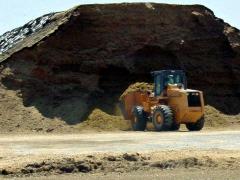
Undercut Silage Face


(Source: Keith Bolsen, Kansas State University)

One way to reduce undercutting is through the use of a silage defacer. A silage defacer has a hydraulic set of rotating knives mounted in an open framework. The defacer is mounted to a skid steer or material handler’s boom (shown below). The purpose of the defacer is to loosen silage vertically from the top to the bottom of the silage face in the horizontal silo, eliminating the undercutting that causes an overhang hazard.
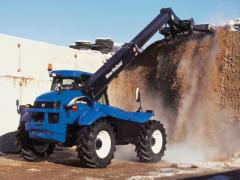
NH Telehandler

(Source:New Holland North America)

Operators using a silage defacer must read the operator’s manual prior to using the equipment to understand how to operate the equipment safely. Anyone operating the silage defacer should first clear the work area of all bystanders. The defacer should be operated only from the operator’s station. The defacer should be positioned at the top of the silage feedout area before the motor is engaged. Once the motor has reached full speed, the unit should be slowly lowered to cut through the recommended depth (that is, 1 to 3 in. per pass). As with all equipment, the operator should not leave the operator’s station until the unit has been shut down, parts have stopped moving, and the keys have been removed from the ignition switch.

It is recommended that no one stand at a silage face that exceeds his or her height. Silage faces can collapse even if an overhang hazard is not present (for example, when a frozen chunk of silage breaks loose). This type of hazard is especially dangerous for individuals, such as nutritionists or students, collecting silage samples. To reduce the risk of a silage-face collapse, those collecting samples should use a loader to scoop up silage and move it away from the silage face before gathering samples from the loader bucket.

Regulations Regarding Hired Labor

Any agricultural operation employing 11 or more workers should adhere to the following standards under OSHA:

  • Rollover Protective Structures (ROPS) for Tractors Used in Agricultural Operations (1928.51): The ROPS standard requires that employees use only tractors equipped with a ROPS and seatbelt.
  • Guarding of Farm Field Equipment, Farmstead Equipment, and Cotton Gins (1928.57): This standard requires that power take-off (PTO) shafts and other moving parts of machinery and equipment be equipped with proper guarding.

The U.S. Department of Labor governs regulations regarding youth employed in agricultural operations. Youth aged 14 and 15 can be employed on farms and ranches, but they must complete a course and receive a certificate of training under the regulations of the Agricultural Hazardous Occupations Order (AgHOs) before operating tractors or powered farm equipment. AgHOs regulations do not apply to youth age 16 or older or to youth working on their own family farms. Safety training is important for all agricultural workers, but it is especially important for youth working on any farm.

Producers who hire custom operators should ensure that the operators are familiar with the farm or ranch’s fields, roads, lanes, and silage storage facilities. It is the responsibility of the farm owner or producer to provide a safe workplace for contractors and warn them of any hazards that cannot be eliminated. All custom operators that have employees should have proof of workers’ compensation and insurance coverage and should provide their workers with safety training.

Additional Safety Recommendations

Producers and workers should adhere to the following safety recommendations when working around horizontal silos: 

  • Allow only mature, experienced individuals to operate equipment.
  • Use tractors that have a low clearance and wide front end.
  • Use tractor weights to improve stability.
  • When packing on sloped surfaces, move by backing the tractor up the slope.
  • When packing, use a tractor equipped with front-wheel drive or front-wheel-assist drive for additional traction and stability.
  • When using a dump truck on the forage slope, back the truck up the slope to reduce the risk of a side overturn.
  • Do not fill a bunker or trench silo higher than the sidewalls.
  • Know where workers are located and use standard agricultural hand signals to communicate.
 

Use the following format to cite this article:

Horizontal silo safety. (2013). Farm and Ranch eXtension in Safety and Health (FReSH) Community of Practice. Retrieved from http://www.extension.org/pages/68328/horizontal-silo-safety.


Sources

Harshman, W., Yoder, A., Hilton, J., and Murphy D. (2013) HOSTA Task Sheet 3.9.2: Packing forage in a horizontal silo. The Pennsylvania State University. Hazardous Occupations Safety Training in Agriculture. Retrieved from http://www.extension.org/sites/default/files/NSTMOP%20Task%20Sheets%20Se….

Harshman, W., Yoder, A., Hilton, J., and Murphy D. (2013) HOSTA Task Sheet 6.9: Silage defacers. Retrieved from http://www.extension.org/sites/default/files/NSTMOP%20Task%20Sheets%20Se….

Murphy, D. and Harshman, W. (2007) Horizontal silo safety. The Pennsylvania State University College of Agricultural Sciences. Retrieved from https://extension.psu.edu/horizontal-silo-safety.


Reviewed and Summarized by:

Linda M. Fetzer, Pennsylvania State University – lmf8@psu.edu
LaMar Grafft, East Carolina University grafftl@ecu.edu
Gail Lapierre, University of Vermont  gail.lapierre@uvm.edu
Dennis J. Murphy, Pennsylvania State University (Has since retired) 
Aaron M. Yoder, University of Nebraska Medical Center – aaron.yoder@unmc.edu


Brucellosis


Use the following format to cite this article:

Brucellosis. (2013). Farm and Ranch eXtension in Safety and Health (FReSH) Community of Practice. Retrieved from http://www.extension.org/pages/68323/brucellosis.


Brucellosis is an infectious disease that can affect cattle, goats, sheep, pigs (including feral swine), and, less commonly, dogs. This disease can also affect humans. Individuals that are at a higher risk of contracting brucellosis include farmers, ranchers, veterinarians, and slaughterhouse workers. Contamination of skin wounds by bacteria can occur in people who work directly with animals. Brucellosis can also be transmitted to humans who come into contact with infected animal products—such as tissue, blood, urine, vaginal discharges, placenta, or abortion products—through breaks in the skin or who drink or eat unpasteurized milk or cheese. Some slaughterhouse workers have contracted the disease by inhaling the bacteria. Note that brucellosis is not transmitted from person to person.

Effects on Human Health

In humans, health effects of brucellosis include, but are not limited to, prolonged influenza-like illness, abdominal pain, chills, back pain, fatigue, headache, weakness, loss of appetite, and weight loss. A fluctuating fever that spikes in the afternoon is also a sign of the disease. In some cases, brucellosis can relapse or become chronic, affecting the heart valves, bones, joints, spleen, and liver.

Diagnosis and Treatment

Since brucellosis is now rare in the United States due to eradication programs, many health care providers have not seen the disease. Thus, a history of livestock exposure and travel to an area where brucellosis is more common are important pieces of information for diagnosis. Physicians can use several laboratory tests (blood culture, urine test, and so on) to diagnose brucellosis. The common treatment for brucellosis is an antibiotic. 

Prevention

Vaccination is the most effective way of controlling brucellosis among livestock. Farmers and ranchers should manage their herds and identify and treat animals with brucellosis. Anyone working with infected animals should wear personal protective equipment (PPE) such as rubber gloves and face protection. After working with animals, individuals should wash their hands with soap and running water for at least 20 seconds and should sanitize environmental surfaces. Anyone with a cut or open wound should cover the area completely so that it cannot be contaminated with the bacteria. The consumption of raw milk and unpasteurized milk products should be avoided.


Use the following format to cite this article:

Brucellosis. (2013). Farm and Ranch eXtension in Safety and Health (FReSH) Community of Practice. Retrieved from http://www.extension.org/pages/68323/brucellosis.


Sources

Antibiotics for treating human brucellosis. (2012). U.S. National Library of Medicine. Retrieved from http://www.ncbi.nlm.nih.gov/pubmedhealth/PMH0049388/.

Brucellosis. (2007) Centers for Disease Control and Prevention. Retrieved from http://www.cdc.gov/brucellosis/.


Reviewed and Summarized by:
Linda M. Fetzer, Pennsylvania State University – lmf8@psu.edu
Glen Blahey, Canadian Agricultural Safety Association  GBlahey@casa-acsa.ca
Lynn Z. Blevins, University of Vermont – lblevins@uvm.edu
Dennis J. Murphy, Pennsylvania State University – djm13@psu.edu
Aaron M. Yoder, University of Nebraska Medical Center – aaron.yoder@unmc.edu

Occupational Injury Surveillance of Production Agriculture Survey

There are a variety of tasks, conditions, and situations in production agriculture that place workers at risk for fatal and nonfatal injury. In addition to workers, family members are at risk for injuries because of the close proximity between the home and the agricultural work environment. The National Institute for Occupational Safety and Health (NIOSH) has been directed by Congress to develop a comprehensive agricultural safety and health program to address the risk of injuries and work-related illnesses for workers and family members in production agriculture.

NIOSH completed the Occupational Injury Surveillance of Production Agriculture (OISPA) survey to provide national injury data covering adults age 20 and older who work on farms in the United States. NIOSH provides the data in accessible online electronic tables (e-tables). Click here to be directed to the NIOSH website for complete access to this valuable information. The e-tables present OISPA data for the years 2001, 2004, and 2009. Additional information located on NIOSH’s OISPA website includes links to interpretations of the data provided in NIOSH documents and publications and the NIOSH Cost-effective Rollover Protective Structures (CROPS) website.

Click here for information about childhood agricultural injury survey data from 2001, 2004, 2006, and 2009.


Reviewed and Summarized by:
Linda M. Fetzer, Pennsylvania State University – lmf8@psu.edu
Kitty J. Hendricks, NIOSH  kjt1@cdc.gov
Dennis J. Murphy, Pennsylvania State University – djm13@psu.edu
Aaron M. Yoder, University of Nebraska Medical Center – aaron.yoder@unmc.edu
 

About Farm & Ranch eXtension in Safety & Health

The Farm & Ranch eXtenision in Safety and Health (FReSH) Community of Practice (CoP) is a collaborative effort between universities, industry, and government to provide user-friendly information for the general rural population, agricultural producers, and agricultural safety and health professionals. Financial support for this project is provided by the United State Department of Agriculture, National Institute of Food and Agriculture; eXtension; and CHS Inc.

The FReSH CoP has more than 90 members that work together to provide, produce, and review agricultural safety and health information. The following information provides an overview of the site content and links to usable resources.

  • Ag Safety & Health Resources: Various types of resources are available from the FReSH homepage (extension.org/agsafety), including options for self-paced and instructor-led learning, training and resources for instructors, videos, publications, and topic pages on various safety and health topics.
  • Ask an Expert: If you still have a question after visiting the resources on the FReSH site, click here to be directed to eXtension’s Ask an Expert option to ask a specific question that will be answered by an agricultural safety and health professional.
  • Online Safety Course: Click here to learn how to enroll in an online agricultural-safety certificate course.
  • Upcoming Events: Click here to locate professional education opportunities.
  • Webinars: Click here to locate upcoming agricultural safety and health webinar opportunities.

If you would like join the CoP, contact Linda Fetzer at lmf8@psu.edu.


Summarized by:
Linda M. Fetzer, Pennsylvania State University  lmf8@psu.edu
Reviewed by:
Dennis J. Murphy, Pennsylvania State University  djm13@psu.edu
Aaron M. Yoder, Pennsylvania State University  ayoder@psu.edu

Farm Family Emergency Response Program

The Farm Family Emergency Response Program provides awareness training for individuals living or working on farms or ranches and outlines basic responses and actions individuals should consider prior to the arrival of emergency response personnel to the scenes of agricultural emergencies. Effective action by individuals at the scene of an accident can raise the likelihood of a positive outcome for an injured victim.

Click here to be directed to the Farm Family Emergency Response Program site.

Program Details

Target Audience

The program is designed for individuals who work in production agriculture or live on farms or ranches or in rural areas. This training is especially important for farm and ranch managers and employees, spouses and family members living on farms or ranches, 4-H members, and FFA groups.

Learning Objectives and Goals

The Farm Family Emergency Response Program was designed to achieve the following objectives:

  • To teach individuals how to keep themselves physically and emotionally safe during agricultural emergencies or rescues
  • To teach individuals the types of actions that will have a positive impact on the well-being of accident victims
  • To teach people how to summon additional help and engage those individuals in the rescue response
  • To reinforce the importance of first aid and CPR training for individuals involved in production agriculture

Instructors

Instructors for this program typically include Cooperative Extension educators, hospital personnel, agricultural education teachers, and emergency services instructors. The instructor materials include a 20-minute tutorial explaining how to present the program, a sample presentation demonstration, reproducible class materials, instructional materials, and module narratives.

Learning Activities

The Farm Family Emergency Response Program is divided into 12 modules that cover topics related to the primary causes of agricultural injury and death. Each module includes a period for the discussion of prevention strategies. Participants are encouraged to implement safety strategies and recommendations on their farms and ranches. 

Evaluation

The instructor should measure the effectiveness of the class by having participants complete the pretest and posttest located in the instructor’s manual. Participants complete registration cards that can be used for follow-up to determine whether participants made changes on their farms or ranches because of the program.


Reviewed and Summarized by:
Linda M. Fetzer, Pennsylvania State University – lmf8@psu.edu
Davis Hill, Pennsylvania State University (Has since retired)
Dennis J. Murphy, Pennsylvania State University (Has since retired)

Aaron M. Yoder, University of Nebraska Medical Center – aaron.yoder@unmc.edu