
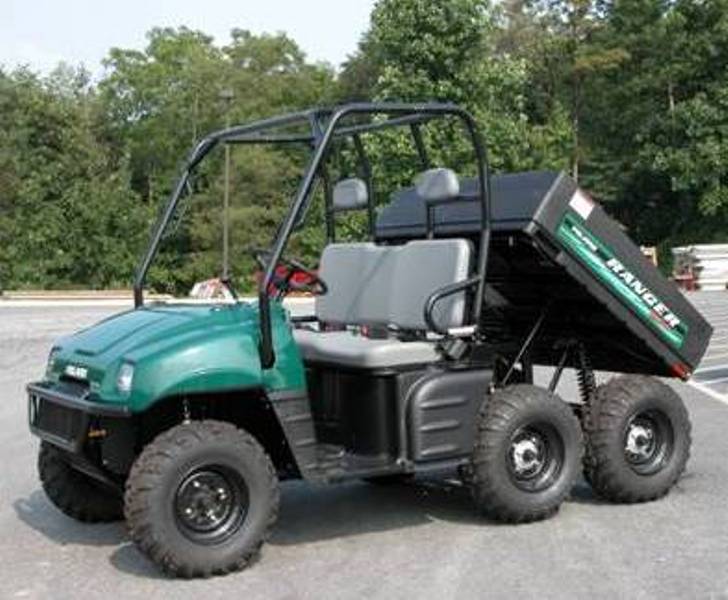
(Polaris Ranger. Source: Pennsylvania State University. Agricultural Safety and Health)
Use the following format to cite this article:
Utility vehicle safety. (2024). Ag Safety and Health Community of Practice. Retrieved from https://ag-safety.extension.org/utility-vehicle-safety/.
The use of utility terrain vehicles (UTVs) on farms and ranches continues to grow because of the versatility, power, and capability these machines offer when completing agricultural tasks. UTVs have four or six wheels powered by diesel, gasoline, electricity, or a hydrogen fuel cell. One advantage of a UTV is the cargo bed, which can haul various items such as feed, supplies, and newborn calves, making it ideal for small jobs. Cargo beds can be equipped with hydraulic bed lifts to reduce the physical strain of unloading materials. UTVs have additional features that, compared to all-terrain vehicles (ATVs), increase their value in agricultural settings. For example, UTVs feature easy access to the seat, power steering, an acceleration pedal and brake pedal, seating space to safely transport a passenger, an enclosed cab, a heater, and various seating options (bucket or bench seats).
Remember that utility vehicles are power tools, not toys. Read the owner’s manual and follow the manufacturer’s recommended maintenance, usage, and operation guidelines. Ensure that all UTVs have appropriate safety decals. Follow the additional safety recommendations outlined below to reduce the risk of injury.
Passengers
A passenger should ride only in their seat, and that person should be tall enough to reach the handholds correctly in the passenger seat. Operators and passengers should keep their legs and arms inside the UTV when the vehicle is in motion. Passengers and drivers must always fasten their seat belts (when seat belts are available).
Overturn Incidents
To reduce the risk of an overturn incident, decrease speed when traveling on rough terrain—this lowers the risk of the operator or passenger being thrown from the vehicle. The UTV’s center of gravity is raised when hauling loads in the cargo bed. It is important to drive slowly and smoothly when taking turns to reduce the risk of overturning, especially when carrying a heavy load. When driving on an incline, remember that driving up or down the slope is safer than driving across. If turning on a sloped area, drive entirely up or down the hill before turning.
Another way to avoid an overturn incident is to avoid driving near ditches or embankments. The recommendation is that if a ditch is six feet deep, stay at least six feet from its edge.
Operator Responsibility
- Always be aware of your surroundings and look behind you, especially for young children, before backing up.
- As with any machinery, never use drugs or alcohol before or while operating a UTV.
- Secure loads in the cargo bed to prevent them from shifting during transportation.
- Even if your utility vehicle is equipped with a roll bar, remember that the seat belts for you and your passenger must be securely buckled to protect in the event of a rollover.
- Avoid driving near ditches or embankments – for example, if there is a ditch that is 6’ deep then you should stay 6’ away from the edge.
- UTVs were designed to haul loads in the cargo bed but it is important to check the operator manual to know the recommended weight limit and to properly secure the load in the cargo bed.
Resources
- Click HERE to be directed to the Youth Agricultural Work Guidelines that provides questions designed to help you determine whether your youth is ready to operate an UTV and have a positive agricultural work experience.
Use the following format to cite this article:
Utility vehicle safety. (2024). Ag Safety and Health Community of Practice. Retrieved from https://ag-safety.extension.org/utility-vehicle-safety/.
Sources
National Safe Tractor and Machinery Operation Program Student Manual Section 6.2 (2020) The Pennsylvania State University Agricultural and Biological Engineering Department.
Jepsen, S.D. & Henwood, K. (2010) Safe operation of utility type vehicles (UTVs). The Ohio State University Extension. Retrieved from http://ohioline.osu.edu/aex-fact/pdf/0597_1.pdf.